


What You Will Accomplish And What You Need Before Starting

You will build a quarterly documentation system that produces auditor-ready records of DeFi yield activity. The system captures transaction exports from twelve major protocols, maintains cost basis continuity across wallets and chains, and classifies income according to IRS treatment. When you finish, you will have eliminated the year-end scramble that costs $2,000 to $5,000 in accountant time for portfolios above $500,000, and you will have contemporaneous records that prevent the 20% accuracy penalty the IRS applies to underreported income.
Before you begin, you need active positions on at least one DeFi protocol, wallet addresses for all accounts holding yield-generating assets, and access to a block explorer for each chain where you have deployed capital. You also need a spreadsheet application and approximately two hours per quarter to execute the reconciliation workflow. If you currently track positions only through protocol user interfaces, you are one UI change away from losing the transaction history your accountant will need to reconstruct basis and income.
Export Transaction History From Twelve Major Protocols

Most DeFi protocols do not provide comprehensive CSV exports. The user interface shows recent activity, typically the last fifty to one hundred transactions, but complete history requires direct blockchain queries. This matters because a single interaction with a liquidity pool or lending protocol can generate multiple taxable events: ordinary income from reward token claims, capital gains from the swap that occurred when you deposited mismatched assets, and disposal events when you withdrew liquidity and received back tokens in different proportions than you deposited.
For Uniswap V3 positions, the protocol dashboard displays your active liquidity positions and recent swaps, but full transaction history requires querying the Uniswap V3 router contract on Etherscan or the relevant block explorer. Navigate to the router address (0xE592427A0AEce92De3Edee1F18E0157C05861564 for Ethereum mainnet), filter by your wallet address, and export all interactions. Each liquidity provision creates an NFT representing your position. Record the NFT token ID, the tick range, the amounts of each token deposited, and the timestamp. When you collect fees or remove liquidity, those transactions reference the same NFT ID. You can find detailed API documentation at the Uniswap developer portal, which provides endpoints for querying historical position data.
Aave positions require similar treatment. The Aave dashboard shows current deposits, borrows, and accrued interest, but withdrawals from six months ago may no longer appear. Export your complete history by querying the Aave lending pool contract for your wallet address. Each deposit generates aTokens (aUSDC, aDAI) that accrue interest through rebasing. The IRS has not published explicit guidance on whether rebasing constitutes a taxable event at the moment of rebase or only upon disposal, but most tax professionals treat each rebase as ordinary income at the moment you gain dominion and control. Record the timestamp, the amount rebased, and the fair market value in USD at that timestamp.
Curve and Convex require block explorer queries because neither protocol offers a built-in export function. For Curve, identify the pool contract address, filter transactions by your wallet, and export deposits, withdrawals, and reward claims. Convex operates as a wrapper around Curve positions, so you will need transaction history from both the Curve pool and the Convex staking contract. Yearn vaults similarly require querying the vault contract directly. When you deposit into a Yearn vault, you receive yTokens that appreciate as the vault executes its strategy. Track the yToken mint transaction, any subsequent transfers, and the eventual burn when you withdraw.
For Compound, Maker, and Balancer, follow the same pattern: protocol UI for recent activity, block explorer for complete history. The router or lending pool contract address is your starting point. Filter by your wallet, export all transactions, and note the transaction type (deposit, borrow, repayment, liquidation, reward claim). Synthetix staking and GMX liquidity provision also require on-chain queries. The shared failure mode across all protocols is relying on the UI, which will not survive a version upgrade or a frontend redesign.
Liquid staking protocols such as Lido and Rocket Pool generate additional complexity. When you stake ETH through Lido and receive stETH, that exchange may or may not be a taxable event depending on how your accountant interprets the transaction. The conservative treatment is to recognize a taxable swap (ETH for stETH) at the moment of receipt, establishing your cost basis in stETH at the fair market value of the ETH you deposited. The stETH balance then rebases daily to reflect staking rewards, and each rebase is ordinary income. Record every rebase with timestamp and USD value. If you later swap stETH back to ETH, that is a disposal event triggering capital gains or losses based on your stETH cost basis.
Cross-chain yield positions require transaction exports from multiple block explorers. If you bridge USDC from Ethereum to Arbitrum, then deposit it into an Arbitrum lending protocol, you need the Ethereum bridge transaction, the Arbitrum receipt, and all subsequent Arbitrum lending activity. Starting January 1, 2025, the IRS requires separate cost basis tracking for each wallet and each chain, so the same USDC bridged to three different Layer 2 networks creates three separate tax lots with independent basis calculations.
Structure The Spreadsheet That Survives An Audit
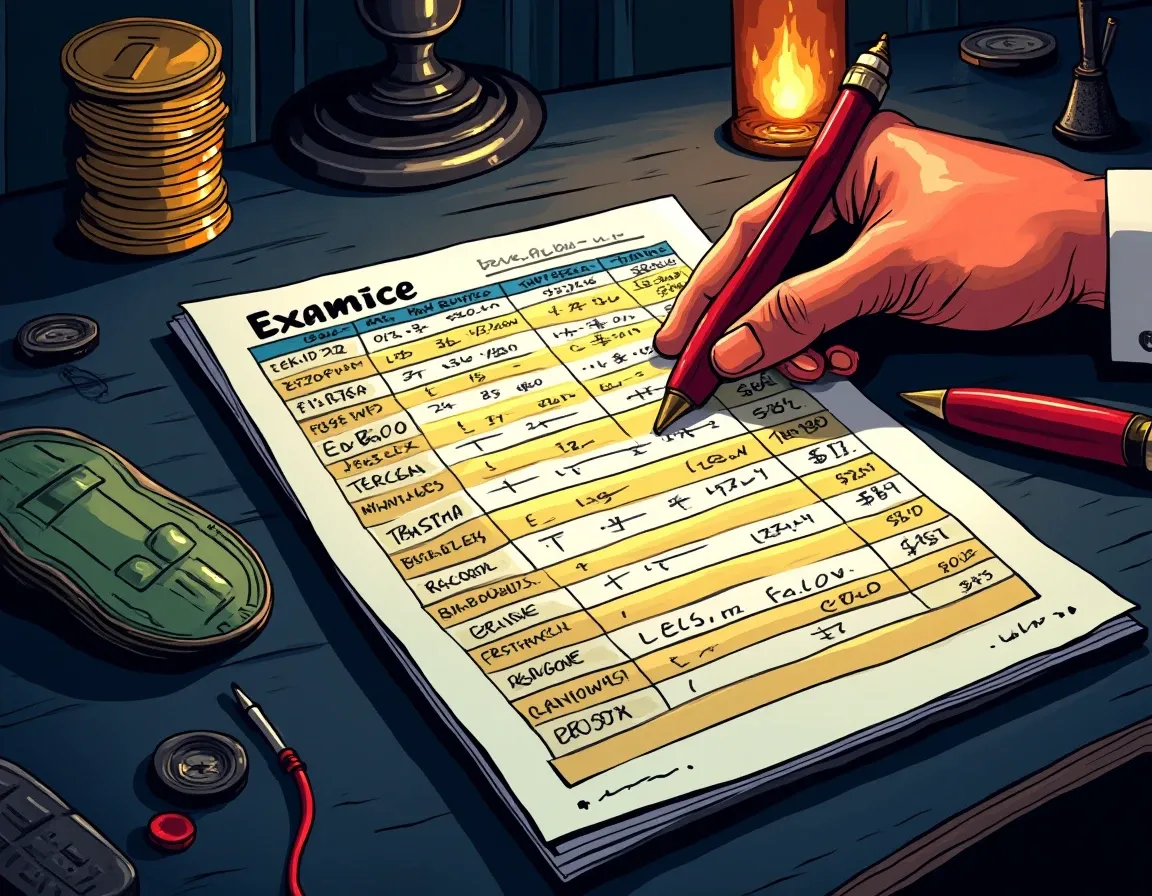
The spreadsheet is not decoration. It is the document that reconciles protocol transactions with tax obligations and provides the audit trail your accountant will need if the IRS requests documentation. Most crypto tax software handles centralized exchange trades adequately but fails on complex DeFi interactions: liquidity pool rebalancing, autocompounding vault strategies, cross-chain bridges, and liquidations. Manual reconciliation is not optional for anyone running more than three active yield positions.
Your spreadsheet needs fourteen columns. The first is transaction date and time, recorded in your local timezone to avoid confusion when reconciling against exchange timestamps or blockchain explorers that default to UTC. The second column is the protocol name and version (Uniswap V3, Aave V3 Arbitrum, Curve 3pool) because tax treatment can vary by protocol and version changes sometimes alter reward mechanisms. The third column is transaction type: deposit, withdrawal, swap, reward claim, liquidation, fee collection, rebase, bridge.
Columns four through seven capture the tokens and amounts involved. For a Uniswap V3 deposit, you will record two token symbols (ETH, USDC), two amounts deposited, and the LP NFT token ID received. For a reward claim, record the reward token symbol, the amount claimed, and the fair market value in USD at the timestamp of the claim. That USD value becomes both your taxable ordinary income for that transaction and your cost basis in the reward token for future capital gains calculations.
Column eight is fair market value in USD at transaction time. This is the number that determines your tax liability, and it must be supportable. If you claimed 150 CRV tokens at 14:32 UTC on March 15, and CRV traded at $0.87 at that timestamp, your ordinary income is $130.50 and your cost basis in those 150 CRV is $130.50. If you sell the CRV three weeks later for $145, you owe capital gains tax on the $14.50 appreciation. Use a consistent price source (CoinGecko, CoinMarketCap, or your tax software’s price feed) and document which source you used.
Column nine is your cost basis in any tokens you are disposing of. When you withdraw liquidity from a Curve pool and receive back DAI and USDC, you are disposing of your LP tokens. Your basis in those LP tokens is the fair market value of the assets you originally deposited, adjusted for any fees you collected and reinvested. If you deposited $10,000 of DAI and USDC, collected $200 in fees (which you recognized as ordinary income and which became part of your LP token basis), your total basis is $10,200. When you withdraw and receive back $10,800 in stablecoins, your capital gain is $600.
Column ten records ordinary income recognized. This is where you classify staking rewards, lending interest, liquidity pool fees, and airdrops at the moment of receipt. Column eleven records capital gains or losses, calculated as proceeds minus basis. Column twelve is the transaction hash, which allows you or your accountant to verify every entry against the blockchain. Column thirteen is gas fees paid, which are not deductible as a standalone expense but do adjust your basis. Column fourteen is notes: impermanent loss calculations, bridge fees split between cost basis and gas, failed transactions that consumed gas but produced no taxable event, wash sale complications.
The European sovereign debt crisis that ran from 2010 through 2012 offers a useful parallel for understanding why this level of documentation matters. When Greece restructured its debt, bondholders who could not document their original purchase price and the series of coupon payments they had received found themselves unable to calculate their actual loss for tax purposes. Some overpaid taxes by claiming the entire position as a loss when they had in fact recovered principal through earlier coupon payments. Others underpaid and faced penalties when the tax authority reconstructed the transaction history from bank records. The IRS now has access to blockchain analytics firms that can reconstruct your DeFi transaction history more completely than you can. The purpose of contemporaneous records is not to hide activity but to ensure your classification and basis calculations are correct before the IRS offers its own version.
Classify Income According To IRS Treatment And Track Basis Across Wallets
The IRS treats cryptocurrency as property, and DeFi yield generates two categories of taxable events: ordinary income when you receive new tokens, and capital gains or losses when you dispose of tokens you already hold. The classification question that matters is which category applies to each transaction, because ordinary income is taxed at your marginal rate (up to 37% federally) while long-term capital gains are capped at 20% for most taxpayers.
Staking rewards, lending interest, liquidity pool trading fees, and protocol incentive tokens are all ordinary income at the moment you gain dominion and control over them. For Aave, that moment is when the aToken rebases and your balance increases. For a Uniswap V3 position, that moment is when you collect accumulated fees from the pool. For a governance token airdrop, that moment is when the tokens become claimable, not when you actually claim them, although some accountants take the more conservative position that income occurs only upon claim. Record the fair market value in USD at that timestamp. That value is your taxable income for the year and your cost basis for calculating future gains or losses when you sell.
Swaps, liquidity provision, and liquidity removal all trigger capital gains or losses if you are disposing of tokens you already hold. When you swap ETH for USDC on Uniswap, you are disposing of ETH. Your gain or loss is the fair market value of the USDC you received minus your cost basis in the ETH you sold. When you add liquidity to a Curve pool by depositing DAI and USDC, you are swapping both tokens for LP tokens. If the pool required you to deposit $5,000 of DAI and $5,000 of USDC but you only held DAI, the protocol executed an internal swap of $2,500 of your DAI into USDC before depositing both. That swap is a taxable event.
Impermanent loss is not a tax deduction. It is a comparison between the value of the tokens you would have held if you had not provided liquidity and the value of the tokens you actually received when you withdrew. The tax system does not recognize opportunity cost. What it does recognize is the capital gain or loss that occurred when you withdrew liquidity and received back tokens in different proportions than you deposited. If you deposited 1 ETH and 2,000 USDC when ETH was worth $2,000, then withdrew six months later and received 0.9 ETH and 2,200 USDC when ETH was worth $2,500, you disposed of your LP tokens (basis: $4,000) and received assets worth $4,450 (0.9 × 2,500 + 2,200). Your capital gain is $450. The fact that you would have had $2,500 worth of ETH if you had simply held it is irrelevant to the tax calculation.
Basis tracking across wallets and chains is now mandatory. If you bought 10 ETH on Coinbase in 2021 for $2,000 each (basis: $20,000), transferred 5 ETH to MetaMask, then bridged 3 of those ETH to Arbitrum, you now have three separate tax lots: 5 ETH on Coinbase, 2 ETH in MetaMask, and 3 ETH on Arbitrum, all with the same $2,000 per token basis but tracked independently. When you sell 1 ETH from Arbitrum, you must be able to demonstrate that it came from the batch with $2,000 basis, not from a different purchase at a different price. The only way to do this is to maintain a separate tab in your spreadsheet for each wallet and chain, logging every transfer in and out with the cost basis that traveled with it.
Bridge transactions create a disposal event if you are swapping one token for its bridged equivalent (ETH for WETH, USDC for USDC.e). Some bridges execute a lock-and-mint (you send ETH to a contract on Ethereum, a wrapped version is minted on Arbitrum), which the IRS has not explicitly addressed. The conservative treatment is to recognize a taxable swap. The fair market value of the wrapped token you received becomes your new basis. Bridge fees paid in the native gas token are not separately deductible but do reduce your proceeds, effectively increasing your capital loss or reducing your capital gain on that transaction.
Execute Quarterly Reconciliation And Identify Documentation Gaps
Quarterly reconciliation prevents year-end chaos. Every ninety days, you will compare your spreadsheet against your wallet balances, identify discrepancies, and fill documentation gaps before the trail goes cold. The workflow takes two hours if you have five to twelve active positions and your records are current. It takes two weeks if you wait until January and try to reconstruct nine months of autocompounding vault activity from incomplete block explorer data.
Start by exporting current wallet balances for all addresses. Compare the tokens you hold now against the tokens your spreadsheet says you should hold based on recorded deposits, withdrawals, swaps, and reward claims. Discrepancies indicate missing transactions. The most common gaps are rebases you did not record (Aave aTokens, Lido stETH), reward claims you forgot to log, liquidity pool rebalancing that happened automatically inside an NFT position, and failed transactions that consumed gas but did not execute.
For each missing transaction, query the block explorer, identify the transaction hash, record the timestamp, determine the fair market value of all tokens involved at that timestamp, and classify the transaction as ordinary income or capital gain. If you claimed 80 LDO tokens as a Lido staking reward but forgot to log it, you now owe ordinary income tax on the USD value of 80 LDO at the moment of the claim. If you cannot determine the exact timestamp, use the date and the daily average price, and document your methodology in the notes column.
Cross-chain positions require separate reconciliation for each chain. If your spreadsheet shows 5,000 USDC on Arbitrum but your Arbitrum wallet holds 5,150 USDC, the missing 150 USDC came from somewhere: a reward claim, a fee collection, a bridge transfer, or a lending interest payout. Trace it backward through the block explorer until you find the transaction that created the discrepancy. Log it, classify it, and calculate the tax impact.
Failed transactions are not taxable events, but they do consume gas, and that gas cost adjusts your basis in the token you used to pay for gas. If you paid 0.02 ETH in gas for a transaction that failed, you disposed of 0.02 ETH for zero proceeds. Your capital loss is your basis in that 0.02 ETH. Record the transaction hash and note “failed transaction, gas cost only” so your accountant understands why you are claiming a small capital loss with no corresponding sale.
Protocol UI changes are the reason you need quarterly reconciliation instead of annual. Uniswap V2 and V3 have different interfaces. Aave V2 positions are no longer visible in the current Aave dashboard. Curve has redesigned its UI three times. If you wait twelve months to export transaction history, the UI you relied on may no longer display the data you need, and you will be reconstructing transactions from raw blockchain logs with no interface to guide you. Export quarterly, while the UI still matches your memory of what you did.
The final reconciliation step is forward-looking: identify positions that will create documentation problems next quarter and decide whether the yield justifies the record-keeping cost. An autocompounding Yearn vault that executes forty internal swaps per quarter and generates $200 in yield is costing you two hours of reconciliation time worth $100 to $300 depending on your hourly rate, plus $150 to $400 in accountant time to verify the transactions and calculate basis adjustments. If similar yield is available from a simpler structure (lending USDC on Aave, holding a yield-bearing stablecoin), the migration saves you money even if the nominal APY is fifty basis points lower.
What To Do Next And What Happens In March
Set a recurring calendar reminder for the last week of each quarter: March 25, June 25, September 25, December 25. Block two hours. Execute the reconciliation workflow: export protocol transaction history, compare wallet balances against your spreadsheet, identify and log missing transactions, and classify income and gains. If you are deploying new capital into a DeFi position, log the transaction the same day, while the amounts and prices are still in your browser history.
In March, export your completed spreadsheet and send it to your accountant along with transaction hashes for any complex or ambiguous transactions. If you used crypto tax software (Koinly, CoinTracker, CoinLedger), export the software’s report as well, but do not assume the software classified everything correctly. Cross-check the software’s income total against your spreadsheet’s income column. Cross-check the capital gains total. Discrepancies indicate transactions the software misclassified or failed to import. Your spreadsheet is the tiebreaker.
If your total DeFi yield income for the year exceeds $20,000, you are statistically more likely to face an IRS inquiry, and contemporaneous records are the difference between a one-hour review and a multi-month audit. The 20% accuracy penalty for substantial understatement applies to underreporting that exceeds the greater of $5,000 or 10% of the correct tax. On $60,000 of underreported yield income at a 35% marginal rate, that is a $4,200 penalty on top of the $21,000 in taxes owed. The penalty does not apply if you can demonstrate reasonable cause and good faith, which in practice means you kept detailed records, used a consistent methodology, and made a good-faith effort to classify transactions correctly even where IRS guidance is ambiguous.
For more on how to report the yield you have documented, see our guide on how to report DeFi yield on your taxes, which covers the specific IRS forms and schedules that correspond to each income category.
The Takeaway: Documentation Is Yield Cost, Not Year-End Problem
Record-keeping is a recurring cost of earning DeFi yield, equivalent to gas fees and protocol commissions. If a position requires two hours of quarterly reconciliation and $400 in annual accountant time, that is $800 to $1,200 in fully-loaded cost. A $100,000 position earning 5% APY generates $5,000 gross. After gas, protocol fees, and documentation cost, net yield may be 3.8% to 4.2%, which changes the comparison against simpler alternatives. The question worth answering is whether the incremental yield justifies the incremental record-keeping burden, and the only way to answer that question is to treat documentation as a line item in your yield cost calculation, measured quarterly, not discovered in January when your accountant sends the bill.
You now have the transaction export procedures, the spreadsheet structure, and the quarterly workflow. The system works if you execute it quarterly. It fails if you defer it.
Frequently Asked Questions
How often should I export transaction history from DeFi protocols?
Export transaction history quarterly, at minimum. Most DeFi protocol user interfaces display only the last fifty to one hundred transactions and are subject to redesigns that can eliminate access to older data. Quarterly exports ensure you capture complete records before UI changes or version upgrades make historical data inaccessible. For high-activity wallets with daily transactions, monthly exports reduce reconstruction effort.
What is the difference between ordinary income and capital gains for DeFi yield?
Ordinary income occurs when you receive new tokens: staking rewards, lending interest, liquidity pool fees, and protocol incentive tokens are taxed at your marginal rate when you gain control of them. Capital gains or losses occur when you dispose of tokens you already hold through swaps, liquidity removal, or sales. The fair market value at receipt becomes your cost basis for future capital gains calculations.
Do I need separate cost basis tracking for tokens on different blockchains?
Yes. Since January 1, 2025, IRS rules require separate cost basis tracking for each wallet and each blockchain. If you bridge USDC from Ethereum to Arbitrum and Optimism, you maintain three independent tax lots even though the token symbol is identical. When you sell or use tokens, you must document which specific lot you disposed of and its corresponding cost basis.
How do I handle liquidity pool tokens for tax reporting?
Depositing into a liquidity pool creates a taxable swap of your deposited tokens for LP tokens. Basis in the LP tokens equals the fair market value of assets deposited. Collecting fees is ordinary income at fair market value when claimed. Withdrawing liquidity disposes of LP tokens, triggering capital gains or losses based on the difference between withdrawal value and your LP token cost basis, adjusted for any reinvested fees.
What records do I need if the IRS audits my DeFi yield reporting?
You need transaction hashes for every deposit, withdrawal, swap, and reward claim; fair market value documentation for all tokens at transaction timestamps; cost basis calculations for every disposal; and classification justification for ambiguous transactions. Contemporaneous spreadsheet records linking wallet addresses to tax lots, quarterly reconciliations comparing recorded transactions to actual balances, and notes explaining complex transactions demonstrate good faith and reasonable cause if your classifications are later disputed.
Tool mentioned above
Koinly
Koinly imports from 800+ exchanges and wallets and handles the DeFi cases most tools get wrong – rebasing tokens, LP positions, staking rewards.
We may earn a commission if you sign up through this link, at no cost to you. It does not change what gets recommended.
The Weekly Yield Report
You now have export procedures for twelve protocols and the spreadsheet structure CPAs require. Those protocols will update their interfaces, and your positions will migrate. This workflow survives both.
Every Thursday: where crypto yield actually is – stablecoins, liquid staking and DeFi lending, with the risk named next to the rate and what changed since last week.
Free. No trade calls, no allocations, no hype. Unsubscribe in one
click.
Source link