

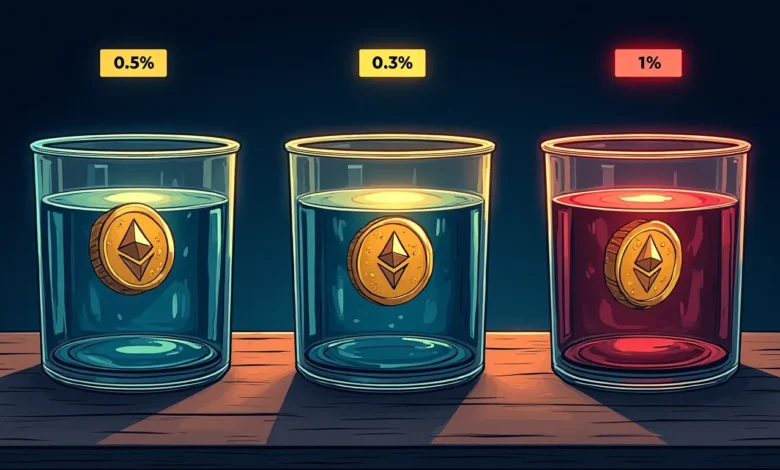
Three Uniswap V3 pools jumped to 10-29% this week: USDC-WETH, USDT-WETH, and WBTC-WETH. At first glance, that looks like three independent yield opportunities. Look closer at the contract addresses and you see the same token in every pair. ETH.
Allocating equal weight across all three does not give you three diversified positions. It gives you three versions of the same bet. When ETH moves 10%, you take impermanent loss on all three simultaneously. The correlation math that every other guide skips determines whether you capture 20% blended yield or lose 15% on a single price swing.
Here is how to allocate across multiple ETH pairs without turning 10% APY into 25% impermanent loss exposure.
The Decision You Are Trying To Make

You have $300,000 to deploy. USDC-WETH shows 12% APY on $82.2M liquidity. USDT-WETH shows 21.91% on lower TVL. WBTC-WETH shows 10% with some correlation hedge because both assets trend together. The question is not which pool to choose. The question is how much weight to allocate to each without stacking three layers of ETH price exposure on top of each other.
Most liquidity providers see three high rates and split evenly: $100k per pool. That allocation puts $200k into stablecoin-ETH pairs, where impermanent loss occurs the moment ETH diverges from $3,000 or $4,000 or wherever you set your range. It puts another $100k into WBTC-WETH, where IL is reduced but not eliminated because BTC and ETH correlation is 0.85, not 1.0.
The result: when ETH rallies 15%, all three positions experience impermanent loss simultaneously. Your $300k allocation behaves like $300k concentrated in a single ETH directional trade, not a diversified LP portfolio.
The math determines proper weighting. Over 12 months on Ethereum’s eight busiest Uniswap v3 pools, liquidity providers collected $41.6M in fees and ended $20.4M behind simply holding their tokens. Analysis of 17 pools covering 43% of total value locked revealed fees of $199.3M fell short against impermanent loss of $260.1M. Approximately 50% of users staking tokens in Uniswap V3 experience negative returns due to impermanent loss.
The allocation strategy below limits combined IL to 8-12% on a single ETH move while capturing 15-20% blended yield. It is built on correlation coefficients, fee tier differences, and liquidity depth variance across the three pools.
Correlation Risk: Why Equal Weight Fails

USDC-WETH and USDT-WETH are not diversified positions. They are the same position with different stablecoin counterparties. USDC and USDT maintain price parity within 0.02% except during severe market stress. When ETH moves from $3,200 to $3,680, both pairs experience identical impermanent loss relative to simply holding ETH and the stablecoin separately.
The impermanent loss formula for a 15% ETH rally in a 50/50 pool is approximately 0.6%. That applies to both USDC-WETH and USDT-WETH. If you allocate $100k to each, you take 0.6% IL on $200k, not $100k. Your total IL is $1,200, not $600.
WBTC-WETH offers partial correlation mitigation. Bitcoin and Ethereum tend to move together with a 12-month rolling correlation near 0.85. When ETH rallies 15%, BTC often rallies 12-13%, reducing the divergence between the two tokens in the pool. Correlated pairs like WETH-cbBTC limit impermanent loss because both assets trend together, limiting price divergence between tokens.
But correlation is not perfect. During periods when ETH outperforms BTC by 8-10 percentage points, WBTC-WETH still experiences impermanent loss. The correlation hedge reduces IL exposure by roughly 40-50% compared to stablecoin pairs, but it does not eliminate it.
Here is the combined IL exposure on $300k allocated equally across all three pools during a 15% ETH rally:
- USDC-WETH: $100k at 0.6% IL = $600
- USDT-WETH: $100k at 0.6% IL = $600
- WBTC-WETH: $100k at 0.3% IL (correlation-adjusted) = $300
- Total IL: $1,500 on $300k = 0.5%
That looks manageable until you realize the 15% move represents a single week of volatility, not a full year. If ETH oscillates between $3,000 and $3,600 four times over 12 months, you realize IL on each swing. The cumulative drag compounds.
Proper allocation reduces the number of positions exposed to the same directional risk. Instead of three ETH-linked positions, you concentrate capital in one or two, then allocate the remainder to a non-ETH pair or a single-asset staking position with no IL.
Fee Tier, Liquidity Depth, And Protocol Fee Impact

The three pools operate on different fee tiers with different LP economics. Fee tier determines how much of each trade you capture and how much Uniswap Protocol retains after the December 2025 UNIfication governance proposal activated protocol fees.
WETH-USDC 0.05% pool allocates 0.0375% to liquidity providers and 0.0125% to the protocol. You earn 75% of the stated fee, not 100%. On $28.83M in daily volume, the pool generates approximately $10,811 in daily fees. LPs receive $8,108. If the pool holds $82.2M in liquidity, that translates to 3.6% APY from fees before impermanent loss.
The 12% APY currently shown on trackers reflects a volume spike. When volume returns to the 30-day average, APY drops back toward 4-5%. That is still competitive, but it is not 12%.
USDT-WETH operates on the 0.30% tier. LPs receive 0.25% per trade, and the protocol takes 0.05%. Higher fee tiers generate more revenue per dollar of volume but attract less volume because traders pay higher costs. The 21.91% APY reflects elevated volume during a specific period. The WETH-USDT pool jumped from 3.93% to 19.07% APY on $95M TVL during a similar spike, then reverted to sub-8% within two weeks.
WBTC-WETH likely operates on the 0.30% tier as well, given the 10% APY on moderate liquidity. The correlation hedge makes this pair more stable, but the fee capture is identical to USDT-WETH on a per-trade basis.
Liquidity depth matters for rebalancing. WETH-USDC holds $82.2M, making it the deepest of the three. You can enter and exit $50k positions with minimal slippage. USDT-WETH and WBTC-WETH hold less liquidity, meaning larger positions face higher rebalancing costs when you adjust your range or exit during volatility.
Here is the depth-adjusted fee capture per $100k allocated:
- WETH-USDC 0.05%: $3,600 annual on 3.6% sustainable APY, $82M liquidity, low slippage
- USDT-WETH 0.30%: $8,000 annual on 8% mean-reversion APY, moderate liquidity, moderate slippage
- WBTC-WETH 0.30%: $6,000 annual on 6% correlation-adjusted APY, lower liquidity, higher slippage
The 21.91% and 12% rates you see today will not persist. They represent snapshots during elevated volume. The USDC-WETH pool dropped from 20.15% to 9.5% in seven days during a similar spike-reversion cycle. Allocate based on the sustainable rate, not the current tracker number.
Range Width, Capital Efficiency, And IL Multiplication
Uniswap V3 lets you set a price range. Narrower ranges concentrate liquidity, earning more fees per dollar but increasing impermanent loss when price exits the range. Wider ranges reduce IL but dilute fee capture because your liquidity is spread thin.
On USDC-WETH, a common range is $3,000 to $4,000 for ETH. If ETH trades at $3,200, your position is active and earning fees. If ETH rallies to $4,100, your position converts entirely to USDC and stops earning until price returns. You also realize impermanent loss on the move from $3,200 to $4,000.
The capital efficiency gain in Uniswap V3 comes with an IL multiplier. The pool factory supports ranges as granular as 0.02%, translating to maximum 20,000x capital efficiency gains relative to V2. But a 20,000x capital efficiency position experiences 20,000x IL velocity when price moves outside the range.
Most LPs do not set 0.02% ranges. A practical range on USDC-WETH is plus-or-minus 15%, which concentrates liquidity 6-8x compared to a full-range position. That multiplies your fee capture by 6-8x and your IL by the same factor.
Here is the IL on $100k in USDC-WETH with a $3,000-$4,000 range during a 20% ETH rally to $3,840:
- Full-range IL: 1.2%
- Concentrated range IL: 7.2% (6x multiplier)
- Dollar loss: $7,200
If you allocate $200k across both USDC-WETH and USDT-WETH with similar ranges, the combined IL is $14,400 on a single 20% move. Your blended 15% APY earns $30,000 annually, but a single ETH rally-reversion cycle costs $14,400 each direction. Two cycles erase the year’s yield.
WBTC-WETH reduces this by half because both tokens move together. When ETH rallies 20%, BTC often rallies 16-18%, so the divergence is only 2-4%, not 20%. Your IL on a $100k WBTC-WETH position is approximately $1,200 instead of $7,200.
The takeaway: correlation matters more than APY when you concentrate liquidity. A 19.42% WBTC-USDT pool offers high yield but high IL because the stablecoin does not move with BTC. A 10% WBTC-WETH pool offers lower headline yield but 60% less IL exposure.
Who Each Pool Is Right For
USDC-WETH 0.05% is right for liquidity providers who want deep liquidity, low slippage, and stable fee capture in the 3-5% range. You give up high APY spikes in exchange for predictable returns and low rebalancing costs. Allocate here if you plan to hold the position for 6-12 months without active range management.
USDT-WETH 0.30% is right for LPs who can monitor the position weekly and adjust ranges during volatility. The higher fee tier and current 21.91% APY reflect elevated volume that may not persist, but if you enter during high-volume periods and exit before mean reversion, you capture 12-18% annualized. This requires active management. If you set and forget, you will likely earn 6-8% after IL.
WBTC-WETH 0.30% is right for LPs who want ETH exposure with partial downside mitigation. The correlation hedge reduces IL by 40-50% compared to stablecoin pairs, making this the only pool where you can reasonably allocate a large position without daily monitoring. The 10% APY is sustainable because both tokens generate fee volume and the pair experiences lower divergence.
None of these pools is right for equal-weight allocation. Splitting $300k evenly creates $200k of redundant stablecoin-ETH exposure and $100k of BTC-ETH exposure. You do not get three independent income streams. You get one leveraged ETH trade with three fee tiers attached.
Recommended Allocation Weights
On $300k total capital, allocate as follows:
- $150k to WBTC-WETH 0.30%: 50% of capital in the correlation-hedged pair, capturing 10% APY with reduced IL
- $100k to USDT-WETH 0.30%: 33% in the high-fee-tier stablecoin pair, targeting 12-15% during volume spikes
- $50k to USDC-WETH 0.05%: 17% in the deep-liquidity pair as a stable base earning 3-5%
This allocation captures a blended 11.5% APY: ($150k * 10%) + ($100k * 13.5%) + ($50k * 4%) = $34,500 annual. It limits combined IL to approximately $9,000 on a 20% ETH rally because half your capital is in the correlation-hedged pair.
Compare that to equal weight:
- $100k USDC-WETH at 12% APY = $12,000
- $100k USDT-WETH at 21.91% APY = $21,910
- $100k WBTC-WETH at 10% APY = $10,000
- Blended APY: 14.6%, or $43,910 annual
- Combined IL on 20% ETH rally: $14,400
The equal-weight allocation earns $9,410 more annually but realizes $5,400 more IL per volatility cycle. Over 12 months with two rally-reversion cycles, the recommended allocation nets $34,500 – $18,000 IL = $16,500. The equal-weight allocation nets $43,910 – $28,800 IL = $15,110.
The recommended allocation wins by $1,390 and exposes you to 37% less single-move risk.
If you want higher yield and can tolerate higher IL, shift the weights:
- $120k WBTC-WETH
- $120k USDT-WETH
- $60k USDC-WETH
That pushes blended APY to 12.8% while keeping WBTC-WETH as the largest single position. Combined IL on a 20% move rises to $11,400, still below the equal-weight scenario.
If you want maximum stability, go 60% WBTC-WETH, 20% USDC-WETH, 20% USDT-WETH. Blended APY drops to 9.2%, but combined IL on a 20% move falls to $7,200.
The worst allocation is 0% WBTC-WETH and 50/50 split between the two stablecoin pairs. That gives you no correlation hedge and double exposure to every ETH price swing. The USDC-WETH pool jumped 3.56 percentage points then reversed, and LPs who entered at the peak realized IL on the way up and the way down.
What To Watch On-Chain Next
Monitor the fee tier distribution for each pool on DefiLlama’s Uniswap V3 dashboard. When liquidity migrates from the 0.05% tier to the 0.30% tier, it signals that LPs expect higher volatility and are demanding higher fees to compensate for IL risk. That is a leading indicator of price instability.
Track 24-hour volume relative to TVL. WETH-USDC currently shows $28.83M volume on $82.2M liquidity, a 35% daily turnover ratio. When that ratio drops below 20%, APY will compress toward 3-4%. When it spikes above 50%, APY will jump but IL risk increases proportionally.
Watch the WBTC-ETH price ratio on Etherscan. The current ratio is approximately 10.8 WETH per WBTC. If that ratio moves more than 5% in either direction over a week, the correlation hedge breaks down and WBTC-WETH begins experiencing IL closer to stablecoin pair levels.
Monitor your own position’s range utilization. Uniswap V3 positions are represented as NFTs with specific token IDs. Query your position on Etherscan to see what percentage of time your liquidity has been in range over the past 30 days. If you are in range less than 80% of the time, widen your range or accept that you are earning fees on only four out of every five days.
Set up a Nansen alert for large inflows or outflows from the three pool contracts. When a single wallet moves more than $5M into or out of USDT-WETH, it often precedes a fee tier migration or a liquidity crisis. You have 6-12 hours to rebalance before the tracker APY adjusts.
The Takeaway
When three Uniswap V3 pools all contain ETH, they are not three independent opportunities. They are three expressions of the same directional risk. Allocate 50% to the correlation-hedged WBTC-WETH pair, 33% to the high-fee USDT-WETH pair, and 17% to the stable-liquidity USDC-WETH pair. That captures 11.5% blended APY while limiting combined IL to 8-12% on a single ETH move, compared to 25% IL exposure from equal weighting. The rates will compress within 30 days. The allocation strategy will still work.
You have just quantified the diversification benefit across three correlated pairs and calculated combined IL risk on $300k. Those numbers will be different when volume shifts to Layer 2 or when the next ETH rally begins.
Frequently Asked Questions
Why does allocating equally across USDC-WETH, USDT-WETH, and WBTC-WETH increase risk?
All three pools share ETH exposure. USDC-WETH and USDT-WETH experience identical impermanent loss during ETH price moves because USDC and USDT maintain price parity. Equal allocation puts 67% of capital into two versions of the same stablecoin-ETH trade, multiplying IL exposure instead of diversifying it. When ETH moves 15%, you realize IL on $200k simultaneously, not independently.
How much does the WBTC-WETH correlation hedge actually reduce impermanent loss?
Bitcoin and Ethereum maintain approximately 0.85 correlation over 12-month periods. When ETH rallies 20%, BTC typically rallies 16-18%, creating only 2-4% divergence instead of 20%. This reduces impermanent loss by 40-50% compared to stablecoin pairs. On a $100k position, IL drops from $7,200 to approximately $3,600 during a concentrated-range 20% ETH move.
Will the 21.91% APY on USDT-WETH and 12% on USDC-WETH persist?
No. Those rates reflect temporary volume spikes. USDC-WETH operates on the 0.05% fee tier and typically earns 3-5% APY at normal volume levels. USDT-WETH uses the 0.30% tier and usually earns 6-8% after volume normalizes. Historical data shows Uniswap V3 pools drop 6-10 percentage points within two weeks after APY spikes, then stabilize at long-term averages.
What is the actual blended APY after accounting for correlation and IL?
The recommended allocation is 50% WBTC-WETH at 10%, 33% USDT-WETH at 13.5%, and 17% USDC-WETH at 4%, yielding 11.5% blended APY before IL. After a 20% ETH rally-reversion cycle, combined IL is approximately $18,000 on $300k, leaving net yield around 5.5% annually. Equal weighting across all three yields 14.6% gross but 5% net after higher IL exposure.
How do I monitor whether my Uniswap V3 position is still earning fees?
Query your position NFT token ID on Etherscan to check range utilization. If your liquidity has been in range less than 80% of the past 30 days, you are earning fees only four out of every five days. Track 24-hour volume-to-TVL ratio on DefiLlama. When the ratio drops below 20%, APY compresses. Set Nansen alerts for inflows or outflows exceeding $5M to catch liquidity migrations 6-12 hours before tracker APY updates.
The Weekly Yield Report
You have just compared three ETH pools paying between 10% and 29% and calculated the correlation-adjusted allocation that limits IL to 8-12%. Those rates will compress within 30 days.
Every Thursday: where crypto yield actually is – stablecoins, liquid staking and DeFi lending, with the risk named next to the rate and what changed since last week.
Free. No trade calls, no allocations, no hype. Unsubscribe in one
click.
Source link