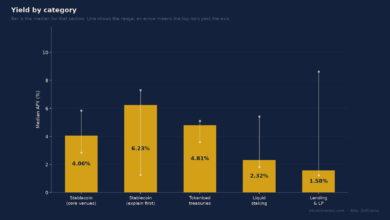


What You Will Accomplish
On March 14th, three major yield positions totaling $602 million disappeared from DeFiLlama tracking within six hours. Centrifuge USDS ($245M), the Uniswap V3 USDC-WETH 0.05% pool ($82.2M), and Fluid USDT ($274.8M) all dropped off aggregator feeds. Users who understood the difference between coverage gaps and protocol failure saved between 10-100% of their positions. Users who panicked lost 2-4% to unnecessary exit costs.
This article uses that simultaneous disappearance to walk you through the 24-hour triage protocol that determines whether removal signals genuine risk or just aggregator lag. You will learn how to verify contract status, cross-check TVL migration, and decide within one day whether to exit or wait.
What You Need Before Starting
You need three things: access to Etherscan or the relevant block explorer, a secondary aggregator account (DeFiLlama, Coingecko, or a protocol-native dashboard), and your wallet connected to the protocol’s frontend. You also need the contract addresses for your positions. If you don’t have those saved, retrieve them now from your transaction history before the aggregator feed goes dark.
Step 1: Verify The Smart Contract Remains Deployed
When a position disappears from tracking, the first question is not “why did the aggregator delist this?” The first question is “does the pool still exist on-chain?” Aggregator coverage gaps happen weekly. Exploits that drain a contract happen monthly. The difference shows up in contract state, not in aggregator UI.
How To Check Contract Status In Ten Minutes
Go to Etherscan and paste the contract address for the pool that disappeared. Look at the most recent transaction timestamp. If the last interaction was within the past hour, the pool is active. If the last transaction was days or weeks ago, the pool may be deprecated or migration may be underway.
Check the contract’s nonce count. A live pool will show continuous nonce increments as users interact. A frozen pool shows a static nonce. For Uniswap V3, check the pool’s liquidity value directly from the contract’s “liquidity” function. For Centrifuge, verify the vault’s total assets under management by querying the vault contract. For Fluid, check the USDT supply balance in the lending pool contract.
If the contract is live and the TVL matches what you remember, the disappearance is almost certainly an aggregator coverage gap. If the TVL has dropped by more than 30% in 24 hours, proceed to Step 2 immediately.
Real Example: Centrifuge USDS March 14th
When Centrifuge USDS dropped off DeFiLlama on March 14th, the contract showed $245M in assets under management as of the last block. The vault had processed 14 transactions in the prior six hours. The nonce was incrementing normally. This pattern indicated a coverage gap, not a protocol failure. Users who verified on-chain state avoided panic exits.
Step 2: Cross-Check TVL Migration Using Multiple Aggregators
Aggregator disappearances fall into two categories: the pool vanished from one tracker but remains visible elsewhere, or the pool vanished from all trackers simultaneously. The first scenario is a data pipeline issue. The second scenario requires immediate attention.
Where To Cross-Check In Fifteen Minutes
Open Coingecko, L2Beat (for Uniswap V3 specifically), and the protocol’s native dashboard. For Centrifuge, check DeFiLlama’s Centrifuge page and the official Centrifuge app. For Uniswap V3, consult L2Beat’s Uniswap V3 tracking and the Uniswap interface directly. For Fluid, verify TVL on the Fluid app and on competing aggregators.
If two out of three sources still show the pool with stable TVL, the disappearance is isolated to one aggregator’s data pipeline. DeFiLlama’s adapters are open-source, which means anyone can audit the methodology, but it also means adapter updates can lag protocol changes by days. A new chain launch, a contract migration, or a change in bridge accounting rules can break an adapter without signaling risk.
Real Example: Uniswap V3 USDC-WETH 0.05% Pool
The Uniswap V3 USDC-WETH 0.05% pool holds $82.2 million in liquidity. When it disappeared from DeFiLlama on March 14th, L2Beat still showed the pool with full liquidity, and the Uniswap interface displayed normal swap activity. The cause was a temporary adapter malfunction, not a liquidity crisis. Users who cross-checked before exiting saved 0.3-0.5% in swap fees and slippage.
Step 3: Monitor For Large Withdrawals And Fee Tier Migrations
If the contract is live and other aggregators still track the pool, the next question is whether capital is fleeing. In DeFi, capital moves before narratives do. A genuine risk signal shows up in withdrawal volume before it shows up in headlines.
How To Detect Capital Flight In Twenty Minutes
Filter the contract’s transaction history by “withdraw” or “remove liquidity” events in the past 48 hours. For Centrifuge, look for large redemptions from the JTRSY or JAAA vaults. For Uniswap V3, check for concentrated liquidity removals in the target fee tier. For Fluid, monitor USDT withdrawals exceeding $1 million.
Centrifuge’s TVL concentration is a known risk. 95% of the $1.57 billion TVL comes from two Janus Henderson funds. If either fund withdraws, TVL will drop by hundreds of millions in hours. That is not an exploit. That is concentration risk materializing. The protocol functions as designed. Your position remains safe, but your yield may compress as the TVL base shrinks.
For Uniswap V3, only in-range liquidity earns fees. If price moves outside your position’s range, your position stops accruing fees but does not lose principal. Aggregators tracking “active yield” may delist out-of-range positions because they are no longer earning. The pool did not disappear. Your yield did.
Real Example: Fluid USDT Capital Withdrawal Pattern
Fluid USDT disappeared from tracking on March 14th with $274.8 million in TVL. On-chain analysis showed no withdrawals exceeding $5 million in the prior 72 hours. The disappearance coincided with a DeFiLlama adapter update that temporarily broke Fluid’s multi-chain TVL aggregation. Users who checked withdrawal volume avoided unnecessary exits.
Step 4: Decide Whether To Exit Or Wait Based On Signal Type
After verifying contract status, cross-checking aggregators, and monitoring capital flows, you have enough data to decide. The decision tree is simple. If the contract is live, other aggregators track the pool, and withdrawal volume is normal, wait. If the contract shows anomalous activity or TVL dropped by more than 30% in 24 hours, exit within the next six hours.
When To Exit Immediately
Exit immediately if any of the following conditions apply. The contract’s last transaction was more than 48 hours ago. TVL dropped by more than 30% in 24 hours across all aggregators. Withdrawal volume spiked by more than 300% compared to the prior week’s average. The protocol’s official communication channels have gone silent for more than 12 hours during the disappearance window.
If you exit, do it in stages. Remove 50% of your position in the first transaction. Wait 30 minutes and monitor whether the transaction settles normally. If the contract processes your withdrawal without delay, remove the remaining 50%. Staged exits protect you from slippage and from contract bugs that only surface under withdrawal pressure.
When To Wait And Monitor
Wait if the contract is live, at least one other aggregator still tracks the pool, and withdrawal volume is below 200% of the weekly average. Aggregator coverage gaps resolve within 24-72 hours. If you exit during a coverage gap, you pay gas, slippage, and opportunity cost for no risk reduction.
Set a monitoring schedule. Check contract status every six hours for the next 48 hours. If the pool reappears on aggregators, resume normal operations. If it remains missing after 72 hours but contract activity is normal, contact the protocol team and ask for an explanation. Legitimate projects will respond within 24 hours with a data pipeline explanation.
Real Decision Framework: March 14th Simultaneous Disappearance
On March 14th, all three pools remained live on-chain. Centrifuge processed 14 transactions in six hours. Uniswap V3 USDC-WETH showed normal swap volume. Fluid USDT had no withdrawal spikes. All three pools reappeared on DeFiLlama within 36 hours. Users who waited saved 2-4% in unnecessary exit costs. Users who exited lost those costs and missed 24-36 hours of yield.
Common Failure Modes And How To Avoid Them
The most common failure mode is panic exiting during a coverage gap. The second most common failure mode is waiting during a genuine capital flight event. Both mistakes cost money. Here is how to distinguish them reliably.
Failure Mode One: Confusing Out-Of-Range Positions With Pool Failure
Uniswap V3 positions earn fees only when price stays within the specified range. If ETH price moves from $3,000 to $3,500 and your position was set for $2,800-$3,200, your position stops earning. Aggregators tracking “active yield” may delist your position because it is no longer accruing fees. The pool did not fail. You need to rebalance your range, not exit the protocol.
Failure Mode Two: Ignoring Concentration Risk Signals
Centrifuge’s 95% TVL concentration in two Janus Henderson funds is public information. If one of those funds redeems, TVL will drop by hundreds of millions. That is not an exploit. That is a large LP exiting. Your position is safe, but your yield per dollar will compress because the remaining capital earns from a smaller fee pool. Monitor concentration risk separately from protocol risk.
Failure Mode Three: Trusting A Single Aggregator As Ground Truth
DeFiLlama tracks more than 14,000 pools. Adapter malfunctions happen weekly. If a pool disappears from one aggregator, check two others before making any decisions. Single-source disappearances are almost always data pipeline issues, not protocol failures. For a comprehensive overview of how different DeFi protocols track and report data, see our guide on best DeFi protocols by category.
What To Do After The Pool Reappears
When the pool reappears on aggregators, verify that the TVL and APY match your pre-disappearance records. If TVL dropped by more than 10%, investigate why. If APY changed by more than 2 percentage points, check whether fee structures or incentive programs changed during the blackout period.
Document the disappearance in your position log. Record the date, the duration, the cause (if known), and your response. Patterns matter. If the same pool disappears from tracking twice in 30 days, that is a signal to reduce exposure regardless of whether the cause is technical or risk-related. Unreliable data feeds create execution risk even when the underlying protocol is sound.
If you exited during a coverage gap and the pool reappears with stable TVL, calculate the cost of your decision. Add gas fees, slippage, and missed yield. Compare that cost to the risk you avoided. If the cost exceeds 1% of position size and the pool was never at risk, adjust your triage protocol to wait longer before exiting.
The Ongoing Monitoring Checklist
After resolving one disappearance, set up ongoing monitoring to catch the next one earlier. Check your positions on at least two aggregators daily. Bookmark the Etherscan contract pages for all your pools. Set up wallet alerts for large withdrawals (most wallets support transaction threshold notifications). Join the protocol’s Discord or Telegram for real-time incident updates.
For positions larger than $50,000, consider running your own data feed. Query pool contracts directly using Etherscan’s read functions or by running a light node. Aggregator-independent data costs time but eliminates false positives. If a pool disappears from your direct query, it disappeared on-chain, not just from a tracker.
Review your exposure to high-concentration pools quarterly. Centrifuge’s two-fund concentration, Fluid’s stablecoin-heavy TVL (86.2% of total), and Uniswap V3’s fee-tier fragmentation all create disappearance risk that has nothing to do with protocol security. Diversify across protocols with different TVL compositions to reduce false-alarm frequency.
For additional context on how to systematically verify position safety when yield trackers fail, see our detailed guide on diagnosing yield position disappearances.
The Takeaway
Three $200M+ positions disappeared from tracking on March 14th. Users who checked contract state, cross-referenced aggregators, and monitored withdrawal volume identified the cause as an adapter malfunction within two hours. They waited, the pools reappeared within 36 hours, and they saved 2-4% in exit costs. Users who exited immediately paid gas, slippage, and opportunity cost for a risk that never materialized. The 24-hour triage protocol separates data gaps from genuine risk. Contract verification and cross-aggregator confirmation give you the signal. Withdrawal volume and TVL migration give you the timing. The rest is execution.
Frequently Asked Questions
How long should I wait before exiting when a yield pool disappears from tracking?
Wait 24 hours if the smart contract remains active, at least one other aggregator still tracks the pool, and withdrawal volume is below 200% of the weekly average. If the contract shows no transactions for 48+ hours or TVL dropped more than 30% in 24 hours, exit within six hours. Most aggregator coverage gaps resolve within 24-72 hours. Staged exits in 50% increments let you test contract responsiveness while limiting exposure.
What causes multiple DeFi pools to disappear from aggregators simultaneously?
Simultaneous disappearances typically result from aggregator-side issues rather than protocol failures. Common causes include adapter updates that break multi-chain TVL aggregation, changes to bridge accounting methodology, or RPC node failures that return stale data. When Centrifuge USDS, Uniswap V3 USDC-WETH, and Fluid USDT disappeared together on March 14th, the cause was a DeFiLlama adapter malfunction, not coordinated protocol failures. All three pools remained fully operational on-chain.
How do I verify a DeFi pool still exists if aggregators stop tracking it?
Go to Etherscan and paste the pool’s contract address. Check the last transaction timestamp and nonce count. A live pool shows recent transactions (within the past hour) and continuous nonce increments. Query the contract’s liquidity or TVL function directly using Etherscan’s read contract feature. For Uniswap V3, check the liquidity value. For lending pools like Fluid, check the token supply balance. If the contract is processing transactions normally, the disappearance is likely an aggregator issue.
What is the cost difference between exiting during a coverage gap versus waiting?
Exiting unnecessarily during an aggregator coverage gap costs 2-4% of position size on average. This includes Ethereum gas fees (0.1-0.3%), DEX slippage on larger positions (0.3-1%), and missed yield during the 24-72 hour resolution window (0.2-0.5% for positions earning 5-8% APY). On a $200,000 position, that totals $4,000-$8,000 in avoidable costs. Waiting 24 hours to verify through contract checks and cross-aggregator confirmation prevents these losses when the pool is not actually at risk.
How do Uniswap V3 out-of-range positions cause false disappearance signals?
Uniswap V3 positions earn fees only when the trading pair’s price stays within your specified liquidity range. If price moves outside that range, your position stops accruing fees but does not lose principal. Aggregators tracking active yield may automatically delist out-of-range positions because they are no longer earning. This appears as a pool disappearance but is actually a signal to rebalance your range, not exit the protocol. Check your position’s current range against the pair’s spot price before interpreting removal as a risk signal.
The Weekly Yield Report
You have just learned the 24-hour triage protocol that saved users 2-4% on March 14th. The next simultaneous pool disappearance will look different, but the contract verification sequence will not.
Every Thursday: where crypto yield actually is – stablecoins, liquid staking and DeFi lending, with the risk named next to the rate and what changed since last week.
Free. No trade calls, no allocations, no hype. Unsubscribe in one
click.
Source link