

Why Instant NFT Sales Usually Mean Selling Below Market Price
The floor price on your NFT collection shows 0.5 ETH. You list at floor. Nothing happens for 48 hours.
This pattern repeats across most NFT collections because floor price is not the same as available liquidity. Floor price is an asking price set by a seller, not a price anyone has paid. It changes when listings are added, bought, or withdrawn.
A displayed floor is the lowest listed ask. It is not evidence that a large position can clear at that price without slippage.
Instant sales occur in two scenarios: accepting an existing bid below floor price, or selling into an AMM liquidity pool that holds sufficient depth. Both paths reduce your proceeds compared to patient listing near the floor.
Healthy collections experience 5-10% slippage on instant sales. Dead collections see 30-90% slippage because there are no actual buyers at floor. AMM-based markets experience 5-15% slippage on trades exceeding 1% of total value locked during NFT floor crashes, versus 2-8% in order-book systems with sufficient depth.
The three collections with more than 100 sales all have a floor within 7% of their average sale price. That 7% gap represents the normal slippage between asking prices and clearing prices in liquid markets.
In low-liquidity collections, the gap widens. A floor much above the clearing price gets undercut. A floor much below it gets bought. The time required for price discovery extends from hours to days or weeks.
What Slippage Actually Costs You
Slippage is the gap between paper value and real cash you receive after fees, royalties, and gas. A 10-NFT collection at 0.5 ETH floor is 5 ETH on paper. After OpenSea’s 2.5% fee, a 5% creator royalty, and approximately $8 gas per sale, you walk away with 4.65 ETH. That is 7% slippage on a healthy mint.
Real cash-out value requires subtracting marketplace fees (0.5-2.5%), creator royalties (typically 5%), and gas (approximately $5-15 per sale). Marketplace fees in 2026 range from 0% on Blur and OKX NFT to 15% on SuperRare primary sales, with OpenSea at 1% and Magic Eden at 2%.
When you accept a collection-wide bid on Blur or sell into a Sudoswap pool to exit immediately, you add execution slippage on top of structural costs. The bid sits 10-25% below floor in most cases. The AMM pool reprices based on your trade size relative to pool depth.
The choice is between waiting for a floor buyer and taking the haircut now. The data shows that in collections with fewer than 10 sales per day, the median time from listing to final settlement exceeds 72 hours. That wait represents opportunity cost. The haircut represents execution cost.
How Order Books, Bids, And Floor Listings Actually Work

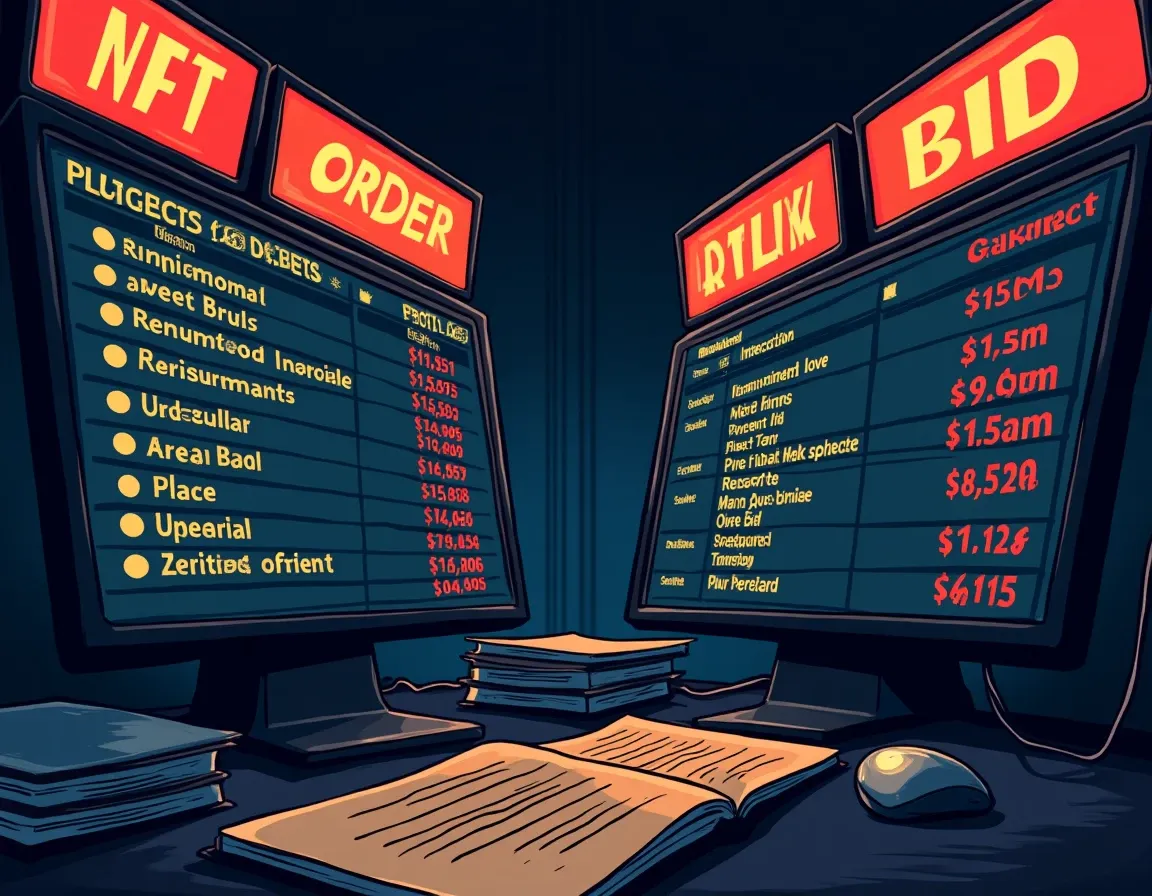
Marketplaces display floor price, but they function differently under the surface. OpenSea operates primarily as a listing board. Blur operates as an order book with visible bid depth.
On Blur, bids and asking prices are displayed much like an order book on crypto exchanges. If bids are stacked up at a certain price, you know the true NFT floor price for the collection. A bid at 0.5 ETH means any seller listing at or below that price has their NFT instantly purchased, creating a functioning order book for NFTs.
OpenSea does not show this clearly. You see floor price, but you do not see how many buyers are bidding near that floor or at what depth. In highly liquid markets, new listings near the floor tend to get filled or repriced quickly, so the cheapest ask can approximate immediate liquidity. In low-liquidity collections, this breaks down entirely.
Order book depth matters more than floor. A high floor with thin bid support does not guarantee instant sales. In a whale-concentrated market, supply distribution heavily influences execution probability. Concentrated ownership increases volatility because coordinated selling can push the floor down rapidly.
Useful operational metrics include the percentage of supply controlled by the top 1%, 5%, and 10% of holders, the ratio of on-chain sales to negotiated deals, and the median time from listing to final settlement. Slippage on bulk purchases of 5-20 items widens when floor liquidity becomes more sensitive to single-wallet listings.
Cross-sectional liquidity analysis across 500+ NFT collections reveals median slippage of 5-15% during 2023 depegs, with 70% of markets exhibiting depth below $100,000. That means most collections cannot absorb a $10,000 exit without moving the floor.
Accepting Below-Floor Bids As The Only Instant Path
If you want to sell today, you accept the highest existing bid. That bid typically sits 10-25% below the displayed floor. The gap represents the bid-ask spread, which widens in illiquid markets.
Instant on-chain buy works for retail and liquid collections but suffers from slippage and failed transfers. Off-chain negotiated sales avoid slippage but require settlement risk and counterparty risk.
By 2026, OpenSea has 382,000 monthly active users compared to approximately 38,300 on Blur before Blur retires its website on November 12, 2026. The liquidity concentration on OpenSea means that patient listing there often yields better net proceeds than instant bid acceptance on lower-volume platforms.
The numbers show that accepting a bid 15% below floor and receiving funds in one block is often preferable to waiting six days for a floor buyer when the floor itself is declining 3% per day. The decision depends on your holding cost and the collection’s momentum.
How AMM Pools Let You Sell Without A Buyer

Automated market makers allow traders to instantly buy or sell their NFTs through liquidity pools without waiting for someone to agree to their price. AMM liquidity pools operate according to the constant-product formula: x multiplied by y equals k, where x and y denote the quantities of the two assets in the pool and k is a constant that remains invariant.
When you sell an NFT into a Sudoswap or similar AMM pool, you are trading against the pool’s inventory. The pool reprices based on the bonding curve and your trade size relative to total value locked. Trades against thin pools incur extreme slippage.
Liquidity pool may not hold enough liquid for the volume of NFTs trading every day. Sudoswap and similar AMM pools require sufficient pool depth. Trades less than 1% of pool TVL typically see 5-8% slippage. Trades exceeding 1% of TVL see 5-15% slippage during normal conditions and much more during floor crashes.
Hourly percentage price changes in NFT markets, on average, are higher than 5%, but with wide dispersion, reaching 44% volatility. This volatility creates the same impermanent loss problem that liquidity providers face in token AMMs.
What Liquidity Providers Earn And Lose
Liquidity providers in NFT AMM pools earn standard swap fees: 0.05% for stable pairs, 0.3% for standard pairs, 1% for volatile pairs. The question is whether fee income covers impermanent loss.
For over half of LPs in some major pools, impermanent loss is actually higher than the trading fees they earn. More than 80% of the pools analyzed saw LPs lose out due to impermanent loss. The base case for a liquidity provider in 2026 is that fee income from a well-chosen pool covers impermanent loss in normal volatility conditions.
Narrowing the range increases capital efficiency but also amplifies impermanent loss risk. LPs in tight price ranges on Uniswap V3 face higher loss if prices diverge. This dynamic also applies to NFT liquidity pools, where concentrated liquidity around the floor price exposes LPs to sharp repricing when the floor moves.
The income mechanism for selling into AMM pools is speed. You pay 5-15% slippage to convert an illiquid NFT into ETH in one transaction. The liquidity provider absorbs that repricing risk in exchange for swap fees. Whether that trade makes sense depends on your urgency and the collection’s decline rate.
Ethereum’s price decline compresses liquidity across ETH-denominated NFT marketplaces. Floor prices lag ETH spot moves by 24-72 hours. If ETH is dropping 5% per day and your NFT floor is stable in ETH terms, you are losing 5% per day in dollar terms by holding. The 8% AMM slippage cost becomes cheaper than the three-day hold.
Understanding how liquidity pools generate yield and the mechanics of impermanent loss helps you evaluate whether to sell into a pool or wait for a bid. The same principles that govern token LP returns apply to NFT AMM pools.
How To Estimate Realistic Sale Timelines And Proceeds
To estimate how long your NFT will take to sell and what you will actually receive, you need three data points: current floor price, bid depth, and recent sale velocity.
Floor price is a weak measure of liquidity. A floor price exists whether one item sells per day or a thousand. Recent sale velocity tells you how many items have sold in the past 24 hours, 7 days, and 30 days. Bid depth tells you how many buyers are waiting at what prices.
If your collection has sold 15 items in the past 24 hours and there are 1,200 items listed, your expected time to sale is approximately 80 days if you list at the current floor. If you want to sell in 24 hours, you need to undercut the floor by enough to move into the top 15 listings, or accept the highest existing bid.
Calculating realistic proceeds requires subtracting all costs. Use the formula: (Sale Price) multiplied by (1 minus Marketplace Fee) multiplied by (1 minus Creator Royalty) minus Gas Cost. For a 0.5 ETH sale on OpenSea with a 1% marketplace fee, 5% creator royalty, and $10 gas cost, the calculation is 0.5 multiplied by 0.99 multiplied by 0.95 minus 0.003 ETH (assuming $3,000 ETH), which equals approximately 0.467 ETH, or 6.6% slippage.
That 6.6% slippage is structural. It applies whether you sell instantly or wait six weeks. Execution slippage adds to structural slippage when you accept below-floor bids or sell into AMM pools.
What To Watch For In Collection Liquidity
The key metrics are sale velocity, unique buyers per day, holder concentration, and bid-ask spread. Sale velocity measures how many items trade per day. Unique buyers per day measures how many distinct wallets are acquiring items. Holder concentration measures what percentage of supply the top 10% of holders control. Bid-ask spread measures the gap between the highest bid and the lowest ask.
A healthy collection shows stable or rising sale velocity, multiple unique buyers per day, distributed holder base, and a bid-ask spread under 10%. A dying collection shows declining sale velocity, the same two or three wallets recycling items, whale-concentrated supply, and a bid-ask spread over 25%.
Floor price by itself does not tell you whether you can exit. Liquidity depth tells you whether the pool can absorb your position without material slippage. In NFT markets, liquidity depth is measured by the number of bids stacked near floor and the number of items sold per day relative to total supply.
If you are evaluating whether to deploy capital into NFT flipping, these liquidity metrics determine your exit risk. Understanding how to flip NFTs for profit requires understanding exit liquidity before you acquire inventory.
When Instant Sales Make Financial Sense
Selling instantly at a 10-25% haircut makes sense in three conditions: when the floor is declining faster than the haircut, when holding cost exceeds slippage cost, or when redeployment opportunity exceeds hold value.
If the floor is dropping 5% per day and you face a 15% haircut to exit today, waiting three days costs you 15% in floor decline plus three more days of exposure. The instant exit preserves more value.
Holding cost includes opportunity cost. If you can redeploy the proceeds into a position with expected 30-day return of 20%, and your NFT has expected 30-day return of 0%, the 12% slippage cost to exit immediately is cheaper than the 20% you are missing by staying in the NFT.
This calculation applies most clearly to NFT positions held as short-term flips. If you minted at 0.3 ETH, the floor ran to 0.8 ETH, and it is now at 0.6 ETH with declining momentum, taking the 0.52 ETH bid (15% below floor) still nets you a 73% gain on the mint and gets you out before the floor returns to mint price.
The numbers show that most NFT flips clear within 7-14 days or they do not clear at all. The tail of listings that sit for months represents either overpriced inventory or collections with no remaining buyer base. Once your listing passes the 30-day mark without a sale, accepting the highest bid becomes the only realistic exit.
How Royalty Enforcement Affects Net Proceeds
Most NFT royalties are marketplace-optional, not on-chain enforcement. OpenSea enforces creator royalties when the collection uses the operator filter registry. Blur does not enforce royalties by default. Magic Eden allows creators to opt into enforcement.
When you sell on a marketplace that does not enforce royalties, you avoid the 5% royalty deduction, but you also list in a pool with lower liquidity because many buyers concentrate on the marketplaces with the most volume. The choice is between 5% higher net proceeds and access to 80% of the buyer base.
The data shows that collections with enforced royalties have 2-4 times the trade volume of equivalent collections without enforcement, because enforcement creates trust that the creator will continue supporting the project. The 5% royalty cost is offset by the higher probability of sale and tighter bid-ask spreads.
Understanding how NFT creator royalty income actually gets paid clarifies which marketplaces will deduct royalties from your sale and which will not. That knowledge lets you calculate net proceeds accurately across platforms.
How To Reduce Slippage When You Need To Exit Fast
If you need to exit within 24 hours, you have four options: accept the highest existing bid, list 10-15% below current floor, split your position across multiple marketplaces, or sell into an AMM pool.
Accepting the highest existing bid gives you certainty. You receive the bid amount minus fees and gas. No price discovery risk. No waiting.
Listing 10-15% below current floor moves you to the top of the order book and attracts immediate attention from buyers monitoring the collection. The risk is that you trigger a repricing cascade where other sellers undercut you further, but in a liquid collection with stable momentum, this approach often clears within hours.
Splitting your position across OpenSea, Magic Eden, and LooksRare exposes your inventory to three different buyer pools. Some buyers filter by marketplace based on interface preference or fee structure. Listing on all three increases the probability that one of them fills quickly.
Selling into an AMM pool like Sudoswap gives you instant execution but the highest slippage. Use this only when the pool has sufficient depth and the collection has stable AMM pricing history. Check the pool’s 24-hour volume and compare it to your position size. If your position exceeds 5% of 24-hour volume, expect double-digit slippage.
What Happens When Everyone Tries To Exit At Once
Floor crashes occur when multiple holders attempt to exit simultaneously. The floor price drops 30-60% in hours. Bid depth evaporates. AMM pools drain.
Cross-sectional liquidity analysis shows that during the 2023 NFT market depeg, median slippage widened to 15% even in previously liquid collections. Collections with fewer than 50 unique holders saw slippage exceed 50% because there was no bid depth to absorb panic selling.
The mechanism is simple. When five sellers list at floor, and no buyers appear, the sixth seller lists 5% below floor. The seventh lists 5% below that. The original five sellers either hold or reprice down. Within 12 hours, the floor has moved 25% and only three items have sold.
This is why sale velocity relative to supply matters more than floor price. A collection with 10,000 items and 5 sales per day has a 2,000-day clearing time at current velocity. When confidence breaks, that clearing time extends to infinity because buyers disappear entirely.
Knowing how to measure exit liquidity in low cap tokens before deploying capital applies equally to NFT collections. The same slippage calculations, the same order book depth analysis, and the same holder concentration risk assessments determine whether you can exit at a known price.
What To Do Next
Open your NFT collection on both OpenSea and Blur if Blur is still operational in your market. Compare the displayed floor price to the highest bid. Calculate the bid-ask spread as a percentage. That percentage is your minimum slippage cost for instant sale.
Check the collection’s 24-hour, 7-day, and 30-day sale volume. Divide total listed supply by daily sale velocity to estimate clearing time. If that number exceeds 30 days, you are holding illiquid inventory.
Calculate your net proceeds using the formula: (Sale Price) multiplied by (1 minus Marketplace Fee) multiplied by (1 minus Creator Royalty) minus Gas Cost. Compare that to the highest existing bid. The difference is the cost of waiting.
If the floor is stable or rising and bid-ask spread is under 10%, list at floor and wait. If the floor is declining 3% per day or faster, accept the highest bid or list 15% below floor. If the collection has fewer than 10 sales in the past 7 days, treat it as illiquid and expect 30-90 day clearing time or forced acceptance of below-market bids.
For collections where you need to monitor multiple liquidity pools or compare AMM pricing to order book depth, Uniswap’s documentation provides the technical foundation for understanding how constant-product AMMs reprice based on trade size. The same bonding curve math applies to NFT AMM pools.
If you are deploying capital into NFT positions with the intent to exit within defined timelines, study how floor price works at the technical level. Floor price is the lowest ask, not the clearing price. The distinction determines whether your exit strategy is realistic or wishful thinking.
The Takeaway
NFTs rarely sell instantly unless you accept a 10-25% haircut through bid acceptance or AMM slippage. Floor price is a listing, not liquidity. Execution speed costs money, and that cost varies from 5% in healthy collections to 50% in illiquid ones.
The collections that clear fastest have daily sale velocity above 1% of supply, bid-ask spreads under 10%, and distributed holder bases. Everything else takes days to weeks, or requires accepting below-market prices.
Structural slippage from fees, royalties, and gas costs 5-8% in all sales. Execution slippage from instant exits adds another 5-20%. The total cost of converting an NFT to cash in under 24 hours typically ranges from 10% to 30% depending on collection liquidity.
Watch bid depth, sale velocity, and floor momentum. Those three metrics tell you whether to wait for floor or take the bid. Floor price alone tells you nothing about exit capacity.
You now have the slippage math, the liquidity metrics, and the execution options. Those numbers will shift with market conditions, collection momentum, and ETH price moves, so re-run the calculations each time you need to exit.
Frequently Asked Questions
Can I actually sell my NFT instantly at the displayed floor price?
No. Floor price is the lowest listing, not a guaranteed sale price. Instant sales require either accepting an existing bid that typically sits 10-25% below floor, or selling into an AMM liquidity pool with 5-15% slippage. The displayed floor represents what one seller is asking, not what buyers are currently paying. Most NFTs in collections with under 10 sales per day take 24-72 hours to sell at floor price, and many never sell without price reductions.
How much does instant NFT sale slippage actually cost?
Structural slippage from marketplace fees (0.5-2.5%), creator royalties (typically 5%), and gas costs ($5-15) totals 5-8% in all sales. Execution slippage from accepting below-floor bids adds 10-25%, and AMM pool sales add 5-15% depending on pool depth and your trade size relative to TVL. Total cost to convert an NFT to cash in under 24 hours typically ranges from 10% to 30% depending on collection liquidity and whether you use bids or AMM pools.
What is the difference between floor price and actual liquidity?
Floor price is simply the lowest asking price currently listed by any seller. Actual liquidity is the volume of assets that can trade at or near that price without moving the market. A collection can have a 0.5 ETH floor with only one buyer willing to pay 0.35 ETH, meaning real liquidity sits 30% below the displayed floor. Liquidity is measured by bid depth, daily sale velocity, and the number of unique buyers. Collections with fewer than 50 unique holders often have bid-ask spreads exceeding 25%.
When does selling instantly make more financial sense than waiting?
Instant sales make sense when the floor is declining faster than your slippage cost, when holding cost exceeds exit cost, or when redeployment opportunity exceeds hold value. If the floor drops 5% daily and you face a 15% haircut to exit today, waiting three days costs 15% in floor decline plus continued exposure. Similarly, if you can redeploy proceeds into a position with 20% expected 30-day return while your NFT has 0% expected return, paying 12% slippage to exit immediately preserves more total value than holding.
How do AMM liquidity pools let me sell NFTs without a buyer?
AMM pools hold inventory of both NFTs and ETH, automatically repricing based on the constant-product formula where x multiplied by y equals k. When you sell an NFT into the pool, you receive ETH at the current bonding curve price, and the pool absorbs your NFT while repricing all remaining assets. Pools require sufficient depth, trades under 1% of pool TVL see 5-8% slippage while larger trades see 5-15% or more. The liquidity provider who funded the pool earns swap fees but faces impermanent loss risk when floor prices move.
The Weekly Yield Report
You just calculated slippage across bids, AMM pools, and patient listings under three liquidity conditions. Those spreads will be different when floor momentum shifts next week.
Every Thursday: where crypto yield actually is – stablecoins, liquid staking and DeFi lending, with the risk named next to the rate and what changed since last week.
Free. No trade calls, no allocations, no hype. Unsubscribe in one
click.
Source link