


The Question

The BlackRock USD Institutional Digital Liquidity Fund, known as BUIDL, holds $3.4 billion in assets and is the largest tracked tokenized real-world asset product by total value locked. In late 2026, the fund disappeared intermittently from several third-party yield aggregators while continuing to accrue yield for qualified holders. The question worth answering is not whether the fund failed, because it did not, but whether a tracking disappearance signals a terms change that could cost a qualified holder thousands of dollars, and how to verify continued accrual when third-party dashboards no longer reflect your position.
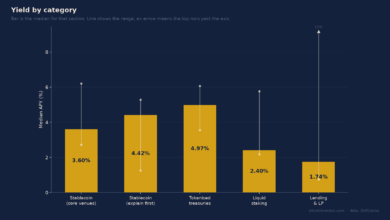
The scenario is specific. You hold $500,000 in BUIDL across two chains. Your portfolio tracker shows the position one week, then does not show it the next. The fund’s advertised yield at the time of disappearance was running between 3.4% and 3.75%, depending on the chain and the period measured. If that yield stopped accruing for three months before you noticed, the cost would be approximately $4,400 in foregone income. If the terms changed in a way that reset your subscription or triggered an early redemption penalty, the cost could be structural. This is the income mechanism at stake when tracking disappears.
What Actually Happened

BlackRock BUIDL did not stop operating when it disappeared from certain trackers. The fund is a permissioned tokenized money market product launched in March 2024 with Securitize as transfer agent and BNY Mellon as custodian. It holds short-duration U.S. Treasury bills, repurchase agreements, and cash equivalents. Each BUIDL token represents a claim on one dollar of net asset value, and yield accrues daily through a rebase mechanism. Dividends are distributed monthly as freshly minted BUIDL tokens rather than as a price change in the existing token. The fund targets qualified purchasers with a minimum subscription of $5 million and restricts token transfers to wallets that Securitize has added to a whitelist after verifying identity and accreditation.
When BUIDL disappeared from third-party trackers, the operational cause was not fund failure but data access restriction. The fund operates across six chains: Ethereum, Arbitrum, Avalanche, Optimism, Polygon, and Aptos. Yield aggregators like DefiLlama and RWA.xyz pull data by querying on-chain contracts and cross-referencing custodian disclosures. When access to one of those data sources tightens or when the rebasing mechanism produces a data structure that an aggregator has not accounted for, the tracker stops updating. DefiLlama currently tracks nine BlackRock BUIDL yield pools with an average yield of 3.4%, but those pools represent only the chains and contract versions for which the aggregator has maintained a functioning data feed.
RWA.xyz, another institutional tracker, publishes a clear delisting policy. When a tokenized asset is delisted, redeemed, wound down, or removed from its issuing platform, the tracker stops updating the asset’s data going forward but preserves its entire history for transparency and research. The language matters. A delisting does not mean the fund closed. It means the tracker lost the data feed or the asset no longer meets the inclusion criteria. For a permissioned product like BUIDL, where only whitelisted wallets can hold or transfer the token, aggregators face a structural problem. If the aggregator’s wallet is not on the whitelist, it cannot query the full holder set or verify transfers. The data becomes partial, and many trackers choose to stop publishing partial data rather than risk publishing incomplete yield calculations.
The other operational factor is the rebasing yield mechanism. Because BUIDL distributes yield as additional tokens rather than as a change in token price, any protocol that wraps or integrates BUIDL must track the daily accrual and adjust its internal accounting to reflect the changing token balance. Ondo Finance, which holds more than $192 million in BUIDL as backing for its own yield-bearing stablecoin products, does this by maintaining a wrapper contract that converts the rebasing BUIDL token into a non-rebasing derivative. If a yield tracker does not account for the rebase, it will understate the yield. If the tracker’s data feed from Securitize’s institutional portal is interrupted, it will have no yield figure to publish at all.
The specific tracking disappearance in late 2026 appears to have resulted from a combination of multi-chain data fragmentation and temporary API access restrictions following Securitize’s update to its institutional disclosure portal. No terms change was announced. No redemption wave occurred. The fund’s custodian and issuer continued publishing daily NAV and yield figures through the institutional portal, but several public aggregators lost automated access to those figures for a period of days to weeks, depending on the chain and the aggregator.
How to Verify Independently

When a position disappears from a third-party tracker, you have six hours to distinguish data lag from liquidity freeze, and 48 hours to verify whether the underlying yield mechanism continues to function. The verification process for a permissioned tokenized fund like BUIDL differs from the process for an open DeFi protocol, because the source of truth is not purely on-chain. Here is the checklist.
First, check the Securitize institutional portal directly. Securitize publishes the current net asset value per share and the trailing yield for BUIDL on a dedicated page accessible to qualified investors. This is the primary source. If the portal shows a current NAV of $1.00 and a trailing 30-day yield in the low-4% range, the fund is operating normally. If the portal is not accessible or if the yield figure has not updated in more than 48 hours, that is a signal worth investigating further.
Second, cross-reference the total value locked figures across multiple aggregators. DefiLlama and RWA.xyz do not always agree on TVL because they index different chains and use different cut-off criteria for inclusion. If DefiLlama shows $3.4 billion and RWA.xyz shows $2.1 billion, the discrepancy likely reflects a difference in which chains are being counted rather than a $1.3 billion outflow. Check each chain individually using the blockchain explorers for Ethereum, Arbitrum, Avalanche, Optimism, Polygon, and Aptos. The BUIDL token contract address is published by BlackRock and Securitize. Query the total supply on each chain and multiply by $1.00 to calculate the total value locked per chain. If the sum matches the last known TVL figure within a few percentage points, no material outflow has occurred.
Third, verify on-chain transfer activity. Even though BUIDL is permissioned and most holders are institutions or treasuries that do not trade frequently, the token contract will show mint and burn events corresponding to new subscriptions and redemptions. If the contract shows daily or weekly mints, the fund is still accepting subscriptions. If the contract shows no activity for two weeks, that is unusual and worth contacting Securitize to confirm whether subscriptions have been paused.
Fourth, contact the custodian or transfer agent directly. BNY Mellon is the custodian. Securitize is the transfer agent. Both have institutional contact channels for qualified investors. If you hold $500,000 or more in BUIDL, you are a qualified investor and you have a right to ask whether the fund’s terms have changed, whether your subscription remains active, and whether yield is accruing. The response time is typically 24 to 48 hours. If you receive no response within 72 hours, escalate to BlackRock’s institutional client service team.
Fifth, monitor official BlackRock communications and regulatory filings. Tokenized funds that hold U.S. securities are subject to SEC reporting requirements. Material changes to the fund’s structure, fee schedule, or distribution policy will appear in an SEC filing before they appear anywhere else. BlackRock publishes press releases for product expansions and changes. When BUIDL expanded from Ethereum to five additional blockchains in late 2024, the announcement came through a press release and was covered by financial media within hours. If no such announcement has been made, no material change has occurred.
Sixth, check the Ondo Finance wrapper contracts. Ondo holds more than $192 million in BUIDL and uses it as collateral for its own tokenized yield products. If Ondo’s contracts show uninterrupted yield pass-through and no pause in BUIDL redemptions, that is a reliable signal that the underlying fund continues to operate normally. Ondo’s contracts are public and audited. Any interruption in BUIDL’s yield accrual would appear as a discrepancy between the yield Ondo advertises and the yield its contracts are actually distributing.
This six-step checklist distinguishes three categories of tracking disappearance. Data lag, where the tracker has temporarily lost its feed but the fund continues operating. Access restriction, where the fund has tightened its whitelist or changed its API structure and the tracker has not yet adapted. And operational failure, where the fund has paused subscriptions, halted yield distributions, or experienced a custodial or regulatory issue. The first two categories are common and non-threatening. The third is rare for a BlackRock product but would be visible through multiple channels within 48 hours.
When It Matters and When It Does Not
A tracking disappearance matters when it masks a terms change that would otherwise trigger an exit decision. The scenario to guard against is this: the fund changes its fee structure, tightens its redemption terms, or experiences a regulatory restriction that limits your ability to exit, and you do not learn of the change for 30 or 60 days because your portfolio tracker is not updating. By the time you notice, your capital is locked or the fee increase has already cost you several basis points of return.
For BUIDL specifically, the fee structure varies by chain. On Ethereum, Arbitrum, and Optimism, the management fee is 50 basis points annually. On Aptos, Avalanche, and Polygon, the fee is 20 basis points. If you deployed $500,000 on Ethereum and the fund later moved all new subscriptions to Polygon at the lower fee without offering existing holders the option to migrate, that is a 30-basis-point annual cost, or $1,500 per year on a $500,000 position. The difference is material. If your tracker does not update and you do not monitor the fund’s disclosures directly, you will not know that lower-cost access is available.
The other scenario where tracking disappearance matters is during a period of rising interest rates. BUIDL’s yield tracks the federal funds rate because the fund invests in short-duration Treasuries and repo. When the Fed raises rates, BUIDL’s yield rises with a lag of a few weeks. If rates rise from 4.0% to 4.5% and your tracker is not updating, you will not see the yield increase reflected in your portfolio. That might delay a decision to allocate additional capital to BUIDL or to exit a lower-yielding position elsewhere. The cost is opportunity cost rather than direct loss, but it accumulates.
A tracking disappearance does not matter when you have established a direct verification routine that does not depend on third-party aggregators. If you already check the Securitize portal weekly, query the on-chain contract monthly, and maintain contact with the transfer agent, then whether DefiLlama or RWA.xyz publishes your position is irrelevant. The tracker is a convenience, not a necessity. The necessary verification is what you do yourself.
It also does not matter if the disappearance is isolated to a single aggregator and other aggregators continue to publish accurate data. If DefiLlama stops updating but RWA.xyz, your exchange’s portfolio tracker, and your own on-chain queries all show the same TVL and yield figures, the problem is with DefiLlama’s data feed, not with the fund. The response in that case is to stop relying on the aggregator that has lost the feed and to use the aggregators that still have it.
The broader principle is this. Tokenized institutional products like BUIDL are structurally different from open DeFi protocols. The yield is not generated by liquidity provision or by trading fees collected from a public pool. It is generated by the returns on a portfolio of regulated securities held by a custodian. The transparency is not purely on-chain. It depends on disclosures published by the transfer agent, the custodian, and the issuer, and those disclosures are gated by the same accreditation and whitelisting requirements that gate access to the fund itself. If you are a qualified holder, you have direct access to the disclosures. If you are not a qualified holder, you cannot hold the fund in the first place, and you have no position to verify.
For similar issues across other tracked positions, the multi-position disappearance framework applies the same verification process to BUIDL, Aave USDe, and Jupiter positions that vanished in the same week. The common thread is that data provider changes, not fund failures, cause most tracking disappearances.
What This Reveals About Permissioned RWA Yield
The BUIDL tracking disappearance is a case study in the transparency gap that exists between permissioned tokenized products and open DeFi protocols. Open protocols publish all data on-chain. Anyone can query the contracts, verify the total value locked, calculate the yield from fee revenue, and confirm that the mechanism producing the yield is functioning. Permissioned products publish some data on-chain, specifically the token supply and transfer activity, but the yield calculation and the underlying portfolio composition are disclosed through off-chain channels controlled by the issuer.
This structure is not a flaw. It is a feature of regulated investment products. A tokenized money market fund that holds U.S. Treasuries is subject to the same disclosure and custody requirements as a traditional money market fund. The custodian must attest to the holdings. The fund must publish a daily NAV. The yield must be calculated according to SEC rules. The difference is that the shares are represented by tokens on a blockchain rather than by entries in a traditional brokerage account. The blockchain provides settlement efficiency and 24-hour transferability within the whitelisted holder set, but it does not eliminate the need for a custodian, a transfer agent, or regulatory filings.
The consequence for yield verification is that you cannot rely solely on on-chain data. You must also monitor the off-chain disclosures. If the transfer agent’s portal goes offline or restricts API access, third-party trackers lose the data feed. If the custodian does not publish daily NAV updates, there is no current yield figure to display. The tracker can still show the token supply and the holder count, but it cannot calculate the yield or confirm that redemptions are being processed at par.
This is the reason that when a protocol drops off yield trackers, the first step is not to assume failure but to check the primary sources. For BUIDL, the primary source is Securitize. For other tokenized treasury products, the primary source is the transfer agent or custodian named in the fund’s documentation. For open DeFi protocols, the primary source is the contract itself.
The broader implication is that permissioned tokenized yield will always have a transparency ceiling. You can verify that the token exists and that transfers are being processed, but you cannot independently audit the portfolio or confirm the yield calculation without access to the custodian’s disclosures. If those disclosures are restricted to qualified investors, then public trackers will always be one step removed from the source of truth. If the issuer tightens access or changes the API structure, public trackers will lose the feed. The solution is not to demand that every tokenized fund become fully transparent, because that would require eliminating the custody and regulatory structure that makes the fund legal in the first place. The solution is to understand the transparency model of the product you are holding and to verify accordingly.
For traditional stablecoin yield opportunities that do not require accreditation, the passive income framework walks through CeFi platforms, DeFi lending, and yield-bearing tokens where the verification process is simpler because the data is fully on-chain or published by platforms with public APIs.
The Takeaway
BlackRock BUIDL did not fail when it disappeared from yield trackers in late 2026. The fund continued to hold $3.4 billion in assets, accrue yield daily, and distribute dividends monthly. What changed was that several public aggregators lost automated access to the data feeds they had been using to calculate and publish the fund’s yield. The cause was a combination of API access restrictions following a portal update by Securitize and the structural difficulty of tracking a permissioned, rebasing token across six blockchains. For a qualified holder with $500,000 deployed, the operational response is to verify independently through the Securitize portal, on-chain contract queries, custodian contact, and regulatory filings rather than relying on third-party trackers. The cost of not verifying is the risk that a terms change or fee structure shift goes unnoticed for weeks or months, eroding several thousand dollars in return. The broader lesson is that permissioned tokenized products will always have a transparency gap compared to open DeFi protocols, and that gap means you cannot verify yield solely through public aggregators. You must go to the primary sources, and if you are not a qualified investor with direct access to those sources, you cannot verify the position at all.
Frequently Asked Questions
Why did BlackRock BUIDL disappear from yield trackers if the fund is still operating?
BUIDL disappeared from some trackers because they lost automated access to data feeds from Securitize, the transfer agent, following a portal update in late 2026. The fund is permissioned and uses a rebasing token structure, which makes it harder for aggregators to track across six blockchains. The tracker lost the feed, not the fund’s operational capacity. Yield continued accruing for qualified holders throughout the tracking disappearance.
How do I verify that my BUIDL position is still accruing yield if my tracker stops updating?
Check the Securitize institutional portal directly for current NAV and trailing yield. Query the BUIDL token contract on your blockchain using a block explorer to verify mint and burn activity. Cross-reference TVL figures across DefiLlama and RWA.xyz. Contact Securitize or BNY Mellon as custodian. Monitor BlackRock press releases and SEC filings for material changes. Check Ondo Finance wrapper contracts, which hold over $192 million in BUIDL, for uninterrupted yield pass-through.
What is the cost of not noticing a tracking disappearance for a $500,000 BUIDL position?
If yield stopped accruing and you did not notice for three months, the foregone income at 3.5% APY would be approximately $4,400. If a terms change altered the fee structure or redemption conditions without your knowledge, the cost could be larger and structural. If the disappearance reflects only a data feed issue and yield continues accruing, there is no cost beyond the inconvenience of verifying manually.
Does a tracking disappearance mean the fund has restricted access or changed terms?
Not necessarily. Most tracking disappearances result from data provider issues, not from fund-level changes. For BUIDL, the late-2026 disappearance reflected Securitize API access restrictions and multi-chain indexing gaps, not a terms change or access restriction. To distinguish, check official BlackRock communications, SEC filings, and the Securitize portal. If those sources show no material change, the issue is with the tracker, not the fund.
Why is BUIDL harder to track than open DeFi protocols?
BUIDL is a permissioned tokenized money market fund. Yield is generated by a portfolio of U.S. Treasuries held by a custodian, not by on-chain fee revenue. The yield calculation depends on off-chain disclosures from Securitize and BNY Mellon, which are restricted to qualified investors. Token transfers are restricted to whitelisted wallets, so aggregators cannot query the full holder set or independently verify the portfolio. Open DeFi protocols publish all data on-chain, making verification simpler.
The Weekly Yield Report
You have just walked through the six-step verification process for a $3.4 billion institutional yield product that disappeared from tracking. Those steps will be different when the next product does the same.
Every Thursday: where crypto yield actually is – stablecoins, liquid staking and DeFi lending, with the risk named next to the rate and what changed since last week.
Free. No trade calls, no allocations, no hype. Unsubscribe in one
click.
Source link