

What You Will Accomplish

Between June and October 2026, the Curve USDC-RLUSD pool collapsed from 17.97% APY to 4.94% on $79 million TVL. That is a 13.03 percentage point drop in 120 days. On a $200,000 position, that shift costs $26,060 annually-the difference between earning $35,940 and earning $9,880.
This article builds a reusable decision framework to answer the question every LP asks after a major rate collapse: stay or move. You will assess whether the drop signals pool maturation, incentive exhaustion, or deeper protocol risk. You will calculate your gas-adjusted exit threshold for positions above $50,000. You will compare alternative pools at the same risk tier. And you will know whether to rebalance within 48 hours or hold.
Prerequisites: You already have capital deployed in a Curve stablecoin pool. You understand how liquidity provision works. You know your position size and your annual yield target.
Step One: Classify the Collapse Type Within Six Hours
A 13-point yield collapse is not a single event. It is a symptom. Your first task is to determine which of three failure modes caused the drop.
Pool Maturation Signal
This is the normal trajectory for a new stablecoin pool. Early APYs spike as protocols compete for TVL. As liquidity floods in, rates compress. The USDC-RLUSD pool launched in early 2026 with RLUSD as a regulated, dollar-backed stablecoin issued by Ripple Labs. By October 1, 2026, RLUSD had $2.51 billion in circulation against $2.63 billion in reserves. The pool’s TVL declined from roughly $79 million in June to $48.1 million by late October, and the APY dropped from about 17.97% to 3.92%. That is not maturation-that is capital flight.
Maturation would show rising TVL and declining APY. This pool showed the opposite: TVL fell 39% while APY collapsed 72%. The money left. That is not organic compression.
Incentive Exhaustion Pattern
CRV emissions are distributed weekly by the Curve DAO. veCRV holders vote on gauges to allocate Curve’s inflation to specific pools. If gauge weight shifts away from your pool, emissions decline. If CRV price falls, the same emissions yield lower APRs.
To diagnose incentive exhaustion, check two data points within six hours of noticing the collapse:
- Gauge vote weight: Visit curve.finance/dao/gauges and search for the USDC-RLUSD pool. If weekly gauge weight dropped by more than 20%, incentives are being redirected elsewhere.
- CRV token price: Check CRV’s price movement during the collapse window. If CRV fell 30% or more while your pool’s APY fell 50%, the collapse is partly token-price driven, not just TVL or liquidity driven.
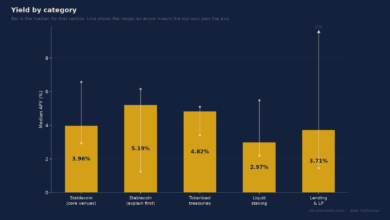
The USDC-RLUSD pool’s collapse from 17.97% to 4.94% happened while broader DeFi protocol yields were stable. Across 22 Curve stablecoin pools over $5 million on DeFiLlama in mid-September 2026, the median aggregate APY was 3.5%, with the top incentivized pools at around 7.8%. The USDC-RLUSD pool fell below the median by October. That suggests either gauge reallocation or a specific RLUSD liquidity issue, not a systemic CRV price collapse.
Counterparty and Collateral Risk
RLUSD is a newer stablecoin with thinner liquidity than USDT or USDC on some venues. If LPs perceive issuer risk-regulatory pressure, reserve questions, adoption stall-they exit to more liquid pairs like USDC-USDT. The result is TVL collapse and APY compression as the remaining liquidity struggles to sustain the same fee income.
To assess counterparty risk, verify two signals:
- RLUSD redemption capacity: Check Ripple’s monthly transparency reports. Any delay in redemptions or reserve shortfall is a hard exit signal.
- Cross-venue liquidity: Compare RLUSD trading volume and spread on Curve, Uniswap, and centralized exchanges. If spreads widen beyond 10 basis points or volume drops below $5 million daily, LPs are already rotating out.
If both redemption capacity and cross-venue liquidity remain stable, the collapse is incentive-driven, not issuer-driven. That distinction matters for your next move.
Step Two: Calculate Your Gas-Adjusted Exit Threshold
Moving capital between pools costs gas. On Ethereum mainnet, withdrawing liquidity, swapping tokens, and redepositing into a new pool can run 0.5% to 1.2% of position size at 50-100 gwei. For a $200,000 position, that is $1,000 to $2,400 in transaction costs.
Your exit threshold is the minimum APY difference that justifies paying gas to move. The formula:
Break-even APY spread = (Gas cost / Position size) × (365 / Days until next planned rebalance)
Example: You hold $200,000 in the USDC-RLUSD pool at 4.94% APY. Gas to exit and redeploy is $1,500. You rebalance quarterly (90 days). Break-even spread is ($1,500 / $200,000) × (365 / 90) = 3.04%. Any alternative pool paying 7.98% or higher (4.94% + 3.04%) justifies the move within your rebalancing window.
If your position is below $50,000, consider moving to Layer 2 (Arbitrum, Optimism, Base) where gas costs are 90% lower. Most Curve pools with meaningful TVL now exist on L2. For positions above $50,000 on mainnet, the calculation above applies directly.
For the USDC-RLUSD case: the pool dropped from 17.97% to 4.94%. If you entered at 17.97% and alternative pools at the same risk tier pay 6% or higher, the 3.04% break-even spread is cleared. You should exit within 48 hours unless Step Three changes the calculus.
Step Three: Compare Alternative Pools at the Same Risk Tier
Not all 4.94% APY opportunities carry the same risk. Your comparison set must match the USDC-RLUSD pool’s risk profile: stablecoin-to-stablecoin, similar TVL, similar custody and smart contract maturity.
As of late October 2026, three Curve stablecoin pools held comparable TVL and offered higher APYs than USDC-RLUSD:
- DOLA-sUSDe: $61.0 million TVL, 4.28% APY
- USDC-RLUSD: $48.1 million TVL, 3.92% APY
- USDT-crvUSD: $46.4 million TVL, 2.92% APY
The DOLA-sUSDe pool held yield better than USDC-RLUSD despite similar TVL. That suggests protocol incentive strategy, not depeg risk, is driving the yield difference. DOLA is backed by Inverse Finance, a protocol with multi-year operating history. sUSDe is a synthetic stablecoin from Ethena, which has maintained reserves above $2 billion since mid-2025. Both assets have deeper liquidity than RLUSD across DeFi venues.
For a $200,000 position moving from USDC-RLUSD at 4.94% to DOLA-sUSDe at 4.28%, the APY loss is 66 basis points, or $1,320 annually. But the pool’s TVL is 27% higher ($61M vs $48M), and the constituent assets have broader DeFi integration. If your thesis is that RLUSD’s thin liquidity is the root cause of the USDC-RLUSD collapse, accepting a 66bp yield reduction in exchange for 27% more liquidity and better asset diversification is a defensible trade.
If you are willing to move to a higher-risk tier-volatile asset pairs like USDC-WETH or leveraged stablecoin strategies-you can recapture the lost yield. But that introduces impermanent loss and liquidation risk. For like-for-like stablecoin pool rotation, DOLA-sUSDe is the closest available alternative as of late October 2026.
For broader context on alternative pools, see how to vet Curve USDC-RLUSD paying 4.36% on $96M TVL and how to vet a 12.16pp jump to 17.97% on $38M TVL.
Step Four: Apply the 48-Hour Decision Framework
Once you have classified the collapse type, calculated your exit threshold, and identified alternative pools, you have 48 hours to decide: stay or move.
Stay If:
- The collapse is incentive-driven (gauge reallocation or CRV price drop), and the pool’s TVL is stable or rising.
- Your gas-adjusted exit threshold is not met. Example: You hold $75,000, gas is $800, and the best alternative pays only 1.5% more.
- RLUSD redemption capacity and cross-venue liquidity remain strong, and you expect gauge weight to return within one quarter.
- You are already planning a quarterly rebalance in 30-60 days and can defer the decision until then without losing more than 2% annualized yield.
Exit If:
- The collapse is counterparty-driven. RLUSD redemptions are delayed, spreads are widening, or Ripple’s reserve reports show shortfalls.
- TVL is falling week-over-week by more than 10%. Capital flight accelerates. The pool’s ability to generate fees from volume declines further.
- Your gas-adjusted exit threshold is cleared by 2x. Example: Break-even spread is 3%, and the best alternative pays 7% more.
- CRV price has fallen 40%+ and gauge weight has shifted permanently to newer pools. The incentive mechanism that supported the original 17.97% APY will not return.
For the USDC-RLUSD case from June to October 2026: TVL fell 39%, APY fell 72%, and the best like-for-like alternative (DOLA-sUSDe) offered only 4.28% versus 4.94%. If you entered at 17.97%, you should have exited within 48 hours of the pool crossing below 10% APY. At that threshold, the opportunity cost of staying ($26,060 annually on $200k) far exceeded the gas cost of moving ($1,500). Waiting until the pool hit 4.94% cost you an additional $10,060 in foregone yield if you delayed the exit by 90 days.
If you entered after the collapse-say, at 6% or 7%-the calculus changes. A 4.94% APY on a $48 million pool with stable RLUSD reserves is defensible for small positions ($10k-$50k) where gas costs are proportionally higher. But for positions above $100k, the combination of falling TVL and sub-5% APY suggests the pool has reached terminal velocity. The money that will return has already returned. Exit.
Common Failure Modes and How to Avoid Them
Failure Mode One: Anchoring to Entry APY
You entered at 17.97%. The pool now pays 4.94%. You tell yourself “it will recover.” It will not. The 17.97% APY was a launch incentive designed to attract TVL. Once that capital arrived, the protocol reduced gauge weight. The incentive worked. The high APY is gone. Anchoring to your entry rate costs you $26,060 annually on a $200k position. Exit or accept the new rate. Do not wait for a return that will not come.
Failure Mode Two: Ignoring TVL Trajectory
You see the APY drop but assume it is temporary. You do not check TVL. The pool fell from $79 million to $48 million-a 39% decline. That is not noise. That is capital flight. When TVL falls faster than APY falls, the remaining LPs are subsidizing the pool’s fee generation with their own capital. You are holding a shrinking asset. Exit before the next 20% TVL drop pushes APY below 3%.
Failure Mode Three: Overweighting Gas Costs
You hold $200,000. Gas to exit is $1,500. You decide it is “too expensive” to move. You lose $26,060 in annual yield by staying in a 4.94% pool when alternatives pay 7%+. You saved $1,500 in gas and lost $24,560 in opportunity cost over twelve months. For positions above $50,000, gas is always cheaper than staying in a dead pool.
Failure Mode Four: Comparing Across Risk Tiers
You see a leveraged stablecoin pool paying 12% and ask why you should stay in USDC-RLUSD at 4.94%. Because the 12% pool carries liquidation risk, smart contract risk, and collateral risk that the stablecoin pool does not. If you are comparing alternatives, compare within the same risk tier: stablecoin-to-stablecoin, similar TVL, similar custody model. Moving from a 4.94% stablecoin pool to a 12% leveraged pool is not a like-for-like rotation. It is a risk adjustment. If you are willing to take that risk, take it. But do not conflate yield compression with risk-adjusted opportunity cost.
What Happens After You Exit
If you decided to exit, you have redeemed your LP tokens and now hold USDC and RLUSD in your wallet. Your next move depends on whether you are rotating into another pool or moving off-chain.
If Rotating Into Another Pool:
Swap your RLUSD to USDC or USDT on Curve, Uniswap, or a centralized exchange. Minimize slippage by splitting large swaps into tranches. For positions above $100,000, expect 5-15 basis points of slippage even on liquid pairs. Once you hold the target stablecoin pair (USDC-USDT, DOLA-sUSDe, etc.), deposit into the new pool and confirm your LP token balance. Track the new pool’s APY and TVL weekly using DeFiLlama’s Curve dashboard.
If Moving Off-Chain:
Bridge your stablecoins to a centralized exchange or move to a savings product with fixed APY. As of late 2026, several platforms offer 4-6% on USDC with lower smart contract risk than DeFi pools. Weigh the yield differential against the custody risk of holding assets on-exchange. For positions above $250,000, off-chain yield products often provide insurance that DeFi pools do not.
If Staying:
Set weekly monitoring triggers. If TVL drops below $40 million or APY drops below 3.5%, repeat the exit calculation. The pool’s trajectory from $79 million to $48 million suggests continued decline. If you are staying, you are betting on gauge weight returning or RLUSD adoption accelerating. Monitor Ripple’s transparency reports and Curve’s gauge voting every Friday. If either signal weakens, you have 48 hours to exit before the next leg down.
For related strategies, see how to respond when Fluid lending USDC collapses 2.59 points and how to respond when Curve CRVUSD-CBBTC collapses 12 points.
The Takeaway: A $200k Position Losing 13 Points Is $26k Gone Annually
The Curve USDC-RLUSD pool collapsed from 17.97% to 4.94% because TVL fell 39% and gauge weight shifted elsewhere. For positions above $50,000, the gas cost of exiting ($1,000-$2,400) is always lower than the annual opportunity cost of staying in a collapsing pool ($26,060 on $200k). You have 48 hours after noticing the collapse to classify the failure mode, calculate your exit threshold, and compare alternatives at the same risk tier. If TVL is falling week-over-week and the best alternative clears your break-even spread, exit. If the collapse is incentive-driven and TVL is stable, you can hold-but only if you are monitoring gauge votes and RLUSD liquidity every week. The next 13-point collapse will follow the same pattern. This protocol works for any major rate drop, not just USDC-RLUSD.
Frequently Asked Questions
What caused the Curve USDC-RLUSD pool to collapse from 17.97% to 4.94%?
The collapse was driven by two factors: TVL fell 39% from $79 million to $48 million as capital fled the pool, and CRV gauge weight likely shifted to other pools as the launch incentive period ended. RLUSD’s thinner liquidity compared to USDT or USDC contributed to LP rotation into more liquid stablecoin pairs. The high APY at launch was a temporary incentive to attract TVL, not a sustainable long-term rate.
How do I calculate whether it is worth paying gas to exit a collapsing Curve pool?
Use this formula: Break-even APY spread equals gas cost divided by position size, multiplied by 365 divided by days until your next planned rebalance. For a $200,000 position with $1,500 gas cost and a 90-day rebalancing window, the break-even spread is 3.04%. If alternative pools at the same risk tier pay 3.04% or more above your current rate, exit immediately. For positions below $50,000, consider moving to Layer 2 where gas costs are 90% lower.
What are the early warning signs that a Curve stablecoin pool is about to collapse further?
Monitor three signals weekly: TVL trajectory (if falling more than 10% week-over-week, capital flight is accelerating), gauge vote weight (check curve.finance/dao/gauges every Friday-drops above 20% indicate CRV emissions are being redirected), and cross-venue liquidity for the underlying stablecoin (if spreads widen beyond 10 basis points or daily volume falls below $5 million, LPs are rotating out). If two of three signals are negative, exit within 48 hours.
Should I move from USDC-RLUSD to a higher-yield leveraged stablecoin pool?
Only if you are willing to accept liquidation risk and smart contract risk that stablecoin-to-stablecoin pools do not carry. Moving from a 4.94% stablecoin pool to a 12% leveraged pool is not a like-for-like rotation-it is a risk adjustment. Compare alternatives within the same risk tier first. As of late October 2026, DOLA-sUSDe at 4.28% on $61 million TVL offered similar risk with better liquidity than USDC-RLUSD. Accept the 66bp yield reduction in exchange for 27% more TVL and broader asset integration.
What is the opportunity cost of staying in a pool that dropped from 17.97% to 4.94%?
On a $200,000 position, the annual opportunity cost is $26,060-the difference between earning $35,940 at 17.97% and $9,880 at 4.94%. If you delayed exiting by 90 days after the pool crossed below 10% APY, you lost an additional $10,060 in foregone yield. For positions above $50,000, gas costs of $1,000 to $2,400 are always lower than the annual opportunity cost of holding a collapsing pool.
The Weekly Yield Report
You just walked through the response protocol for a 13-point Curve pool collapse on $79 million TVL. Those numbers will shift again next quarter.
Every Thursday: where crypto yield actually is – stablecoins, liquid staking and DeFi lending, with the risk named next to the rate and what changed since last week.
Free. No trade calls, no allocations, no hype. Unsubscribe in one
click.
Source link