


CFTC Chairman Michael Selig cited the recent $6.3 billion Binance security breach, attributed by the FBI to North Korean actors, as evidence that offshore cryptocurrency exchanges require stronger regulatory oversight. In public remarks following the incident, Selig said the breach reinforced the CFTC’s argument for establishing a federal registration framework that would impose cybersecurity requirements, fraud prevention protocols, and segregated custody standards on digital asset exchanges operating in U.S. markets. The proposed framework, for which public comments are due December 14, 2026, establishes a voluntary opt-in pathway for exchanges to register federally, replacing the current patchwork of state money transmitter licenses with a single regulatory regime.
The proposal is not a response to the Binance hack alone. It is the product of years of regulatory development that stalled in Congress.
What is now moving forward shapes the compliance baseline for U.S. exchanges, and by extension determines which platforms can credibly offer compliant staking, lending, and custody services to retail users designing income strategies around regulated access points.
What The Proposed Framework Covers

The CFTC’s voluntary registration framework establishes federal standards in four core areas: market manipulation prevention, fraud prevention, segregated custody of customer assets, and functional separation among broker, exchange, and clearing operations. These requirements mirror the existing regime governing futures commission merchants and designated contract markets, adapted for spot digital asset trading.
The segregated custody provision is the most direct impact on income strategy design. Under the proposed rules, an exchange that registers federally must hold customer digital assets in accounts legally segregated from the exchange’s proprietary holdings. The requirement addresses what the CFTC has identified as a systemic risk following the FTX collapse in 2022, in which customer funds were commingled with exchange operational capital and deployed without customer authorization. For readers allocating assets to staking or yield programs offered by centralized exchanges, the distinction determines whether their deposited tokens remain legally their property or become general liabilities of the exchange.
Functional Separation and Its Implications for Staking Services
The functional separation requirement prohibits a single entity from simultaneously operating as broker, exchange, and clearinghouse unless firewalls are established between those functions. The provision targets conflicts of interest that arise when an exchange also custodies user assets and facilitates staking on behalf of users.
Most U.S. exchanges currently offer staking services by aggregating user deposits, validating on their behalf, and distributing rewards net of a commission. That structure will face scrutiny under the proposed framework. If staking is treated as a custodial function, the exchange must demonstrate that staking operations are legally separated from its order-matching and settlement operations. If it cannot, it may be required to divest staking services to a third-party custodian or abandon them entirely.
The practical consequence for retail users is that compliant staking access through centralized exchanges may become less seamless. Platforms that choose federal registration may outsource staking to licensed custodians, adding a layer of counterparty risk and reducing net yields due to additional custody fees. Platforms that remain offshore or operate under state licenses may continue to offer integrated staking, but users bear the regulatory risk that those services could be classified as unregistered securities offerings under separate SEC enforcement actions.
Voluntary Registration and Competitive Dynamics

The framework is opt-in, not mandatory. Exchanges can continue operating under state money transmitter licenses, or offshore with no U.S. licensing at all, provided they do not serve U.S. customers or violate anti-money laundering requirements enforced by FinCEN. That creates a two-tier market: federally registered exchanges subject to CFTC oversight, and unregistered platforms operating in jurisdictions with lighter or no regulatory requirements.
The Binance breach provides the competitive case for federal registration. Exchanges that can demonstrate compliance with CFTC cybersecurity standards, including third-party audits, segregated custody, and incident response protocols, gain a compliance credential that offshore competitors cannot match. Institutional allocators and retail users prioritizing asset safety will favor registered platforms, even if fees are higher or yields are lower. Exchanges that decline registration accept the risk that a future enforcement action, legislative mandate, or additional high-profile hack accelerates a shift to mandatory federal licensing.
Impact on Exchange Yield Products
Centralized exchanges generate yield for users through staking services, lending programs, and structured products tied to DeFi protocols. All three product categories face uncertainty under the proposed framework.
Staking services, as discussed above, may require functional separation. Lending programs, in which exchanges lend user deposits to institutional borrowers or market makers and distribute interest, face similar segregation requirements and may be subject to additional securities law analysis if the lending arrangement is deemed an investment contract. Structured products that wrap DeFi yield into exchange-branded offerings will require disclosure of the underlying protocol, the smart contract risk, and the legal characterization of the yield as either a return on custodied assets or a security subject to separate registration.
The result is that compliant yield products offered by federally registered exchanges will carry more disclosure, more legal overhead, and lower net yields than their offshore or DeFi equivalents. For users designing income strategies around regulated access, that trade-off is the cost of legal clarity and segregated custody protection. For users willing to accept counterparty and regulatory risk, offshore platforms and direct DeFi participation remain available, but without the legal protections the CFTC framework provides.
What the Framework Does Not Address
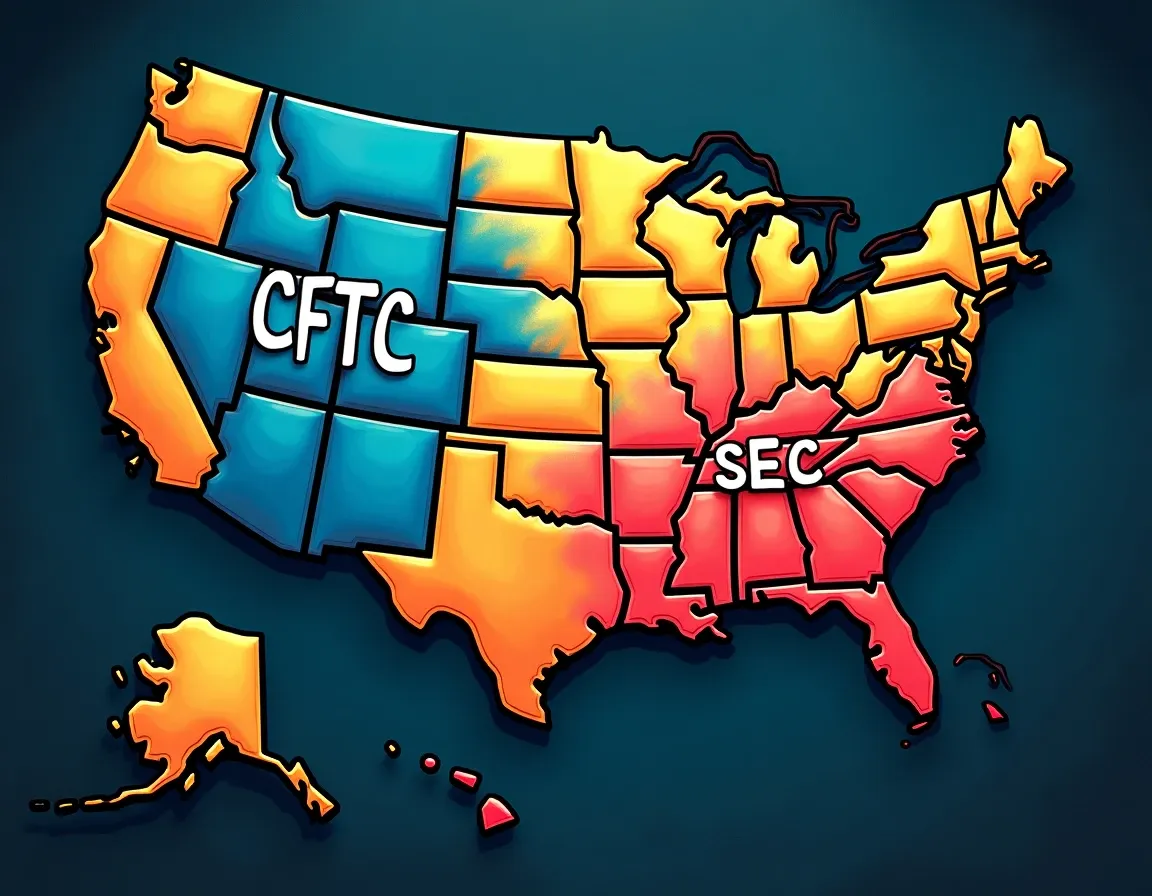
The proposed rules are silent on how the CFTC will coordinate with the SEC, which claims jurisdiction over digital assets it classifies as securities. The SEC has pursued enforcement actions against exchanges offering tokens it deems unregistered securities, most notably in its ongoing litigation against Coinbase and its 2023 settlement with Kraken over staking services. The CFTC framework does not resolve that jurisdictional overlap.
An exchange that registers with the CFTC and complies with segregated custody and cybersecurity standards is not shielded from SEC enforcement if it lists tokens the SEC considers securities or offers staking services the SEC considers investment contracts. The voluntary framework provides compliance certainty only within the CFTC’s statutory authority over commodities. It does not create a safe harbor for tokens or yield products subject to securities regulation.
The framework also does not specify how state money transmitter licenses will interact with federal registration. Some states, including New York through its BitLicense regime, impose requirements that exceed the CFTC’s proposed standards. An exchange that registers federally may still be required to hold separate state licenses, creating duplicative compliance costs. Whether federal registration preempts state licensing remains an open question that will likely require legislative resolution or court clarification.
Timeline and Implementation Path
Public comments on the proposed framework are due December 14, 2026. Following the comment period, the CFTC will review submissions, revise the proposed rules as needed, and issue a final order establishing the registration framework. The timeline for final implementation depends on the volume and substance of public comments, but the CFTC has indicated it intends to finalize the framework within the first half of 2027.
Once finalized, exchanges will have a specified period to elect federal registration or decline it. Exchanges that opt in will be subject to an initial compliance review, including audits of custody arrangements, cybersecurity protocols, and operational controls. Exchanges that pass the review will be granted federal registration and listed on a public registry maintained by the CFTC. Exchanges that decline registration will not face penalties under the CFTC framework, but they will not be able to claim federal compliance credentials in their marketing or user agreements.
Precedent and Institutional Response
The CFTC’s approach mirrors the SEC’s 2020 proposal for a special purpose broker-dealer framework for digital asset platforms, which was withdrawn following industry objections that the requirements were too restrictive. The CFTC framework is less prescriptive, allowing exchanges to demonstrate compliance through third-party audits instead of mandating specific technical implementations. That flexibility increases the likelihood that major U.S. exchanges, including Coinbase, Kraken, and Gemini, will opt into federal registration.
Institutional participation in exchange-offered yield products depends on federal registration. Asset managers, pension funds, and corporate treasuries cannot allocate to platforms operating under state licenses alone due to internal compliance policies that require federal regulatory oversight. The CFTC framework, if finalized as proposed, removes that barrier and opens federally registered exchanges to institutional yield allocations that have been restricted to custodial staking providers like Coinbase Institutional and Anchorage Digital.
The Binance breach accelerates institutional demand for compliant platforms. The $6.3 billion loss, one of the largest in digital asset history, demonstrates that offshore platforms without federal oversight present unacceptable counterparty risk for fiduciaries. That shift in institutional sentiment creates competitive pressure for exchanges to register federally, even if compliance costs reduce profitability.
The Takeaway
The CFTC’s voluntary registration framework establishes a federal compliance pathway for digital asset exchanges, driven by the Binance breach and years of regulatory development. The proposed rules impose segregated custody, cybersecurity standards, and functional separation requirements that will reshape how exchanges offer staking, lending, and structured yield products. Exchanges that register federally gain institutional credibility but face higher compliance costs and lower yields. Exchanges that remain offshore or operate under state licenses retain flexibility but accept regulatory risk. For readers designing income strategies around compliant access points, the framework clarifies which platforms will offer legally segregated custody and federal oversight. Those protections come at a cost, but they are the baseline for participation in regulated yield markets that institutional capital can access. The comment period closes December 14, 2026.
Frequently Asked Questions
Frequently Asked Questions
Does CFTC registration protect users from SEC enforcement actions?
No. The CFTC framework provides compliance certainty only within the CFTC’s statutory authority over commodities. It does not create a safe harbor for tokens or yield products the SEC classifies as securities. An exchange that registers with the CFTC can still face SEC enforcement if it lists tokens deemed unregistered securities or offers staking services the SEC considers investment contracts. The framework does not resolve jurisdictional overlap between the two agencies.
Will federally registered exchanges offer lower yields than offshore platforms?
Yes, in most cases. Compliance costs associated with segregated custody, cybersecurity audits, and functional separation reduce net yields on staking, lending, and structured products offered by federally registered exchanges. Offshore platforms and direct DeFi participation may offer higher nominal yields, but users accept counterparty risk and regulatory risk in exchange. The trade-off is legal clarity and custodial protection versus higher returns without federal oversight.
Is federal registration mandatory for U.S. exchanges?
No. The framework is voluntary. Exchanges can continue operating under state money transmitter licenses or offshore with no U.S. licensing, provided they comply with anti-money laundering requirements. However, exchanges that decline federal registration cannot claim CFTC compliance credentials and may face competitive disadvantages as institutional allocators and retail users prioritize federally registered platforms following high-profile breaches like the $6.3 billion Binance hack.
How will the framework affect staking services offered by centralized exchanges?
Staking services will likely require functional separation under the proposed rules. Exchanges that aggregate user deposits, validate on their behalf, and distribute rewards may need to demonstrate that staking operations are legally separated from order-matching and settlement functions. Some platforms may outsource staking to licensed custodians, adding custody fees and reducing net yields. Others may discontinue staking services entirely if separation requirements prove too costly.
When will the CFTC finalize the registration framework?
Public comments are due December 14, 2026. Following the comment period, the CFTC will review submissions and revise the proposed rules as needed. The agency has indicated it intends to finalize the framework within the first half of 2027. Once finalized, exchanges will have a specified period to elect federal registration and undergo initial compliance reviews, including audits of custody arrangements and cybersecurity protocols.
The Weekly Yield Report
You have just reviewed the CFTC’s proposed federal registration framework and its impact on compliant exchange yield products. Those compliance costs and segregation requirements will change as the final rules are issued in 2027.
Every Thursday: where crypto yield actually is – stablecoins, liquid staking and DeFi lending, with the risk named next to the rate and what changed since last week.
Free. No trade calls, no allocations, no hype. Unsubscribe in one
click.
Source link