


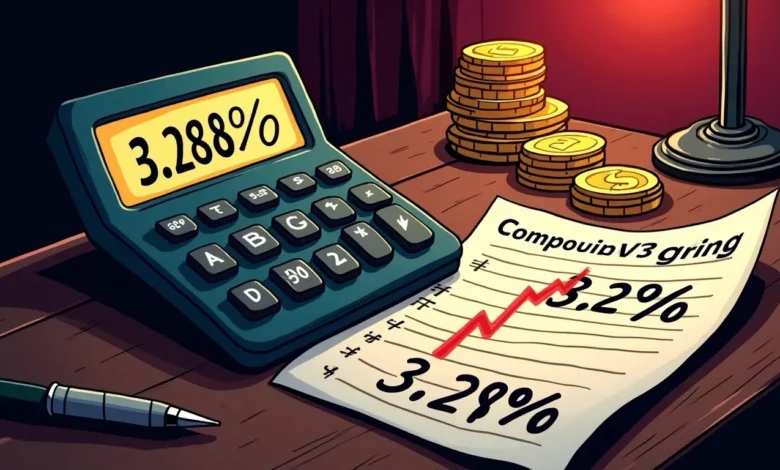
What This Migration Calculation Accomplishes
You will determine whether the drop from 6.51% to 3.23% justifies paying Ethereum gas fees to migrate your USDC to a higher-yielding protocol. The analysis covers position-specific breakeven windows, historical rate volatility to assess whether 3.23% is a temporary trough or new baseline, competitive alternatives at similar smart contract risk, and withdrawal timing to minimize rate drag.
You need an active Compound V3 USDC position, access to your wallet’s transaction history for tax lot selection, and current balance data. Gas fees on Ethereum mainnet typically range $10-30 per supply or withdraw transaction, totaling $50-60 for a full migration cycle (withdraw from Compound, deposit to alternative). The income mechanism is straightforward: a 3.28 percentage point loss on $400,000 costs $13,120 annually. Migration to a protocol paying 4.5-5% recovers $8,000-10,000 of that, net of gas.
Calculate Your Position-Specific Annual Loss

Start with your exact Compound V3 USDC balance. Multiply by 0.0651 to determine what you were earning at 6.51%. Multiply the same balance by 0.0323 to determine current earnings at 3.23%. The difference is your annualized income loss.
Example: $100,000 at 6.51% earned $6,510 annually. At 3.23%, it earns $3,230. Your annual loss is $3,280.
Scale this to your position. If you hold $400,000, the annual loss is $13,120. If you hold $50,000, the annual loss is $1,640. This number determines whether migration math closes favorably after gas costs.
Current Compound V3 TVL on Ethereum is $39 million, down from recent highs. This suggests either outflows due to the rate compression or data lag between on-chain figures and aggregator reporting. Cross-reference your position against recent Aavescan data showing 379,870,803 USDC supplied on Compound III, which indicates the protocol still manages significant capital despite rate compression.
Assess Historical Rate Volatility To Determine Baseline

Compound V3 USDC rates ranged from 3.36% on September 25 to 7.08% on September 23, 2026, demonstrating significant intra-month swings. Over the past 30 days, average APY increased by 2.94 percentage points, from 2.94% to 5.87%, reflecting rising borrowing demand relative to supply.
The current 3.23% rate aligns with mid-September trough levels. Historical baseline data shows Compound V3 typically stays in the 4.5-6% range on USDC markets. The 3.23% level is below the normal floor, which suggests this is demand-driven compression (low leverage trading activity) rather than structural protocol decay.
Critical question: is this a temporary trough worth waiting out, or a new baseline driven by competitive outflows to Aave? On October 6, 2026, Aave v3 USDC paid 4.60% on Ethereum with $128 million supplied, while Compound v3 paid 3.23%. The 1.37 percentage point differential points to competitive pressure.
If Compound returns to its historical 5% median, a $100,000 position earns $5,000 annually. Staying put gains $1,770 versus the current 3.23% rate. Compare that to the $50-60 migration cost: payback period is approximately three months if rates revert. The decision hinges on whether you believe borrowing demand will return within that window.
The protocol uses a borrow-side kink at 90% utilization. When utilization crosses this threshold, rates spike non-linearly. Recent snapshots show utilization fluctuating between 70% and 90%, which explains the volatility. If utilization rises above 90%, supplier rates will climb sharply. If it stays below 80%, rates remain compressed.
Compare Current Alternatives At Similar Smart Contract Risk
Aave v3 USDC on Ethereum paid 4.60% as of October 6, 2026, with $128 million supplied. As of October 22, 2026, dependable stablecoin sources paid approximately 3.5-5.2%, with Aave showing USDC at 4.51% on Ethereum. This is a 1.28 percentage point improvement over Compound’s 3.23%.
On a $100,000 position, Aave pays $4,510 annually versus Compound’s $3,230. The annual gain is $1,280. Migration gas cost is approximately $50-60. Breakeven window is 14-17 days. On a $400,000 position, the annual gain is $5,120, with breakeven in the same 14-17 day window.
Both Compound V3 and Aave v3 carry similar smart contract risk profiles. Compound III was audited by ChainSecurity (January 16, 2023) and OpenZeppelin (July 20, 2022). Aave has been reviewed by OpenZeppelin and ChainSecurity with publicly released audit reports. Both protocols use isolated market architectures and dynamic interest-rate curves, expanding attack surface relative to earlier versions.
Compound V3 introduces isolated collateral markets, eMode, and cross-chain liquidity aggregation. No formal audit report for V3 has been publicly released beyond the initial Compound III audits. Vulnerability analysis identified 21 issues ranging from critical (core market logic, oracle manipulation) to medium (upgrade/governance, L2 bridge). Compare this to OpenZeppelin’s comprehensive Compound III audit, which details findings and fixes for price feed validation, collateral parameters, and state management.
If you are migrating for a 1-2 percentage point gain, you are not reducing smart contract risk. You are trading one audited blue-chip protocol for another. The decision is purely economic.
Execute Withdrawal With Tax Lot Consideration
DeFi protocols do not natively support FIFO or LIFO lot selection. This is entirely a tax accounting layer issue. Withdrawals are fungible. Gas fees paid to withdraw should reduce cost basis proportionally.
If you deposited USDC in three separate transactions at different dates, your wallet holds a single fungible balance. For tax purposes, you must designate which lots you are selling based on your preferred accounting method (FIFO, LIFO, or specific identification). Most jurisdictions default to FIFO unless you elect otherwise.
To minimize tax drag on partial exits, identify the lots with the highest cost basis. If you deposited $100,000 in January 2024 and another $100,000 in March 2026, and USDC has remained at $1.00, your cost basis is identical. No tax optimization is possible. If you received COMP token rewards and converted them to USDC, those tokens have a cost basis equal to their fair market value at the time of receipt. Withdrawing those lots first may generate different tax outcomes.
Gas fees should be capitalized into cost basis. If you pay $30 in ETH to withdraw $100,000 USDC, your cost basis increases by $30. This reduces taxable gain (or increases deductible loss) when you eventually dispose of the USDC.
For positions larger than $100,000, consider partial migration in tranches to test liquidity and execution quality before committing the full balance. Compound V3 liquidity is constrained by utilization. A lending pool can return only funds that are not on loan. At 90.73% utilization, supplier rate is 5.56%, but redemption speed is limited during high-utilization periods. If utilization is currently 85% and you attempt to withdraw 10% of the pool’s total supply, your transaction may only partially fill, or you may experience slippage in the form of delayed settlement.
On Layer 2 deployments (Base, Arbitrum), gas fees are under $1, making frequent rebalancing viable. If you hold USDC on Compound V3 Base rather than Ethereum mainnet, migration cost drops to negligible levels. In that scenario, the breakeven window for even a 0.5 percentage point gain is measured in days, not weeks.
Monitor For Withdrawal Timing Risk And Known Issues
Compound DAO disclosed a known issue on October 19, 2026: zero-value transfers can reduce the recipient’s Comet principal. This is a minor accounting bug, not a critical vulnerability, but it signals the protocol is under active monitoring and may experience temporary withdrawal pauses or upgrades.
No major exploits have been reported in 2026. Protocol-level TVL increased 6.2% over the past 30 days, reaching $1.526 billion. The majority is on Ethereum Layer 1 (approximately $950 million), with the remainder on Layer 2s (approximately $439 million). This TVL growth suggests user confidence remains intact despite rate compression.
Liquidity risk is highest during periods of utilization above 90%. When borrowing demand spikes, available supply contracts, and redemption windows narrow. If you need guaranteed same-block settlement, execute withdrawals during periods of sub-80% utilization. Check current utilization on DeFiLlama’s Compound V3 dashboard before initiating large withdrawals.
For partial exits, ladder your withdrawal in 10-20% increments. Withdraw 10% on day one, assess settlement speed and gas cost, then proceed with subsequent tranches. This de-risks execution and allows you to re-evaluate if rate conditions change mid-migration.
Compare Migration Cost Against Rate Recovery Probability
The migration decision reduces to three scenarios. First: rates remain at 3.23% for the next six months. In this case, migrating to Aave at 4.51% recovers $1,280 annually on $100,000, or $5,120 annually on $400,000, net of $50-60 gas. Payback period is 14-17 days.
Second: rates revert to the historical 5% median within 90 days. In this case, staying put gains you $1,770 annually on $100,000 versus the 3.23% baseline, and you avoid $50-60 in migration gas. The opportunity cost of migrating is the forgone upside if Compound recovers before you move. If you migrate to Aave and Compound jumps back to 5.5%, you lose the differential unless you migrate again (incurring another $50-60 gas charge).
Third: rates drop further, to 2.5-3%. In this case, Aave may also compress, but historical data shows Aave maintains a 0.8-1.5 percentage point premium during low-utilization environments due to deeper liquidity and stronger borrowing demand. Migration locks in the current differential and limits further downside.
The probability-weighted decision depends on your view of Ethereum DeFi borrowing demand over the next quarter. If you expect leverage trading to remain subdued (low volatility, range-bound markets), rates stay compressed. If you expect volatility to return (macro events, altcoin rallies, leverage re-entering the system), utilization climbs and rates follow.
For context: over the past 30 days, Compound V3 average APY increased by 2.94 percentage points, from 2.94% to 5.87%. That suggests borrowing demand is variable but responsive. The current 3.23% rate may represent a local minimum rather than a structural shift.
If you hold $400,000 and the annual loss is $13,120, waiting 30 days costs you $1,093. Migration to Aave recovers approximately $427 monthly ($5,120 annual gain divided by 12). The net monthly benefit of migrating is $427. The net monthly cost of waiting is $1,093 minus whatever Compound earns in the interim. If Compound stays at 3.23%, you lose $666 monthly by waiting ($1,093 forgone Aave income minus $427 earned on Compound). Breakeven is 22 days if Compound holds at 3.23%, or 90 days if Compound reverts to 5%.
Execute The Migration Or Set A Rate Trigger
If historical volatility analysis and your borrowing demand outlook suggest 3.23% is a temporary trough, set a rate trigger rather than migrating immediately. Monitor Compound V3 USDC utilization daily. If utilization climbs above 85% and holds for three consecutive days, rates will likely follow. Wait for confirmation before committing gas to migration.
If you conclude 3.23% reflects a structural shift (competitive outflows to Aave, sustained low borrowing demand, protocol-level issues), execute migration in the following sequence. First, withdraw 10% of your Compound V3 USDC position. Assess gas cost and settlement speed. Second, deposit that 10% into Aave v3 USDC. Confirm deposit transaction and verify your updated balance. Third, repeat in 20% increments until migration is complete, pausing if gas costs spike above $40 per transaction or if Compound rates jump above 4.5% during the process.
For positions above $500,000, consider splitting between Aave and a third alternative such as Morpho or other stablecoin yield sources to reduce single-protocol concentration risk. The income gain is similar, but you diversify smart contract exposure.
If you migrate and Compound rates subsequently recover, you can reverse the migration. Gas cost is symmetric: $50-60 to exit Aave, $50-60 to re-enter Compound. Total round-trip cost is $100-120. On a $400,000 position earning 1.5 percentage points more on Compound (hypothetical recovery to 6%), you recover the round-trip gas cost in approximately six days.
The Takeaway
The 3.28 percentage point drop to 3.23% is below Compound V3’s historical baseline. On positions above $50,000, migration to Aave at 4.51% pays back gas costs in 14-17 days and recovers $8,000-10,000 annually on $400,000. If borrowing demand returns and Compound reverts to 5% within 90 days, waiting is cheaper. Set a utilization trigger at 85% and monitor daily. If utilization stays below 80% for two weeks, migrate. Rate volatility in isolated markets is the signal, not the headline APY.
Frequently Asked Questions
What is the breakeven window for migrating from Compound V3 to Aave after a 3.28 percentage point rate drop?
On a $100,000 position, migrating from Compound V3 at 3.23% to Aave at 4.51% costs $50-60 in gas and generates $1,280 in additional annual income. Breakeven occurs in 14-17 days. On larger positions ($400,000+), the breakeven window remains the same because gas costs are fixed while income gains scale linearly. The calculation assumes rates remain stable during the migration period.
Is the 3.23% rate on Compound V3 USDC a temporary trough or new baseline?
Historical data shows Compound V3 USDC rates ranged from 3.36% to 7.08% in September 2026, with a typical baseline of 4.5-6%. The current 3.23% rate is below the historical floor, suggesting demand-driven compression rather than structural decay. The protocol uses a kinked interest rate model with a 90% utilization threshold. If borrowing demand returns and pushes utilization above 85%, rates will likely climb back toward 5-6% within 30-90 days.
How do I select tax lots when withdrawing USDC from Compound V3 for migration?
DeFi protocols do not support native FIFO or LIFO lot selection. Withdrawals are fungible, and tax lot designation occurs at the accounting layer. Identify deposits by date and amount in your wallet transaction history. For U.S. taxpayers, FIFO is the default method unless you elect specific identification. To minimize tax drag, withdraw lots with the highest cost basis first. Gas fees paid to withdraw increase your cost basis proportionally, reducing taxable gain.
What is the liquidity risk when withdrawing large USDC positions from Compound V3?
A lending pool can only return funds that are not currently on loan. At 90.73% utilization, Compound V3 USDC has limited available liquidity for immediate withdrawal. During high-utilization periods (above 85%), large withdrawals may experience delayed settlement or require multiple transactions. Monitor current utilization on DeFiLlama before executing withdrawals above $100,000. Ladder withdrawals in 10-20% increments to reduce execution risk and avoid liquidity constraints.
Does migrating from Compound V3 to Aave reduce smart contract risk?
No. Both Compound V3 and Aave v3 are audited blue-chip protocols with similar risk profiles. Compound III was audited by ChainSecurity and OpenZeppelin, while Aave has undergone multiple audits by the same firms. Both use isolated market architectures and dynamic interest rate curves. Migration is an economic decision based on yield differential, not a risk-reduction strategy. If you are migrating for a 1-2 percentage point gain, you are not reducing smart contract exposure.
The Weekly Yield Report
You have just calculated migration breakeven for a 3.28 point Compound V3 drop against Aave at 4.51%. Those rates will be different next week.
Every Thursday: where crypto yield actually is – stablecoins, liquid staking and DeFi lending, with the risk named next to the rate and what changed since last week.
Free. No trade calls, no allocations, no hype. Unsubscribe in one
click.
Source link