


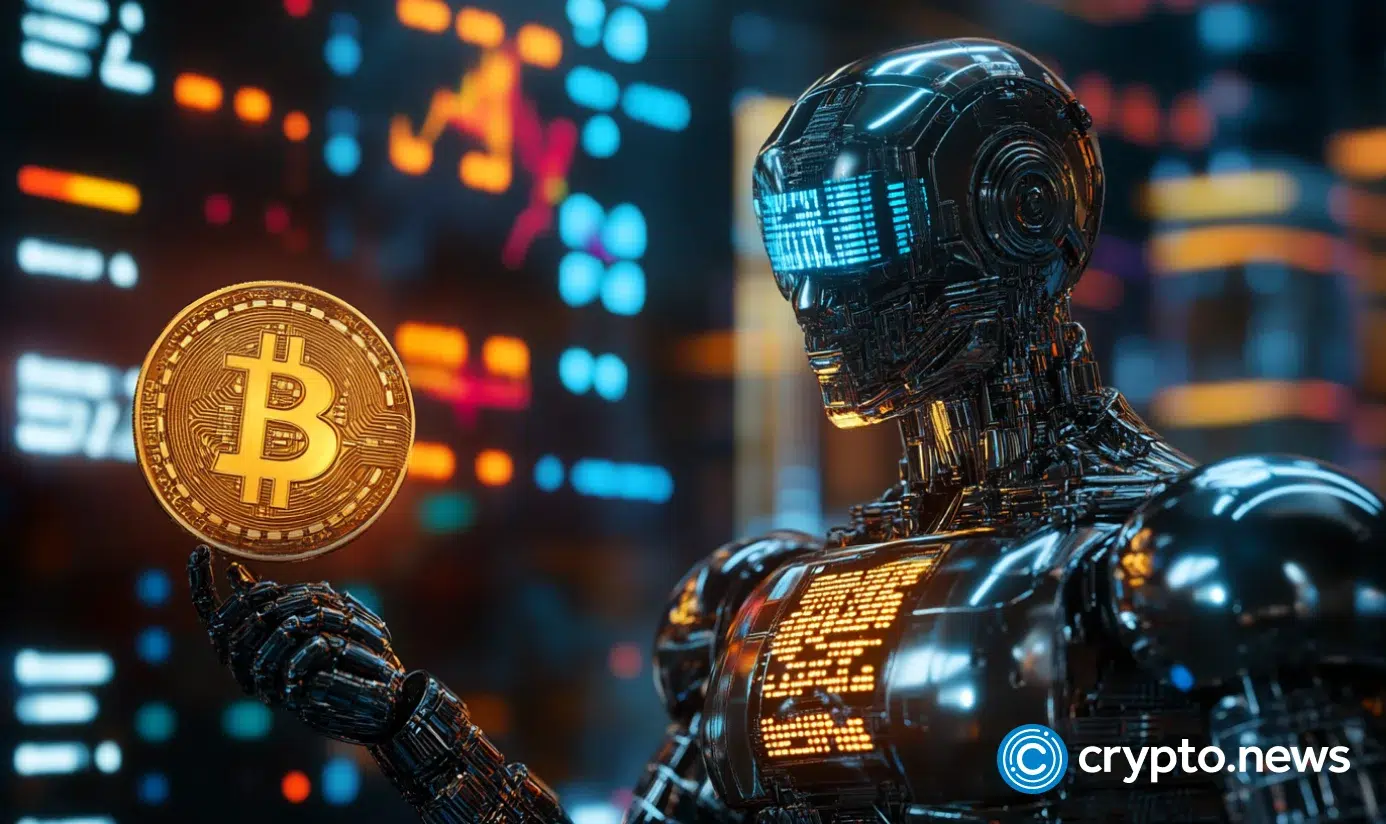
Binance founder Changpeng Zhao has drawn a line between Bitcoin’s 21 million supply cap and an AI investment cycle that JPMorgan CEO Jamie Dimon expects to attract $725 billion this year.
Summary
- CZ says AI boosts productivity, while Bitcoin’s fixed supply protects wealth from inflation.
- Jamie Dimon expects AI investment to reach $725 billion amid a powerful spending cycle.
- BlackRock executives believe debt and currency concerns could strengthen Bitcoin’s long-term case.
CZ wrote in a recent X post that artificial intelligence and Bitcoin serve separate financial and economic roles, rejecting the idea that rapid advances in AI can protect investors when fiat currencies lose purchasing power.
“AI is great, but it does not protect you against inflation. Bitcoin does.”
According to CZ, artificial intelligence can raise productivity, improve business efficiency and support technological development, while Bitcoin gives holders access to an asset whose supply cannot be expanded. His comparison places scarcity at the center of Bitcoin’s appeal rather than treating it as another fast-growing technology investment.
Capital has continued to enter AI software, chips, data centers and computing infrastructure as companies seek applications across healthcare, finance and manufacturing, CZ noted. Although those investments may produce new services and higher output, he argued that ownership in an AI company remains tied to revenue, execution and competition.
Companies developing AI products can also issue additional shares or raise fresh capital to fund expansion, according to CZ. Such financing can dilute existing shareholders, whereas Bitcoin’s protocol limits the total number of coins to 21 million, preventing any company or government from increasing its supply.
For CZ, that difference gives Bitcoin its potential as a long-term store of value when inflation weakens fiat money. His case does not rest on Bitcoin matching the productivity gains promised by AI; instead, he views the asset as protection against monetary expansion and the loss of purchasing power.
Bitcoin and AI serve different investment needs
CZ has previously acknowledged that the AI boom could temporarily pull money away from Bitcoin and other assets. As private companies such as OpenAI and Anthropic attract large funding rounds, he argued that some investors may sell existing holdings to gain exposure to AI-related opportunities.
Despite that competition for capital, CZ does not consider Bitcoin and artificial intelligence direct rivals. Under his framework, AI helps companies produce more goods and services, while Bitcoin allows investors to hold an asset that cannot be diluted through additional issuance.
The distinction also separates the risks attached to the two themes. According to CZ, an AI company’s value depends on its ability to turn technology spending into a durable business while competing against other developers. Bitcoin holders face different risks, but its programmed scarcity does not depend on one management team meeting sales targets or defending market share.
Demand for AI infrastructure remains strong, with JPMorgan CEO Jamie Dimon forecasting that related investment will reach $725 billion this year. Dimon has linked his optimism to the volume of capital entering the industry and the continuing strength of the U.S. economy.
Describing the spending cycle as difficult to stop, Dimon compared its momentum with a wave gaining force.
“We’re in a bull market. It’s like a little tsunami. When that kind of thing happens, it’s very hard to stop.”
Dimon’s view supports CZ’s assessment that AI will continue drawing large amounts of investor capital, although the two executives differ sharply on Bitcoin. The JPMorgan chief has repeatedly criticized the cryptocurrency, while CZ has built his inflation argument around its fixed issuance.
Rather than dismissing the AI trade, CZ’s comments assign it a separate purpose. He credits the technology with improving productivity, but he does not believe higher output or stronger corporate earnings can replace an asset designed to resist supply expansion.
Debt concerns strengthen Bitcoin’s scarcity case
At the same time, rising government borrowing has added weight to the monetary concerns behind CZ’s position. Dimon, despite his long-running criticism of Bitcoin, has recently warned about government debt and geopolitical risks that could affect markets over the next several years.
BlackRock executives have also connected fiscal pressure with Bitcoin’s investment case. Robert Mitchnick, BlackRock’s head of digital assets, has argued that concern over U.S. debt and persistent budget deficits could become a major source of demand for the cryptocurrency.
BlackRock CEO Larry Fink issued a similar warning in his 2025 annual letter, stating that uncontrolled U.S. debt could eventually threaten the dollar’s reserve-currency status. Fink argued that decentralized assets such as Bitcoin could benefit if investors lose confidence in national currencies and seek alternatives outside government control. BlackRock’s 2025 annual letter also placed technological change and long-term investing among the forces reshaping capital markets.
BlackRock’s fixed-income team has separately identified rising U.S. debt as a risk to demand for long-dated Treasury bonds and the dollar. The asset manager’s analysis warned that heavier issuance and reduced demand from major buyers could push borrowing costs higher, adding another fiscal concern to the case advanced by Bitcoin supporters.
Against that setting, CZ’s argument treats AI spending and Bitcoin ownership as responses to different conditions. His view assigns AI a role in generating economic growth while reserving Bitcoin for investors seeking scarcity when debt, inflation, or currency weakness threatens the value of conventional money.
Source link