



Bitcoin is pressing the upper boundary of a two-month ascending channel near $77,500, with the 4H MACD histogram turning negative at the trendline and the FOMC meeting on April 28 and 29 serving as the next major catalyst. This article examines the technical structure, key levels, and on-chain data shaping Bitcoin’s next directional move.
Summary
- Bitcoin is pressing the upper boundary of a 4H ascending channel near $77,500 as the MACD histogram turns negative at -183.29.
- The SMA ribbon remains bullishly stacked below price, but momentum is decelerating at the trendline.
- A confirmed 4H close above $80,000 targets the 200-day SMA near $85,000; rejection risks a pullback to $75,721.
Bitcoin (BTC) is trading at approximately $76,863 on April 27, up less than 1% on the session, after briefly touching $77,067 during Asian hours. The asset has climbed nearly 30% from its February lows near $59,000 inside a well-defined ascending channel, but is now pressing the upper boundary of that structure at the same time as the 4H MACD histogram turns deeply negative, setting up a directional tension that the FOMC meeting on April 28 and 29 may finally resolve.
Bitcoin ascending channel reaches a critical juncture
The 4H chart shows Bitcoin constructing a textbook ascending channel, defined by two parallel upward-sloping trendlines, since the February lows near $59,000. The pattern has delivered a sequence of higher highs and higher lows across roughly two months, with price now pressing the upper boundary near $77,500 where prior tests have stalled.
The moving average ribbon remains constructively positioned. The SMA 20 sits at $77,691, the SMA 50 at $77,204, the SMA 100 at $75,721, and the SMA 200 at $72,145, all stacked below price in a bullish order that has supported the entire recovery.
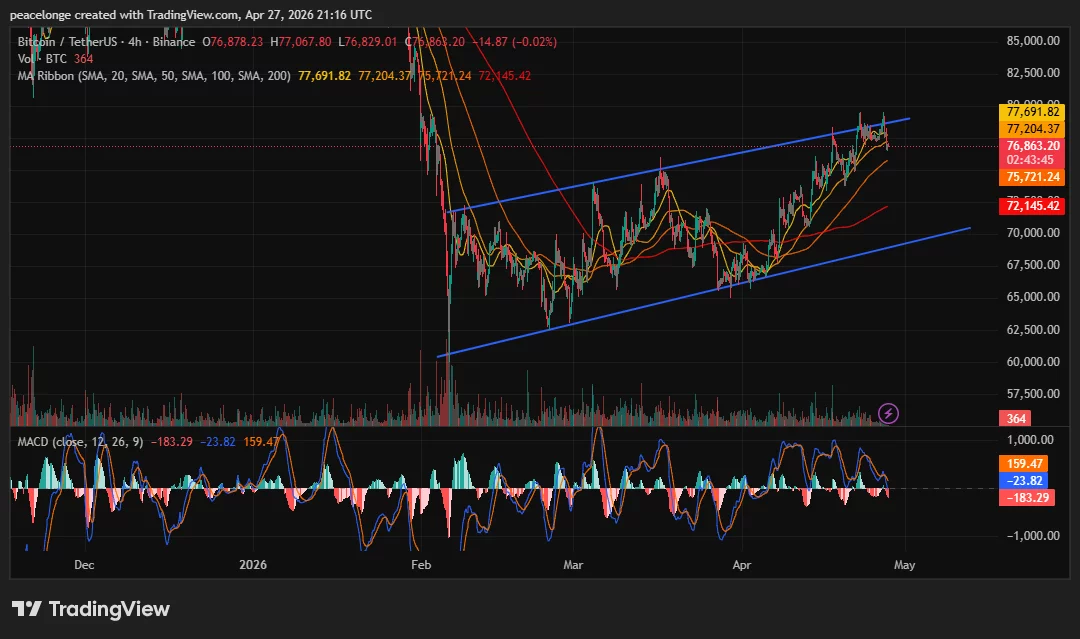
However, the MACD indicator is sending a cautionary signal. The MACD line reads at 159.47 with a signal line at -23.82, producing a histogram of -183.29. A negative histogram at the channel’s upper trendline indicates that upside momentum is decelerating rather than accelerating, a pattern that in prior channel tests has preceded consolidation or a brief pullback rather than an immediate breakout. Crypto analyst Ali Martinez said on X that “technical patterns are not fixed; they morph as price develops,” and that buyer and seller behavior at resistance ultimately decides whether a level becomes a liquidity wall.
Key levels: support, resistance, and price targets
The immediate resistance sits at the upper channel trendline between $77,500 and $78,000, which aligns with the level that capped Bitcoin during April 22’s 11-week high test. Above it, the $80,000 round number is the primary bull-case target and the level that would confirm a channel breakout. A 4H close above $80,000 with volume expansion would open the path toward the 200-day SMA near $85,000, the threshold analysts identify as separating the prevailing corrective trend from a confirmed structural reversal.
On the downside, the SMA 100 at $75,721 is the first meaningful support on a closing basis. A 4H close below that level removes mid-channel support and exposes the lower boundary of the ascending channel near $72,000 to $73,000, where the SMA 200 at $72,145 converges. A daily close below that zone invalidates the ascending channel structure entirely and shifts the near-term bias bearish.
ETF inflows and derivatives positioning
The rally into the channel’s upper boundary has been supported by a historic institutional inflow streak. According to data tracked by crypto.news, spot Bitcoin ETFs logged an eight-day inflow streak totaling $2.43 billion through April 23, with BlackRock’s IBIT absorbing $907.97 million across the week of April 13 to 17 alone. April’s total inflows are already nearly double March’s $1.32 billion haul.
Despite the strong institutional bid, Glassnode on-chain data indicates that short-term holders are using ETF demand as exit liquidity near the $78,000 to $80,100 range, levels that have repeatedly capped rallies in 2026. Bitcoin futures open interest fell over 6% in the 24 hours surrounding the most recent $78,000 test, per CoinGlass data, pointing to leverage unwinding rather than fresh long accumulation at resistance.
FOMC as the next defining catalyst
The FOMC meeting on April 28 and 29 is the primary macro event that could resolve the channel test in either direction. As crypto.news reported, CME FedWatch shows a 98% probability of a rate hold, making the tone of Chair Jerome Powell’s press conference the key variable. A dovish signal implying rate cuts in the second half of 2026 would reduce the opportunity cost of holding BTC and could provide the catalyst for a close above $80,000. A neutral or hawkish tone would likely extend the channel consolidation and increase the probability of a pullback toward mid-channel support.
If Bitcoin holds the ascending channel and clears $80,000 on volume following the FOMC outcome, the 200-day SMA near $85,000 becomes the next structural test for a confirmed trend reversal.
Source link