

What You Will Accomplish
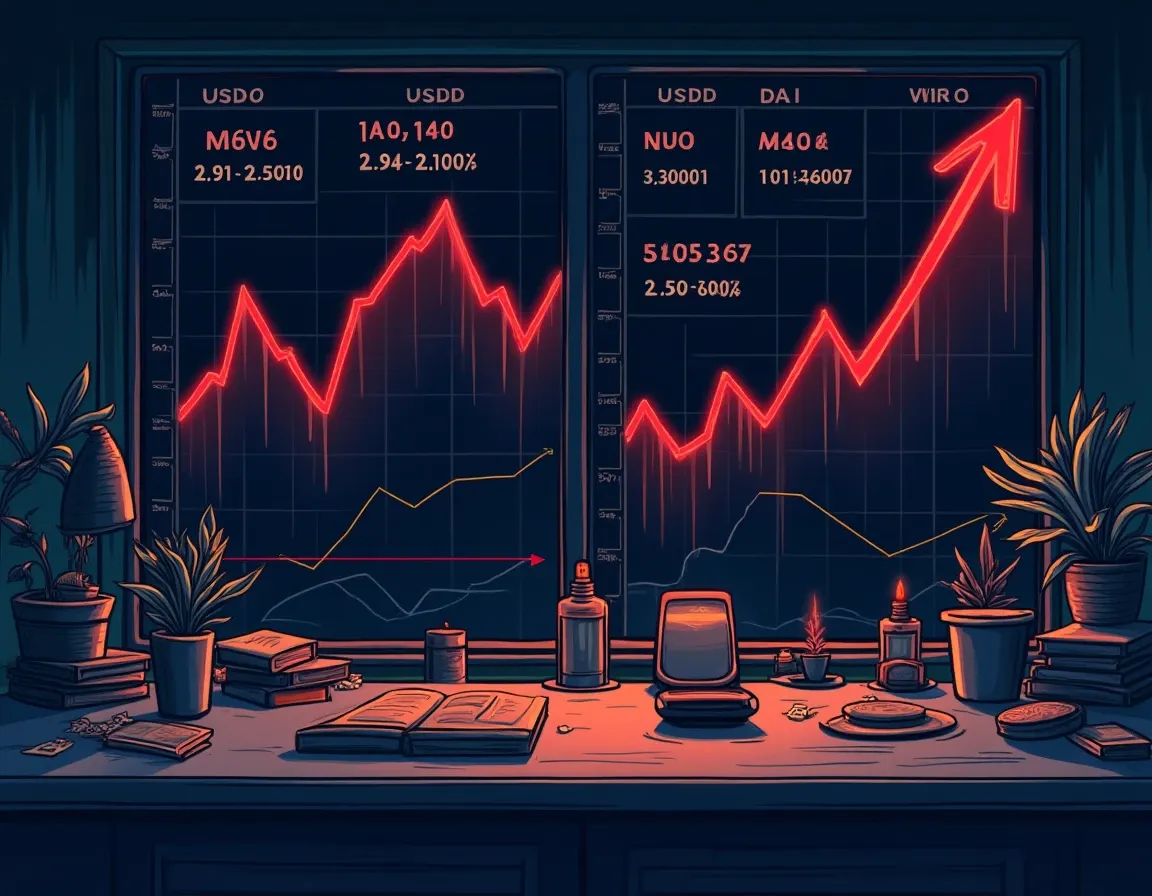
When Fluid USDC drops from 6.08% to 4.92%, Sky USDS compresses to 3.75%, and Convex stablecoin pools slide from a 4.6% median to lower ranges in the same seven-day window, you have 48 hours to diagnose whether the synchronized decline reflects macroeconomic rate policy changes or protocol-specific risk events.
This guide teaches you how to cross-reference US Treasury bill rates, isolate Fed transmission lag windows, and compare protocol-specific failure modes to determine whether to accept the new rate floor or migrate capital. On $300,000 in stablecoin holdings, distinguishing between these scenarios determines whether you are looking at a 1.5 to 4.5 percentage-point difference in annual yield, which translates to $4,500 to $13,500 annually.
Prerequisites: You hold positions in at least one DeFi stablecoin lending protocol (Fluid, Aave, Morpho, Compound) or yield-bearing stablecoin (sUSDS, sUSDe) or Curve/Convex LP token. You track your yields weekly using DeFiLlama or Stablewatch. You understand that stablecoins peg to $1.00 but the yield on them varies by protocol and macro environment.
Step 1: Confirm the Magnitude and Timing of the Decline

Open your yield tracker (DeFiLlama Yields, Stablewatch.io, or your wallet’s position dashboard). Document the current APY for each of your three positions and compare it to the seven-day average APY shown in the tracker’s historical view.
Fluid USDC on Ethereum currently shows 4.92% APY as of November 3, 2026, with a seven-day average of 6.08%. That is a 1.16 percentage-point drop. Sky sUSDS sits at 3.75% over 30 days, down from 3.6% in mid-September, but the compression trend has been steady since the governance-driven rate cut from 9% to 6.5% in September 2024. Convex stablecoin pools over $5 million TVL showed a median APY of 4.6% on September 16, 2026, with individual pools ranging from 0.01% to 14.2%.
If all three positions dropped within the same calendar week, the timing matters. Write down the date range. If the drops occurred across different weeks or over a two-month period, they are likely independent events driven by utilization changes or governance votes, not systematic macro shifts.
On $300,000 split evenly across Fluid, Sky, and Convex, a synchronized 2 percentage-point drop across all three costs you $6,000 annually. You need to know if this is temporary utilization-driven volatility or a structural rate floor reset driven by Fed policy.
Step 2: Check the Federal Funds Rate and Treasury Bill Yields

DeFi stablecoin yields track the federal funds rate and secured overnight financing rate (SOFR) with a documented three-day structural lag. The effective federal funds rate sat at 3.63% on September 11, 2026. The Federal Reserve held rates at 3.75% to 4.00% on October 28, 2026.
Go to FRED (Federal Reserve Economic Data) and pull the three-month US Treasury bill rate for the week your yields dropped. USDC rewards exhibit a 98.7 percent correlation with Treasury yields under normal market conditions. After the GENIUS Act’s enactment (which banned issuer-paid stablecoin yields), third-party USDC lending rates still maintained an 84.6 percent correlation with Treasuries as of August 2026.
If the three-month Treasury bill rate dropped by 50 basis points or more in the three-day window preceding your DeFi yield drops, you are observing Fed transmission. The T+3 lag exists because DeFi protocols reprice lending supply as borrowers repay or refinance positions, which takes settlement time even on-chain.
If the Treasury bill rate was flat or rose during the week your DeFi yields dropped, the decline is not macro policy transmission. You are looking at protocol-specific utilization changes, governance rate adjustments, or risk events.
Edge case: DeFi interest rates sometimes move opposite to Fed policy changes. Over 2021 to 2026, DeFi rates exhibited an average 100 basis-point spread relative to the federal funds rate, and around monetary policy rate hikes, borrowing demand sometimes increased (traders leveraging for expected volatility), temporarily raising protocol yields even as the Fed tightened. Check borrowing demand by reviewing protocol utilization rates, not just the Fed announcement.
Action: Cross-Reference Protocol Utilization
Fluid USDC uses a kinked rate model with a first kink at 85% utilization (5.40% rate) and a second kink at 93% utilization (7.50% rate). If Fluid’s utilization dropped from 90% to 80% in the same week yields fell, borrowing demand declined and the protocol rate curve repriced downward. That is utilization-driven, not Fed-driven.
Sky sUSDS yield comes from the Sky Savings Rate, which is governance-set and funded by Sky Protocol revenue (collateralized loans, US Treasury bill exposure, and lending markets). If sUSDS yield dropped and Sky governance published a blog post or governance proposal announcing a DSR reduction in the same week, the drop is governance policy, not market-driven or Fed-driven.
Convex stablecoin yields are incentive-dependent: they combine Curve trading fees with CRV and CVX token emissions. If Convex APY collapsed but Curve base fee APY remained stable, check CRV and CVX token prices on CoinGecko. A 30% token price drop reduces the dollar value of emitted rewards even if the emission rate in tokens stayed constant. That is token price volatility, not Fed policy or protocol insolvency.
Step 3: Isolate Protocol-Specific Failure Modes
Each protocol has distinct failure modes. When yields drop simultaneously, you need to rule out or confirm protocol-specific risk before deciding whether to stay or migrate.
Fluid: Utilization Volatility and Smart Contract Risk
Fluid launched as a top USDC lending venue in mid-September 2026 with $154 million USDC at 5.19% on Ethereum. By November 3, TVL had declined slightly to $138 million and yield dropped to 4.92%. The seven-day average of 6.08% suggests intra-week volatility.
Fluid is managed by the Instadapp team and entered the top lending set recently, meaning it has less battle-tested history than Aave or Compound. If Fluid yield dropped but Aave V3 USDC and Compound V3 USDC yields remained stable or rose, Fluid is experiencing isolated utilization decline or perceived smart contract risk premium repricing.
Check Ethereum gas prices and staking yields during the drop week. If gas spiked or staking APR rose, capital may have rotated out of lending protocols into liquid staking derivatives, reducing Fluid’s supply and utilization simultaneously.
Sky sUSDS: Governance Rate-Setting and USDC Contagion Risk
Sky sUSDS yield is set by governance, not market supply and demand. The DSR was deliberately cut from 9% to 6.5% in September 2024 to grow USDS supply rather than maximize holder yield. The current 3.75% rate is a governance policy choice funded by Sky Protocol revenue.
If sUSDS yield drops in a week without a governance vote or blog post, check USDC’s price and depeg risk. Sky’s PSM (peg stability module) holds significant USDC reserves and prices USDS to USDC at $1.00. If USDC depegged (as it briefly did in March 2023 during the Silicon Valley Bank event), USDS would move with it, and capital would flee both USDC and USDS-denominated positions.
Sky’s collateral base showed $16.62 billion in collateral against 10.14 billion USDS on October 9, a cushion above 160%. However, S&P rates Sky Protocol B-, citing depositor concentration, governance risk, and liquidity risk. If USDS yield dropped and Sky’s collateral ratio declined or a large withdrawal queue formed, that signals depositor flight risk, not Fed policy transmission.
Convex: Token Price Volatility and Incentive Dependency
Convex is a yield aggregator built on Curve. It pools user CRV deposits to maintain a perpetual veCRV lock, then passes boosted APY back to LPs who deposit Curve LP tokens with Convex. The APY splits into two components: base Curve trading fees and CRV + CVX token emissions.
On August 24, 2026, Curve crvUSD/USDC on Convex showed 7.60% APY: 0.48% from trading fees and 7.12% from CRV emissions. If total Convex APY dropped but Curve base fee APY remained at 0.48%, the decline is token-price-driven.
Go to CoinGecko and pull CRV and CVX prices for the week yields dropped. If CRV dropped 20% and CVX dropped 25%, your emission-based yield component declined proportionally even though the protocol emitted the same number of tokens. That is not a protocol failure or Fed transmission. It is crypto market beta affecting reward token valuations.
If Curve base fees also dropped (visible in Curve’s pool analytics page for each individual pool), liquidity or trading volume declined in that specific pool. That is a pool-specific event, not a Convex platform-wide or macro policy event.
Step 4: Compare Alternative Stablecoin Venues
Open DeFiLlama Yields and filter for USDC, USDT, DAI, and USDS lending pools with TVL above $50 million. Sort by APY descending. If Aave V3 USDC rose to 5.8%, Morpho USDC stayed at 5.6%, and Compound V3 USDC held at 5.35% during the same week Fluid, Sky, and Convex dropped, the rate environment did not collapse across the board. Your three positions experienced isolated declines.
If every major stablecoin lending protocol dropped by 1 to 2 percentage points in the same week and US Treasury bill rates also dropped by 50 basis points in the T+3 window, you are observing systematic Fed transmission. The entire DeFi stablecoin rate floor reset lower because the risk-free rate anchor dropped.
Third-party USDC rates in August 2026 ranged from 3.3% to 5.7%. If your current Fluid rate of 4.92% sits in the middle of that range and Aave V3 USDC offers 5.8%, migration is economically justified if gas costs and position lock-up time are favorable. Calculate migration breakeven by dividing your gas cost plus opportunity cost of downtime (3 to 5 days at zero yield) by the annual yield gain.
On $300,000, a 0.88 percentage-point gain (from Fluid’s 4.92% to Aave’s 5.8%) is worth $2,640 annually. If migration costs $150 in gas and $350 in foregone yield during a three-day position transfer, breakeven is 190 days. If you plan to hold for longer than six months, migrate. If you plan to exit within three months, stay.
Step 5: Set Up Monitoring for the Next Macro or Protocol Event
Once you have determined whether the yield drop was macro or protocol-specific, set up forward-looking monitoring so you catch the next event before it costs you yield.
For Fed transmission monitoring: Subscribe to FRED email alerts for the three-month Treasury bill rate and the effective federal funds rate. Set a threshold alert for changes greater than 25 basis points. When Treasury yields move, you have a three-day window before DeFi protocols fully reprice.
For Fluid utilization monitoring: Bookmark Fluid’s analytics dashboard (visible on DeBank or the Fluid app). Check utilization weekly. If utilization drops below 80%, expect yield to compress toward the lower end of the rate curve. If utilization rises above 90%, expect yield to spike toward the upper kink at 7.50%.
For Sky governance monitoring: Follow Sky’s governance forum and blog. DSR changes are announced in governance proposals before they execute on-chain. If a proposal to cut the DSR by 1 percentage point or more reaches voting, you have a one-week window to migrate before the rate change takes effect.
For Convex token monitoring: Set price alerts on CoinGecko for CRV and CVX tokens at 15% decline thresholds. When either token drops 15%, revisit your Convex positions and recalculate APY using the new token price. If your effective APY after token price decline is below alternative venues, migrate.
Common Failure Modes and Real Examples
Mistaking Token Price Decline for Protocol Failure
In early 2022, CRV dropped 40% in a two-week period during broader crypto market sell-off. Convex APYs displayed on aggregators dropped proportionally because the dollar value of emitted CRV rewards declined. Many LPs withdrew, assuming Convex or Curve was failing. Curve’s base fee APY remained stable at 0.3% to 0.8%, and CRV emission rates did not change. The protocol was functioning normally. The LPs who stayed earned identical CRV token quantities and captured the rebound when CRV price recovered.
If you withdraw during token price volatility and miss the recovery, you lock in losses. If you stay and the token continues declining, you accept lower yield until you migrate. The correct decision depends on whether you believe the token will recover (correlated to broader crypto market beta) or structurally decline (correlated to protocol-specific weakness like governance attacks or liquidity migration to competitors).
Ignoring Governance Signals in Favor of Price Action
Sky publicly announced its DSR cut from 9% to 6.5% in September 2024. The governance proposal was visible for two weeks before execution. LPs who monitored governance forums had time to migrate to Aave or Morpho before the rate cut took effect. LPs who only tracked price or APY dashboards woke up to a 2.5 percentage-point yield loss overnight.
If you hold governance-set rate products like sUSDS, monitoring governance is not optional. It is the earliest signal.
Confusing Data Gaps with Protocol Failure
In mid-2026, three major Uniswap V3 pairs disappeared from DeFiLlama tracking because liquidity fell below the aggregator’s inclusion threshold. The pools were still live on-chain, earning fees. LPs who relied solely on aggregator dashboards assumed the pools had failed or been exploited and withdrew. LPs who checked the Uniswap V3 interface directly saw that the pools were functioning normally with reduced TVL but stable fee APY.
If a position disappears from tracking, verify on-chain before reacting. Tracker removal does not equal protocol insolvency.
What to Do Next
If your diagnosis showed Fed transmission (Treasury bill rates dropped, DeFi yields followed three days later, and all major protocols dropped proportionally), accept the new rate floor. The entire risk-free rate anchor reset lower. Migration gains you nothing because alternative venues repriced similarly.
If your diagnosis showed protocol-specific risk (Fluid utilization dropped, Sky governance cut the DSR, or Convex token prices collapsed), calculate migration breakeven for the highest-yielding alternative venue. Review current top stablecoin yields and gas costs, then migrate if breakeven is under six months.
If your diagnosis showed mixed signals (one protocol dropped due to utilization, another due to governance, and a third followed Fed transmission), treat each position independently. Migrate the isolated-risk positions and hold the macro-driven position.
On $300,000 split across three protocols, a 2 percentage-point yield difference between staying and optimally migrating costs $6,000 annually. Systematic diagnosis every time yields move synchronized protects that spread.
The Takeaway
You now have the cross-referencing framework to distinguish Fed rate transmission from protocol-specific yield drops across Fluid, Sky, and Convex positions. The three-day lag between Treasury bill rate changes and DeFi repricing is your macro confirmation window. Utilization curves, governance votes, and token price movements are your protocol-specific risk signals. Track both, decide independently for each position, and recalculate migration breakeven quarterly as rates and gas costs shift.
Frequently Asked Questions
How long does it take for Fed rate changes to affect DeFi stablecoin yields?
DeFi stablecoin yields reprice within three days (T+3 lag) after Federal Reserve rate policy changes or US Treasury bill rate movements. The delay exists because DeFi lending protocols adjust rates as borrowers repay or refinance positions, which requires on-chain settlement time. USDC lending rates maintain an 84.6% to 98.7% correlation with Treasury yields, depending on whether issuer-paid or third-party yields are measured. Monitor Treasury bill rate changes; if they drop 50 basis points or more, expect your DeFi lending yields to follow within 72 hours.
Why did Convex yield drop when Curve base fees stayed the same?
Convex APY splits into two components: Curve trading fees (base APY) and CRV plus CVX token emissions (incentive APY). If Curve base fees remained at 0.48% but total Convex APY dropped from 7.6% to 4%, the decline reflects CRV or CVX token price drops, not protocol failure. Emission rates in tokens stayed constant, but the dollar value of emitted rewards declined proportionally to token price. Check CRV and CVX prices on CoinGecko during the yield drop week. A 30% token price decline reduces incentive yield by 30% even though the protocol functions normally.
How do I know if Sky sUSDS yield dropped due to governance or market conditions?
Sky sUSDS yield is governance-set via the Sky Savings Rate (DSR), not market-driven. If sUSDS APY drops, check Sky’s governance forum and blog for DSR adjustment proposals or announcements. The September 2024 cut from 9% to 6.5% was publicly proposed two weeks before execution. If no governance vote or announcement occurred during the yield drop week, check USDC depeg risk, since Sky’s PSM prices USDS to USDC at parity. USDC contagion (like the March 2023 SVB event) would trigger sUSDS withdrawals and yield compression without a governance vote.
When is it worth migrating stablecoins after a 2 percentage-point yield drop?
Calculate migration breakeven by dividing total migration costs (gas fees plus foregone yield during the three to five-day transfer window) by the annual yield gain. On $300,000 USDC, a 2 percentage-point gain is $6,000 annually. If migration costs $150 in gas and $350 in opportunity cost (three days at zero yield), total cost is $500, and breakeven is 30 days. If you plan to hold longer than one month, migrate. If you exit within three weeks, stay. Recalculate whenever gas costs or yield spreads change.
What should I monitor to catch the next stablecoin yield drop early?
Set up three monitoring streams: FRED email alerts for three-month Treasury bill rates (threshold 25 basis points), protocol-specific utilization dashboards (Fluid’s rate curve kinks at 85% and 93% utilization), and governance forums for DSR or rate policy proposals (Sky governance blog, Aave governance snapshot). Token price alerts on CoinGecko for CRV and CVX at 15% decline thresholds catch Convex incentive yield compression before it shows in aggregator APY displays. Treasury rate changes give you a three-day lead before DeFi protocols fully reprice.
The Weekly Yield Report
You just cross-referenced Fed policy, protocol utilization curves, and token price movements to diagnose synchronized yield drops across three venues. Those correlations and thresholds will shift again next quarter.
Every Thursday: where crypto yield actually is – stablecoins, liquid staking and DeFi lending, with the risk named next to the rate and what changed since last week.
Free. No trade calls, no allocations, no hype. Unsubscribe in one
click.
Source link