



What Simultaneous Pool Disappearance Signals

Fluid Lending USDT and ETH both disappeared from yield tracking aggregators within 72 hours of each other. On $250,000 deployed across both pools, the question is simple: protocol-wide smart contract failure requiring immediate exit, or ordinary rate decay crossing a tracking threshold.
The difference matters. Exit on false alarm and you burn $150-$300 in gas plus three to five days at zero yield while capital moves. Remain deployed during a protocol-level event and you risk total loss. This is pattern recognition, not guesswork.
Simultaneous disappearance of two pools from the same protocol occurs every few months across the DeFi ecosystem. It reflects one of three conditions: tracking infrastructure failure, rate normalization below aggregator thresholds, or shared liquidity layer stress that affects all pools at once.
The income mechanism: on capital deployed across multiple same-protocol pools, a verified pattern of simultaneous disappearance establishes whether you face normal rate decay (no action required) or correlated protocol risk (requiring immediate position review and potential exit). The savings from correct classification range from avoided gas waste to avoided capital loss.
You will learn to verify on-chain TVL independently, cross-reference utilization rates, identify shared architecture risk, and apply a withdrawal trigger checklist that separates signal from noise within 12-48 hours.
Prerequisites
You need active positions in at least one DeFi lending protocol. You should understand the difference between TVL and available liquidity. You must have access to an Ethereum block explorer and know how to read basic smart contract data.
If you do not yet have DeFi exposure, review category-organized DeFi protocols to understand the landscape before deploying capital.
Step 1: Verify On-Chain TVL Within Two Hours

Aggregators delist pools when TVL falls below internal thresholds or when adapter code breaks. The first question is whether capital still resides in the pool or has exited en masse.
Go to DeFiLlama and navigate to Fluid Lending. Check total protocol TVL. As of the latest tracking, Fluid holds $714.19 million in TVL, down 5.2% over 30 days. That is normal variance, not a bank run.
Now verify the specific pools. Top pools include USDT on Ethereum with $119.67 million TVL at 6.28% APY, and ETH on Ethereum with $55.84 million TVL at 1.66% APY. If those numbers still appear on DeFiLlama but not on your preferred aggregator, the issue is tracker-specific, not protocol-wide.
If DeFiLlama also shows zero TVL, cross-reference the Fluid contracts repository for the pool’s contract address. Query the contract directly via Etherscan. Check the balance of the underlying asset. If TVL registers on-chain but not on aggregators, you have a tracking bug. If TVL is zero on-chain, capital has left.
DeFiLlama does not double-count within the same protocol. If users deposit a token, receive a receipt token, and deposit that in another part of the protocol, it is counted once. Pool disappearance can reflect zero TVL in that specific pool, adapter issues, or protocol delisting due to low utilization.
What To Look For
A single-day TVL drop exceeding 20% is anomalous. Fluid has experienced two large single-day drawdowns in fourteen months, both driven by external collateral asset events: $21 million in bad debt from Resolv collateral exposure in March 2025, and a $215,000 loss from compromised reward distribution keys in May 2026.
Those were not bugs in Fluid’s core contracts. They were counterparty and operational failures. The distinction matters because it defines your risk exposure. If the drop clusters around collateral crises rather than code exploits, the protocol’s smart contract security remains intact but its collateral screening does not.
If TVL across both USDT and ETH pools dropped simultaneously by more than 15%, check whether the drawdown was driven by a single large depositor exit or distributed withdrawals. Etherscan transaction logs will show this. One whale exiting is a liquidity event. Fifty small depositors exiting in parallel is a confidence event.
Step 2: Cross-Reference Utilization Rate And Liquidity
A lender can withdraw only the funds a pool is not currently lending out. During the April 2026 Aave run, several large stablecoin pools hit 100% utilization, and billions of dollars could not be withdrawn for a time.
Check the utilization rate for both Fluid USDT and Fluid ETH. Utilization is borrowed capital divided by supplied capital. If USDT shows $119.67 million TVL and $95 million borrowed, utilization sits at 79%. That leaves $24.67 million available for withdrawal.
If utilization exceeds 90%, liquidity risk is material. If both pools simultaneously show elevated utilization, that signals borrow demand exceeding supply, which can reflect either organic growth or distressed borrowing ahead of a known event.
Fluid combines lending and DEX functions in a single liquidity layer. Depositor capital simultaneously earns lending interest and DEX swap fees. That architecture introduces shared risk. A bug or collateral freeze in the DEX component drains lending pools at the same time. The liquidity layer serves lending, vaults, DEX, and stETH, meaning a single failure mode cascades across all products.
This is Fluid-specific. Standalone lending protocols such as Compound or Aave do not share liquidity across product lines. Integrated architectures increase attack surface and introduce correlated risk.
How To Check Utilization
DeFiLlama displays utilization for most tracked pools. If the data is not available, query the pool contract directly. The relevant function is typically totalBorrows divided by totalSupply. Multiply by 100 for percentage.
If utilization for both USDT and ETH pools spiked in the same 24-hour window, check whether borrow rates also increased. Rising borrow rates reflect organic demand. Flat or falling borrow rates with rising utilization suggest a supply-side exit, which is a warning signal.
Step 3: Identify Protocol-Wide Versus Pool-Specific Risk
Simultaneous disappearance can reflect either two independent rate decays or a single shared cause. The distinction determines your response.
Check whether Fluid pools on other chains also disappeared. Fluid operates 72 pools across five blockchains, including Arbitrum, Base, and Ethereum. Ethereum holds $500.02 million, Arbitrum holds $141.82 million, Plasma holds $42.94 million, and Base holds $25 million. If only Ethereum USDT and ETH dropped while Arbitrum pools remained stable, the issue is Ethereum-specific, not protocol-wide.
If pools across multiple chains disappeared simultaneously, the cause is either a governance action (such as incentive withdrawal) or a protocol-level freeze. Fluid has executed protocol-level pauses in March, April, and June 2026 in response to external collateral failures.
Next, check whether other lending protocols experienced simultaneous pool delistings. If Compound, Aave, and Morpho all saw USDT pools drop from tracking in the same week, the issue is market-wide, not Fluid-specific. That pattern reflects either a Tether-related event or a cross-protocol change in how aggregators classify stablecoin pools.
Comparative delisting analysis is fast. Open DeFiLlama, filter by lending protocols, and scan the top ten. If three or more show recent pool removals in the same asset class, you are observing a category-wide shift, not isolated protocol risk.
For additional context on interpreting cross-protocol pool disappearances, review the protocol risk framework for multi-pool tracking failures.
Shared Architecture As Correlated Risk
Fluid’s integrated design is capital-efficient but architecturally concentrated. The liquidity layer that supports lending also supports the DEX, vaults, and liquid staking products. That means a single oracle failure, collateral freeze, or governance exploit affects all pools at once.
Attackers target the gap between reported price and realizable liquidity. If an attacker can temporarily drive a token’s quoted price high enough for the protocol to value holdings at inflated amounts, a 60% borrowing limit creates millions in borrowing capacity against phantom collateral.
For USDT and ETH, stablecoin depeg or collateral asset freeze triggers cascading liquidations affecting all pools. Fluid takes vaults to the next level by enabling up to 95% loan-to-value on collateral. That efficiency comes with liquidation sensitivity. A 5% price move can trigger liquidation, and liquidation in one pool drains shared liquidity available to all others.
If you identify shared architecture risk, your withdrawal trigger threshold drops. On a standalone lending protocol, you might tolerate a 10% single-day TVL drop. On a shared liquidity protocol, the threshold is closer to 5%.
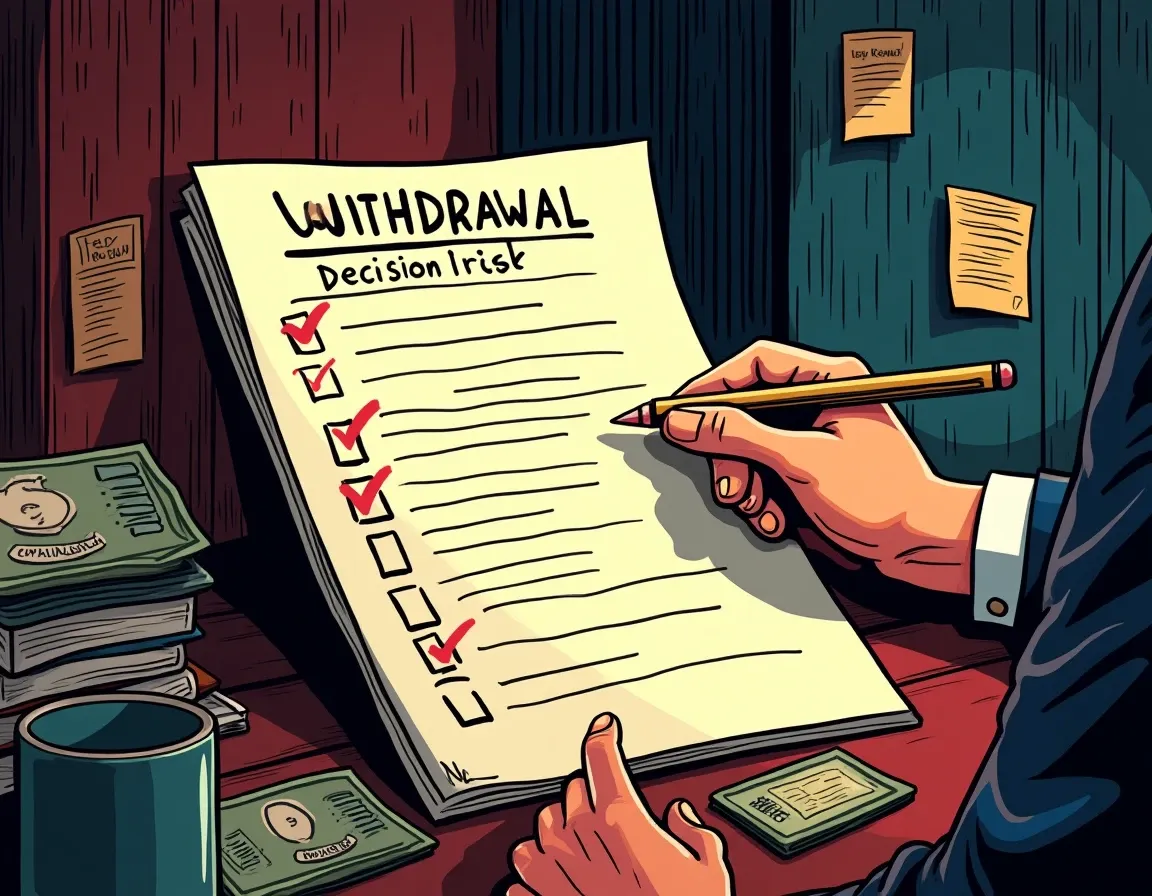
Step 4: Apply The Withdrawal Trigger Checklist
You now have verified TVL, utilization, and architecture risk. The next step is applying a structured decision framework.
The checklist has six components. Each is binary. Three or more yes answers trigger position review. Four or more trigger withdrawal unless you have specific protocol-level information contradicting the signal.
On-Chain TVL Verification
Did on-chain TVL drop more than 15% in 24 hours across both pools? Yes or no. If yes, mark it.
Utilization Rate
Did utilization exceed 90% in either pool, or did it increase more than 20 percentage points in 48 hours? Yes or no. High utilization restricts exit liquidity. If marked yes, withdrawal may require waiting for utilization to normalize.
Oracle Health
Check whether Fluid’s price oracles are operating normally. Fluid uses Chainlink for most price feeds. Go to Chainlink’s data feeds page and verify the USDT/USD and ETH/USD feeds show recent updates within the expected heartbeat interval (typically 1-3 hours for stablecoins, 1 hour for ETH).
If the oracle has not updated in 6+ hours, or if the protocol activated a fallback oracle, mark yes. Oracle failure is a precursor to liquidation cascades.
Collateral Concentration
Does Fluid hold more than 15% of its TVL in a single collateral asset class, such as liquid staking tokens or algorithmically pegged stablecoins? Check the protocol’s collateral breakdown on DeFiLlama. If wstETH, sUSDai, or other LST exposure exceeds 15%, mark yes.
Concentration risk is contagion risk. When Kelp’s rsETH froze in April 2026, Fluid experienced a sharp TVL drop because rsETH was a significant collateral component. The freeze prevented liquidations, locking bad debt into the system and reducing available liquidity for all depositors.
Recent Governance Pauses
Did Fluid governance execute a protocol-level pause, collateral freeze, or emergency withdrawal restriction in the past 30 days? Check the Fluid governance forum and the protocol’s official Twitter account. If yes, mark it.
Governance pauses are not inherently negative. They reflect responsive risk management. But repeated pauses within a short window indicate the protocol is operating at the edge of its risk tolerance. Three pauses in 90 days is a yellow flag. Four is red.
Comparative Liquidity
Did pools disappear across other lending protocols simultaneously? If yes, mark it. This is the least concerning signal because it suggests market-wide event rather than Fluid-specific failure. But it still merits attention because market-wide events propagate through interconnected protocols.
As protocols become more interconnected using each other’s assets as collateral, the risk of contagion increases. If one small protocol fails, it can trigger liquidations in larger ones. That is what happened during the Terra Luna collapse in May 2022. The failure cascaded through Anchor, then Curve, then Aave.
Scoring The Checklist
Zero or one yes: normal variance, no action required. Continue monitoring.
Two yes: heightened vigilance, check daily.
Three yes: review position size, consider partial exit.
Four or more yes: exit unless you have protocol-specific intelligence contradicting the signal.
On $250,000 deployed, a false positive costs $150-$300 in gas plus foregone yield during migration. A missed exit during a protocol failure costs the full position. The asymmetry favors caution.
For comparison on how simultaneous rate increases signal different dynamics, review the Sky Lending dual-pool rate jump analysis.
Step 5: Execute Withdrawal Or Confirm Continued Deployment
If your checklist score is three or higher, execute withdrawal in tranches. Do not attempt to exit the full position in a single transaction if utilization is above 80%. You will either fail due to insufficient liquidity or move the rate enough to signal distress to other depositors.
Withdraw 25% of your position first. Wait 6-12 hours. Monitor whether your withdrawal triggered additional exits. If TVL remains stable, withdraw another 25%. Repeat until fully exited or until the triggering condition resolves.
If your checklist score is two or lower, confirm continued deployment but increase monitoring cadence. Check TVL, utilization, and oracle status daily instead of weekly. Set an alert for any governance proposals affecting collateral policy or withdrawal restrictions.
Where To Migrate
If you exit Fluid USDT, the closest comparable is Compound V3 USDC or Aave V3 USDT. Both offer lower APY but materially lower protocol risk due to longer operational history and audited simplicity.
Fluid’s average yield of 2.73% is below the lending category average of 6.74%. The protocol compensates for lower base yield with higher capital efficiency (up to 95% LTV). If you exit, you trade efficiency for safety.
For sizing decisions when migrating to alternative protocols, review the Fluid USDC allocation framework for maturity-adjusted risk scoring.
Common Failure Modes
The most frequent error is conflating tracker issues with protocol risk. Aggregators delist pools for reasons unrelated to safety: API changes, low TVL below minimum thresholds, or temporary adapter bugs.
The second error is overreacting to single-pool disappearance. One pool vanishing is often rate-driven. Two pools vanishing from the same protocol in the same 72-hour window has different statistical characteristics and merits investigation.
The third error is ignoring utilization when planning exit. If you hold $100,000 in a pool with 95% utilization and $200 million TVL, only $10 million is available for all depositors. Your withdrawal represents 1% of available liquidity. If three other large holders attempt simultaneous exit, the pool hits 100% utilization and locks everyone in until borrowers repay.
When Disappearance Is Normal
Incentive reward programs can bootstrap a new market, but they also create temporary liquidity that disappears when incentives are reduced. If Fluid USDT and ETH both carried platform-issued governance token rewards and those rewards ended in the same week, simultaneous rate decay and tracker delisting is expected, not alarming.
Check whether the pools offered additional yield from governance tokens. If yes, and if that yield has now ended, the base lending rate likely dropped below the aggregator’s minimum display threshold (often 1-2% APY). That is rate normalization, not protocol failure.
For parallel analysis of how to interpret rate drops in isolation, review the Fluid USDC rate collapse framework.
What To Do Next
Set a recurring calendar check every Monday at 9 a.m. to review TVL, utilization, and recent governance activity for any protocol holding more than 10% of your DeFi allocation. The review takes five minutes. It prevents the scenario where a pool disappears on Tuesday and you do not notice until the following Monday when the position is already impaired.
Build a spreadsheet tracking your top five protocols with columns for TVL, 7-day TVL change, utilization, APY, and last audit date. Update it weekly. If any protocol shows two consecutive weeks of TVL decline exceeding 10%, move it to daily monitoring.
For protocols with shared liquidity architecture like Fluid, subscribe to the governance forum and enable notifications for emergency proposals. You will receive advance warning of pauses, collateral freezes, or withdrawal restrictions before they execute on-chain.
Diversify across protocols with different architecture. Do not hold more than 25% of your DeFi allocation in integrated liquidity layer protocols. Balance Fluid exposure with standalone lending protocols such as Compound or Aave, which do not share liquidity across product lines.
Finally, stress-test your exit assumptions. If you hold $250,000 across Fluid USDT and Fluid ETH, calculate how long full withdrawal would take at current utilization. If utilization is 85%, you have access to 15% of TVL. On $119.67 million USDT TVL, that is $17.95 million available. Your $125,000 USDT position represents 0.7% of available liquidity. You can exit in one transaction under normal conditions. But if utilization spikes to 95%, available liquidity drops to $5.98 million, and your position becomes 2% of available liquidity. Now you must exit in tranches or wait for utilization to normalize.
Knowing your exit constraints before you need them is the difference between orderly withdrawal and forced hold during distress.
The Takeaway
Simultaneous disappearance of two pools from the same protocol occurs when shared architecture risk, rate decay below tracking thresholds, or collateral concentration stress affects multiple products at once. On Fluid, the integrated liquidity layer that serves lending, DEX, and vaults introduces correlated risk absent in standalone protocols. A checklist score of three or higher triggers position review; four or higher triggers exit unless contradicted by protocol-specific intelligence. The pattern repeats across DeFi every few months, and recognizing it within 12-48 hours determines whether you avoid panic or avoid loss.
Frequently Asked Questions
What causes two pools from the same protocol to disappear from tracking simultaneously?
Three primary causes: tracking infrastructure failure where aggregator adapters break, rate normalization where both pools drop below the aggregator’s minimum display threshold (often 1-2% APY), or shared liquidity layer stress affecting all protocol products at once. Fluid’s integrated architecture serving lending, DEX, and vaults introduces correlated risk where a single collateral freeze or oracle failure cascades across all pools. Distinguish by verifying on-chain TVL directly via block explorer and cross-referencing utilization rates.
How do I verify whether capital actually left the pool or if it is just a tracker bug?
Go to DeFiLlama and check total protocol TVL and specific pool balances. If DeFiLlama shows zero TVL but the pool appeared recently, query the pool’s smart contract directly via Etherscan using the contract address from the Fluid contracts repository. Check the balance of the underlying asset. If TVL registers on-chain but not on aggregators, you have a tracking bug. If TVL is zero on-chain, capital has exited. A single-day drop exceeding 20% is anomalous and requires investigation.
What utilization rate signals liquidity risk for withdrawal?
Utilization above 90% restricts exit liquidity because a lender can withdraw only funds not currently borrowed. If utilization hits 100%, no withdrawals are possible until borrowers repay. On Fluid USDT with $119.67M TVL at 85% utilization, $17.95M is available for all depositors. If both USDT and ETH pools simultaneously show utilization exceeding 90% or a 20+ percentage point increase in 48 hours, mark it as a withdrawal trigger. Check DeFiLlama pool pages or query the contract’s totalBorrows divided by totalSupply.
How does Fluid’s shared liquidity architecture increase risk compared to standalone lending protocols?
Fluid combines lending, DEX, vaults, and liquid staking in a single liquidity layer where depositor capital simultaneously earns lending interest and swap fees. A bug or collateral freeze in any product drains all pools at once. Standalone protocols like Compound or Aave isolate lending pools, so a DEX failure does not affect lending liquidity. Fluid enables up to 95% LTV, which increases capital efficiency but also liquidation sensitivity. A 5% collateral price move triggers liquidations that drain shared liquidity available to all depositors.
What checklist score triggers withdrawal and what does each factor measure?
Six factors: on-chain TVL drop exceeding 15% in 24 hours, utilization above 90% or 20+ point increase in 48 hours, oracle delays beyond 6 hours or fallback activation, collateral concentration above 15% in one asset, governance pauses in past 30 days, and simultaneous cross-protocol delistings. Zero to one yes requires no action, two yes requires daily monitoring, three yes triggers position review and potential partial exit, four or more yes triggers full withdrawal unless contradicted by protocol intelligence. On $250k deployed, false positive costs $150-300 in gas; missed exit during failure costs the full position.
The Weekly Yield Report
You have just applied a six-factor checklist to distinguish rate decay from protocol-wide risk. Those thresholds will shift as DeFi matures and tracking standards evolve.
Every Thursday: where crypto yield actually is – stablecoins, liquid staking and DeFi lending, with the risk named next to the rate and what changed since last week.
Free. No trade calls, no allocations, no hype. Unsubscribe in one
click.
Source link