

What This Article Solves
Centrifuge USDS dropped 1.07 percentage points, from roughly 3.17% to 2.1%. On a $400,000 position, that costs $4,280 in annual yield. The $327 million TVL that stayed after the drop suggests institutional allocators are paying a premium to hold RWA-backed stablecoin exposure instead of migrating to DeFi protocols offering 3.75% to 6%.
This article quantifies what that safety premium is worth. You will calculate the annual yield forgone, adjust for smart contract risk, redemption mechanics, and counterparty concentration, then set a migration threshold tied to your risk tolerance and position size.
Prerequisites: A funded wallet on Ethereum mainnet, familiarity with DeFi yield aggregators, and access to DefiLlama or comparable on-chain data sources to verify current rates. If you need a broader overview of stablecoin yield strategies, see How To Earn Passive Income From Stablecoins In 2026.
Step 1: Calculate Your Annual Yield Opportunity Cost

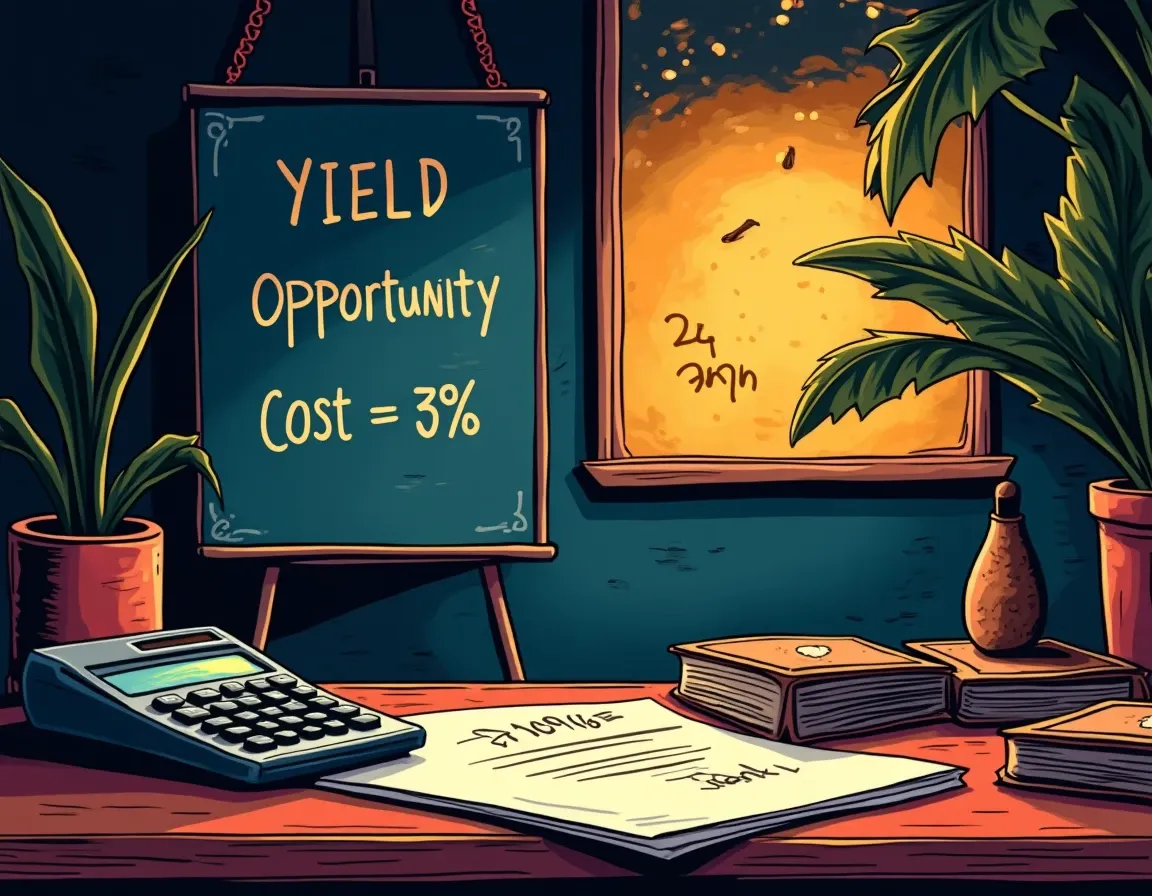
Start by quantifying the income you are leaving on the table by staying in Centrifuge USDS at 2.1% instead of migrating to higher-yielding alternatives.
Basic formula per $100,000 allocated:
- Centrifuge USDS: $100,000 × 2.1% = $2,100/year
- Sky Savings Rate (sUSDS): $100,000 × 4.0% = $4,000/year
- Aave V3 USDC (variable): $100,000 × 5.5% = $5,500/year
The differential ranges from $1,900 to $3,400 per $100,000 annually. On a $400,000 position, staying in Centrifuge instead of Aave costs $13,600 per year. That is the price you are paying for RWA collateral backing.
Do not stop here. The raw yield differential is incomplete without adjusting for failure modes, redemption friction, and gas costs.
Account for Migration Gas Costs
Ethereum mainnet gas makes small migrations uneconomical. At 30 gwei and $3,000 ETH, a two-step migration (withdraw from Centrifuge, deposit into Aave) costs roughly $40 to $80 depending on contract complexity. You need to earn back that cost before migration becomes net-positive.
On $100,000 moved to Aave at a 3.4pp yield advantage, breakeven occurs in 8.6 days ($80 gas / $3,400 annual gain × 365 days). Below $10,000, migration takes weeks to recover gas. Below $5,000, it may never recover unless rates diverge further.
Step 2: Adjust for Smart Contract Risk and Historical Track Record

The yield differential is not free money. It is compensation for taking on different risk profiles. Centrifuge earns 2.1% by allocating to tokenized real-world assets, primarily U.S. Treasury bills and AAA-rated collateralized loan obligations managed by Janus Henderson. Aave and Sky earn higher yields by lending to overcollateralized crypto borrowers whose positions can liquidate if collateral falls below maintenance thresholds.
Here is the risk adjustment framework:
Centrifuge-Specific Risk Profile
Centrifuge has undergone 38 security audits and operates on 12 blockchains. The protocol holds $1.635 billion in TVL, down 6% quarter over quarter. Grove, the allocator deploying on behalf of Sky and its USDS stablecoin, holds roughly $895 million of exposure across Centrifuge products. 95.6% of that capital sits in two funds run by the same asset manager.
The concentration risk is not protocol-level smart contract exploit risk. It is manager and regulatory risk. If Janus Henderson faces redemption pressure or if regulators restrict tokenized asset issuance, liquidity can freeze even though the on-chain contracts function correctly. Daily redemptions plus committed liquidity facilities mitigate this, but they do not eliminate it.
Active loans on the platform total $78.66 million. Total TVL sits at $1.57 billion. That means roughly 95% of the capital in Centrifuge is sitting in tokenized funds and treasuries, not actively lending. The protocol is more of a tokenized fund wrapper than a lending market. That changes the failure mode from borrower default to off-chain asset manager operational risk.
DeFi Alternative Risk Profile
Aave V3 has operated on Ethereum mainnet for over two years without a material exploit. It has liquidated billions in positions across multiple market cycles. Oracle risk exists but is mitigated by Chainlink’s decentralized price feeds. The smart contract risk is not zero, but it is well-understood and priced by the market.
Sky (formerly MakerDAO) has an even longer track record. The sUSDS wrapper pays 3.75% to 4.5% and inherits the collateral backing of Sky’s CDP system. Depeg risk comes from severe stress in the Sky CDP collateral, particularly if a large vault liquidates into thin on-chain liquidity. That scenario is less likely than a manager-level freeze at Centrifuge, but the impact would be larger.
Morpho Blue, Compound V3, and other lending protocols offer 4% to 8% variable rates but carry higher utilization risk. When borrowing demand spikes, utilization can approach 100%, temporarily gating withdrawals. That is a liquidity risk, not a solvency risk, but it matters if you need to exit quickly.
How to Price the Risk Differential
The 3.4 percentage point yield gap between Centrifuge (2.1%) and Aave (5.5%) is the market’s implied price for swapping RWA collateral risk for smart contract and liquidation risk. If you believe Centrifuge’s RWA backing reduces tail risk by more than 3.4pp of annual yield, stay. If you believe DeFi protocols are sufficiently battle-tested and diversified, migrate.
For reference, migration decisions in Compound V3 use similar risk-adjusted yield math when rates compress.
Step 3: Factor in Redemption Mechanics and Liquidity
Yield is irrelevant if you cannot exit your position at par. Centrifuge and DeFi protocols have different redemption mechanics, and those mechanics determine how fast you can move capital when rates shift.
Centrifuge Redemption Process
Centrifuge JTRSY and JAAA funds offer daily redemptions plus committed liquidity facilities. In practice, that means you can redeem at net asset value once per day, and the protocol maintains enough liquidity to meet typical redemption volumes without selling underlying assets at a loss. Large redemptions may take 2-5 business days if the liquidity facility needs to be tapped.
This is slower than DeFi instant withdrawals but faster than traditional money market funds. The trade-off is predictable pricing. You redeem at NAV, not at whatever price the on-chain order book offers.
DeFi Protocol Withdrawal Constraints
Aave, Sky, and Morpho allow instant withdrawals as long as utilization remains below 90-95%. When utilization spikes, available liquidity shrinks. At 98% utilization, you might be able to withdraw $10,000 from a $100,000 position immediately, with the rest queued until borrowers repay or new lenders arrive.
Sky’s sUSDS wrapper has never experienced a significant redemption queue, but the mechanism exists. Centrifuge’s daily redemption cadence is less flexible but more predictable. If you are allocating $500,000 or more, Centrifuge’s liquidity facility is an advantage. Below $100,000, DeFi’s instant withdrawals usually win unless utilization is extreme.
Step 4: Set Your Migration Threshold
Now combine the yield differential, risk adjustment, and liquidity constraints into a single decision rule. The threshold depends on your position size, risk tolerance, and whether you prioritize capital preservation or yield maximization.
Conservative Threshold: RWA Backing Justifies 2-3pp Yield Sacrifice
If your primary goal is capital preservation and you are uncomfortable with smart contract risk, staying in Centrifuge at 2.1% is rational as long as the yield gap remains under 3 percentage points. That assumes you value RWA legal enforceability and daily NAV redemptions more than an extra $3,000 per $100,000 annually.
This approach makes sense for allocators who have already experienced a DeFi exploit or who operate under compliance frameworks that prefer off-chain collateral. The $327 million TVL remaining in Centrifuge after the rate drop suggests this is the dominant view among institutional allocators.
Balanced Threshold: Migrate When Yield Gap Exceeds 3pp and Position Size Exceeds $50k
If you are indifferent between RWA and DeFi risk profiles and prioritize risk-adjusted yield, migrate when the gap exceeds 3 percentage points and your position exceeds $50,000. Below $50,000, gas costs and attention overhead erode the advantage. Above $250,000, split the position to diversify redemption risk.
Example allocation at $400,000 total:
- $150,000 in Centrifuge USDS at 2.1% (RWA backing, daily redemptions)
- $150,000 in Sky sUSDS at 4.0% (battle-tested, lower yield than Aave but more stable)
- $100,000 in Aave V3 USDC at 5.5% (highest yield, highest smart contract surface area)
This structure captures 3.85% blended yield while limiting single-protocol exposure to 37.5% of total capital. If Centrifuge rates recover or Aave rates compress, rebalance quarterly.
Aggressive Threshold: Full Migration Above 4pp Gap
If you are yield-maximizing and comfortable with DeFi protocol risk, migrate 100% when the gap exceeds 4 percentage points. At 2.1% Centrifuge versus 6% Aave, you are sacrificing $15,600 annually per $400,000 to hold RWA collateral that offers minimal diversification benefit if you already hold stablecoins in multiple DeFi venues.
This approach assumes you monitor utilization weekly and can tolerate temporary withdrawal delays during high-utilization periods. It is appropriate if you are already diversified across Aave, Compound, Morpho, and Sky, and you view Centrifuge as redundant rather than complementary.
Step 5: Monitor These Signals for Future Rate Changes
Centrifuge yields are tied to real-world interest rates, not on-chain borrowing demand. That makes them more stable but also slower to adjust. DeFi yields fluctuate weekly based on leverage cycles. Your migration decision today will need to be revisited as macro conditions change.
Signals That Favor Staying in Centrifuge
- Federal Reserve cuts rates by 50-100 basis points over the next six months, compressing DeFi yields toward 3-4%
- A major DeFi protocol experiences an exploit, even if Aave is not directly affected
- Centrifuge TVL grows above $2 billion, signaling increased institutional confidence
- Regulatory clarity in the U.S. favors tokenized securities over DeFi lending (the stablecoin bill that passed the Senate in 2025 defines permitted payment stablecoins as non-yield-bearing, which could push institutional capital toward RWA structures)
Signals That Favor Migration to DeFi
- DeFi yields remain above 5% for three consecutive months while Centrifuge stays below 2.5%
- Grove or Janus Henderson reduces Centrifuge allocations, signaling reduced institutional confidence
- Active loans on Centrifuge continue to decline as a percentage of TVL, indicating the protocol is becoming less of a lending market and more of a passive fund wrapper
- Gas costs on Ethereum drop below 15 gwei sustained, reducing migration friction
Track these signals using DefiLlama for protocol-level data and Centrifuge’s DefiLlama page for TVL and utilization trends. If you are managing multiple stablecoin positions, this Sky migration guide covers similar decision frameworks for rate compression scenarios.
Common Failure Modes and How to Avoid Them
Chasing Yield Without Accounting for Withdrawal Liquidity
A 6% yield in Morpho Blue looks attractive until utilization hits 98% and you can only withdraw 2% of your position. Always check current utilization before migrating. If utilization is above 90%, either wait or split your migration across multiple protocols.
For low-liquidity venues, use this liquidity stress test framework to calculate maximum safe position size.
Ignoring the Regulatory Overhang on Yield-Bearing Stablecoins
The stablecoin bill moving through Congress could require yield-bearing instruments to register as securities or money market funds. If that happens, Centrifuge’s RWA structure may comply more easily than on-chain lending protocols. DeFi venues might restrict U.S. IP addresses or implement KYC. That regulatory risk is hard to price, but it is real. If you are a U.S. person allocating more than $500,000, legal structure matters.
Migrating Without Testing Gas Costs on Small Positions
On a $5,000 position, $60 in gas costs requires 73 days of extra yield at a 3pp advantage to break even. If rates converge before then, you lose money. Test the migration on 10% of your position first to confirm gas costs match your estimates. If gas exceeds $100 round-trip, wait for lower network congestion or increase position size before migrating.
The Takeaway
The $327 million TVL that remained in Centrifuge after the 1.07 percentage point drop is paying a 2-3.4pp annual premium for RWA collateral backing and daily NAV redemptions. That premium is rational if you prioritize capital preservation over yield maximization, operate under compliance constraints that favor off-chain collateral, or expect DeFi yields to compress faster than RWA yields over the next 12 months. If none of those apply and your position exceeds $50,000, migrate when the gap exceeds 3 percentage points and utilization in the target protocol remains below 85%.
Frequently Asked Questions
What caused the Centrifuge USDS yield to drop 1.07 percentage points?
The drop reflects changes in the underlying real-world asset yields, primarily U.S. Treasury bill rates and AAA collateralized loan obligation returns managed by Janus Henderson. Centrifuge yields track off-chain interest rates, which move more slowly than on-chain DeFi borrowing demand but respond to Federal Reserve policy and credit market conditions. The 95% allocation to tokenized funds rather than active lending means protocol yields follow fund NAV performance, not utilization rates.
Is Centrifuge USDS safer than Aave USDC despite the lower yield?
Centrifuge and Aave have different risk profiles, not a simple safety ranking. Centrifuge earns yield from tokenized real-world assets with legal enforceability and daily NAV redemptions, carrying manager and regulatory risk. Aave earns from overcollateralized crypto loans with instant withdrawals but carries smart contract and liquidation risk. Centrifuge has 38 security audits and $1.635 billion TVL; Aave has multi-year exploit-free operation. The $327 million TVL staying in Centrifuge after the rate drop suggests institutions value RWA backing, but that preference is not universal.
How much does it cost to migrate from Centrifuge to Aave on Ethereum?
At 30 gwei gas and $3,000 ETH, a two-step migration (withdraw from Centrifuge, deposit into Aave) costs $40 to $80. On a $100,000 position moving to Aave at a 3.4pp yield advantage, breakeven occurs in 8.6 days. Below $10,000, migration can take weeks to recover gas. Below $5,000, gas costs may exceed annual yield gains unless the rate gap widens further or gas drops below 15 gwei.
What yield gap justifies migrating from Centrifuge to DeFi protocols?
The migration threshold depends on risk tolerance and position size. Conservative allocators who prioritize RWA collateral stay in Centrifuge if the gap remains under 3 percentage points. Balanced allocators migrate when the gap exceeds 3pp and position size exceeds $50,000, often splitting capital across Centrifuge, Sky, and Aave. Aggressive yield-maximizers migrate fully when the gap exceeds 4pp, accepting higher smart contract risk for $15,600+ additional annual income per $400,000 position.
Can I withdraw from Centrifuge USDS instantly like Aave?
No. Centrifuge JTRSY and JAAA funds offer daily redemptions at net asset value, not instant on-chain withdrawals. Typical redemptions settle within 24 hours; large redemptions may take 2-5 business days if committed liquidity facilities are tapped. Aave allows instant withdrawals when utilization stays below 90-95%, but liquidity can gate during high-utilization periods. Centrifuge’s daily cadence is slower but more predictable. For positions above $500,000, Centrifuge’s liquidity facility reduces large-redemption slippage compared to on-chain order books.
The Weekly Yield Report
You have calculated the exact yield differential and risk premium between Centrifuge at 2.1% and Aave at 5.5%. Those rates will change next month.
Every Thursday: where crypto yield actually is – stablecoins, liquid staking and DeFi lending, with the risk named next to the rate and what changed since last week.
Free. No trade calls, no allocations, no hype. Unsubscribe in one
click.
Source link