


The Decision: Certain Income vs Uncertain Allocation
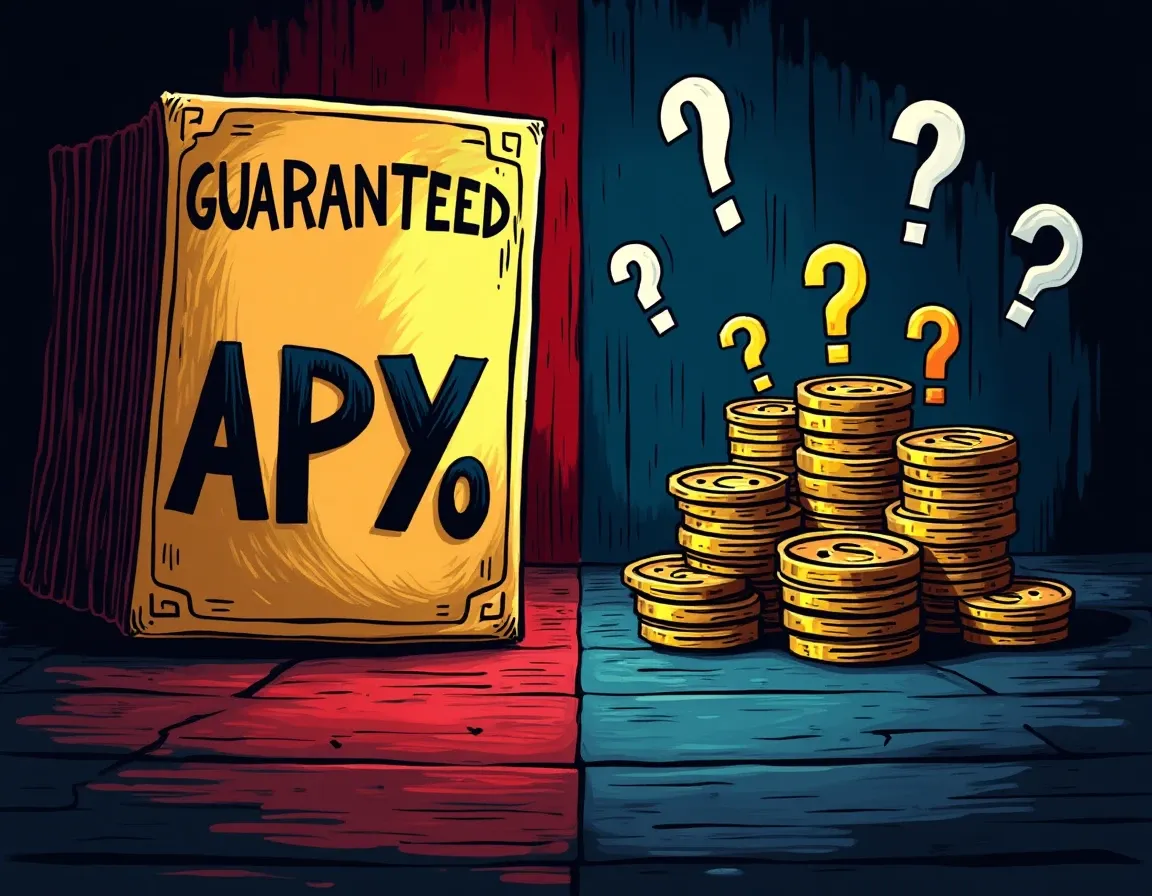
You deploy $10,000 to a DeFi protocol. You have two paths to income.
First path: supply USDC to Aave V3. You receive 3.8% to 5.2% APY, paid daily in USDC. The rate fluctuates with utilization, but the mechanism is visible on-chain and the payout is contractual. Your principal earns a known rate from a known counterparty with $76.6 billion in TVL. This is direct yield.
Second path: deposit the same USDC to a protocol running a points program. You receive no immediate payout. Instead, the protocol credits your address with points based on deposit size, duration, and activity multipliers. The points have no market price, no contractual conversion rate, and no guaranteed token allocation. The protocol may distribute a token in six months. It may distribute in eighteen months. It may never distribute at all. If it does distribute, your allocation depends on total points issued, the percentage of supply allocated to users, and the token’s launch price.
This is the core comparison. One pays a known rate. The other grants an option on future value with no strike price, no expiration date, and no obligation from the issuer.
What Points Programs Actually Are

Points programs are non-transferable ledger entries that protocols use to size future token allocations. You cannot sell them. You cannot trade them. You cannot redeem them for anything until the protocol decides to launch a token and convert the ledger into supply.
The correct financial analogy is a zero-coupon bond with default risk.
A traditional zero-coupon bond pays no interest. You buy it at a discount to face value, hold it to maturity, and receive the full face value at expiration. The difference between purchase price and face value is your return. The bond has a known maturity date, a known face value, and a contractual obligation from the issuer.
A points program has none of those guarantees. You deploy capital today. You receive no current yield. You accumulate points over an undefined period. The protocol may convert those points into tokens at an undefined conversion ratio. The token may launch at an undefined valuation. Or the protocol may extend the program indefinitely, issue more points, dilute your balance, and never distribute anything.
The bond analogy holds because both instruments trade current income for future value. But the points version has discretionary terms on every variable that matters: timing, conversion ratio, token supply, and whether a payout happens at all.
Historical Conversion Data
Uniswap distributed 400 UNI tokens to every user who had interacted with the protocol before September 2020. At launch, 400 UNI was worth approximately $1,200. At peak valuation weeks later, the same allocation was worth $16,800. The total airdrop distributed $1.1 billion across roughly 250,000 addresses. No points program existed. The distribution was retroactive, based on historical usage.
Hyperliquid distributed 31% of HYPE’s total supply to platform users in November 2024. No venture capital allocation. The airdrop was the most valuable in crypto history by per-user value. Some traders received allocations worth hundreds of thousands of dollars. HYPE launched near $2 and traded above $30 within weeks. This was a points-based distribution. Users accumulated points for months through trading volume and protocol activity.
EigenLayer ran a points program for eleven months. Users deposited capital into restaking vaults and accumulated points based on deposit size and duration. TVL grew from $1 billion in January 2024 to $15 billion by mid-2024. The EIGEN token launched in May 2025. The airdrop allocated 5% of total supply to depositors at token generation. The per-point conversion was lower than most depositors expected. Geographic restrictions excluded users in several jurisdictions. Many participants earned less than they would have by deploying the same capital to stablecoin yield for the same period.
These three cases represent the range. Uniswap: retroactive, no points, massive per-user value. Hyperliquid: points-based, large allocation, strong token performance. EigenLayer: points-based, below-market conversion, geographic exclusions, dilution from TVL growth.
Current Valuations
Variational’s points trade at a theoretical value between $44.50 and $59.20 per point as of early 2026. That valuation comes from prediction markets and assumes a specific token launch FDV and a specific percentage of supply allocated to points holders. Neither assumption is contractual. The calculation is: (Total Supply × Allocation %) ÷ Final Point Total × FDV. If final point issuance is higher than expected or the allocation percentage is lower, the per-point value drops proportionally.
Extended has distributed approximately 70 million points cumulatively under a program cap of 600,000 points, with an estimated 30% of eventual token supply floated as community allocation. The allocation percentage is not formally confirmed. The token has not launched. The valuation is speculative.
Both examples share the same structure: you are valuing a ledger entry based on assumptions about future supply, future allocation, and future market price. Change any variable and the valuation changes. The protocol controls all three variables.
Valuation Framework: How To Price Uncertain Allocations

The correct way to value a points position is to model it as a probability-weighted expected value and compare that expectation to the opportunity cost of deploying the same capital to direct yield.
Start with the best-case scenario. Assume the protocol launches a token, allocates a reasonable percentage of supply to points holders, and the token achieves a valuation similar to comparable projects. Calculate your expected allocation based on your current points balance and the total points issued to date. Multiply that allocation by the assumed token price. That is your best-case outcome.
Next, assign a probability to that outcome. What is the chance the protocol actually launches a token? What is the chance it allocates the rumored percentage of supply? What is the chance the token holds value post-launch? Historical data: 88% of airdrop tokens lost value within three months of listing. 64% of recipients sold immediately. Unless a project explicitly states in official documentation that points will convert into a defined token allocation, you are farming on speculation.
Multiply the best-case value by the probability. That gives you expected value.
Now calculate the opportunity cost. Take the capital you deployed to the points program. Multiply it by the APY you could earn in a direct yield position over the same time period. Aave USDC: 3.8% to 5.2%. Morpho USDC vaults: 4.1% to 6.8%. Maple syrupUSDC: 7% to 8%. sUSDe: 11.6% average in 2026. Those are known rates on known protocols.
If the expected value of the points position exceeds the opportunity cost by a margin wide enough to justify the uncertainty, the points program is worth farming. If it does not, deploy to direct yield.
The Default Risk Component
Points programs have three failure modes that direct yield positions do not.
First: no token launch. The protocol runs the points program indefinitely, using the dashboard as free marketing, and never distributes anything. This has happened. Multiple projects ran full point seasons across a year or more and delivered nothing.
Second: below-market conversion. The protocol launches a token but allocates a smaller percentage of supply than the community expected, or the final point total is much higher than early participants anticipated, diluting per-point value. EigenLayer’s TVL grew 15x during its points program. Every new dollar deposited diluted the per-point allocation for earlier participants.
Third: price collapse post-launch. The protocol distributes tokens, but the token loses 70% to 90% of its value within weeks. Your tax liability is calculated at the fair market value on the day of receipt. If you receive $5,000 worth of tokens and they drop to $500 before you sell, you still owe taxes on $5,000 in the United States. The loss does not offset the tax event unless you sell and realize the loss in the same tax year.
Direct yield has its own risks: smart contract exploits, oracle failures, governance attacks, liquidity crises. But those risks are different in kind. A points program can fail by simply never converting into anything. A yield position fails only if the underlying protocol breaks.
Six Factors That Decide The Allocation
1. Certainty vs Optionality
Direct yield is contractual. You deposit USDC to Aave, you receive the supply APY shown on the dashboard, paid in USDC, compounded daily. The rate fluctuates with borrow demand, but the mechanism is transparent. The payout is enforceable through the smart contract.
Points programs grant optionality. You may receive a valuable token. You may receive a token that immediately dumps. You may receive nothing. The upside is unbounded in theory. Hyperliquid participants who accumulated points through trading volume received allocations worth six figures in some cases. But the downside is total loss of opportunity cost.
If you need predictable income, choose direct yield. If you can afford to lock capital for an uncertain period in exchange for lottery-ticket upside, points programs are a rational allocation.
2. Capital Efficiency
Direct yield deploys capital once. You supply USDC to a lending market, you earn APY, you can withdraw at any time subject to protocol utilization. The capital is working immediately.
Points programs lock capital for weeks or months with no current return. Sophisticated participants mitigate this by deploying capital in market-neutral positions: stablecoin liquidity, delta-hedged perpetual positions, or yield-bearing collateral that also accumulates points. Depositing sUSDe into a points program, for example, allows you to earn the sUSDe yield while also accumulating points on the same capital.
But most points programs require active participation to maximize accumulation: swapping tokens, providing liquidity, interacting with protocol features. Each interaction costs gas. Each trade incurs spread and slippage. The stated benefit is “free points,” but the true cost is gas fees, transaction costs, and the opportunity cost of capital that could be earning yield elsewhere.
3. Dilution Dynamics
Point supply is uncapped and issuer-controlled. Every new participant dilutes existing balances. Every multiplier event dilutes participants who do not qualify. Every extended season dilutes early participants.
EigenLayer’s point program is the clearest example. TVL grew from $1 billion to $15 billion over eleven months. Total points issued grew proportionally. Early depositors who expected a certain per-point allocation based on initial TVL saw that expectation cut by 90% as new capital flooded in.
Direct yield does not have this problem. APY may drop as more capital enters the market, but your pro-rata share of the yield is determined by your deposit size relative to total deposits, not by an arbitrary ledger the protocol can expand at will.
4. Time Horizon
Direct yield has no required holding period. You can deploy capital, earn for a week, and withdraw. The income accrues continuously.
Points programs require multi-month commitments. Most airdrops occur six to eighteen months after the points program launches. If you withdraw early, you forfeit accumulated points in most programs. The capital is effectively locked, not by smart contract, but by the incentive structure.
5. Tax Treatment
Direct yield is taxed as ordinary income in the United States. You receive USDC, you report it as income at fair market value on the day of receipt. The tax treatment is clear.
Airdropped tokens are also taxed as ordinary income, but the valuation cliff is sharper. Tokens are valued at fair market value on the day of receipt. If you receive an allocation worth $10,000 on launch day and the token drops 80% before you sell, you owe taxes on $10,000 but realize only $2,000 in proceeds. The $8,000 loss is a capital loss, which offsets capital gains but does not offset the ordinary income tax owed on the airdrop receipt. You can end up with a net tax liability higher than your net proceeds.
6. Failure Mode Specificity
Direct yield fails when the protocol fails. Aave has been operational since 2020 with $76.6 billion in TVL and multiple audits. The failure modes are known: oracle manipulation, governance attack, smart contract exploit, mass liquidation event that drains reserves. Those risks are real but historically low for mature protocols.
Points programs fail when the protocol chooses not to convert points into tokens, or converts them at a ratio far below expectations, or launches a token that immediately loses value. The failure is discretionary, not mechanical.
Who Each Option Is Right For
Direct Yield
Deploy to direct yield if you need current income, if you cannot afford to lock capital for an undefined period, or if your capital base is large enough that earning 4% to 8% APY on six figures generates meaningful absolute returns.
A $100,000 position in Morpho USDC at 6% APY generates $6,000 per year in income. That is contractual, withdrawable, and predictable. A $100,000 position in a points program may generate $50,000 if the airdrop is generous and the token holds value. It may also generate $0.
If you are deploying five figures or more, direct yield makes sense as the core allocation. Use points programs as satellite positions with capital you can afford to lock.
Points Programs
Farm points if you have small capital, long time horizon, and high risk tolerance. A $5,000 position earning 6% APY generates $300 per year. The same $5,000 deployed to a successful points program can generate $5,000 to $15,000 if the airdrop is generous. The risk-reward asymmetry favors points programs when the base is small and the opportunity cost is low.
Points programs also make sense if you are already active in a protocol for other reasons. If you are trading on a perpetual DEX, you are paying fees and spread regardless. Accumulating points on that activity is a free option. The opportunity cost is zero because you would be transacting anyway.
Structured farming across three to five active programs simultaneously is realistic for earning $500 to $5,000+ per major airdrop for consistent users, according to 2025-2026 data. That requires multi-month commitment, gas cost accounting, and strict sybil-avoidance hygiene. Projects now use clustering algorithms to detect automated farming: multiple addresses funded from the same source, performing identical swaps in tight time windows, with near-identical amounts. If your wallet cluster is flagged, your entire allocation is voided.
The Framework: How To Allocate Between The Two
Start with your total deployable capital. Subtract your emergency reserve and any capital you cannot afford to lock for twelve months. What remains is your DeFi allocation.
Split that allocation into two buckets: core and satellite.
Core bucket: 60% to 80% of your DeFi capital. Deploy this to direct yield on mature protocols with multi-year track records. Aave, Morpho, Sky, Maple, Pendle. Target 4% to 8% APY on stablecoins or stablecoin-equivalent synthetics. This is your baseline income. It compounds daily. It is withdrawable. It is predictable.
Satellite bucket: 20% to 40% of your DeFi capital. Deploy this to points programs with confirmed token launches or strong historical precedent. Prioritize programs that allow you to earn points on yield-bearing collateral, so you earn both the base yield and the points optionality. Depositing sUSDe into a points program, for example, earns you 11.6% APY on the sUSDe plus points accumulation on the same capital.
Within the satellite bucket, diversify across three to five active programs. Do not concentrate in a single protocol. Dilution risk, program extensions, and no-launch risk are all real. Spreading across multiple programs reduces the chance that a single failure wipes out your entire speculative allocation.
Position Sizing By Capital Base
Under $10,000: allocate 50% to direct yield, 50% to points. The absolute income from yield is small, and the risk-reward asymmetry of airdrops favors higher speculative allocation.
$10,000 to $50,000: allocate 70% to direct yield, 30% to points. The yield income becomes meaningful in absolute terms, and you want to preserve capital while maintaining upside optionality.
Above $50,000: allocate 80% to direct yield, 20% to points. At this capital level, earning 6% APY on $50,000 generates $3,000 per year in predictable income. That is more valuable than chasing uncertain airdrops with the bulk of your capital.
Active Monitoring
Points programs change terms mid-season. Multipliers expire. New seasons dilute existing points. Protocols extend timelines or add new qualifying activities. You cannot set and forget a points position.
Check your active programs weekly. Verify your points balance matches expected accumulation. Watch for announcements about program extensions, which usually signal dilution. Monitor TVL growth in the underlying protocol. If TVL doubles, your per-point allocation just halved.
Direct yield requires less frequent monitoring. Check APY monthly. Verify no governance proposals have changed fee structures or introduced new risks. Confirm your position is still accruing yield at the expected rate. Rebalance if a better rate appears on a comparably safe protocol.
My Recommendation
Deploy 70% to 80% of your DeFi capital to direct yield on Aave, Morpho, or Maple. Earn 4% to 8% APY on stablecoins. That is your baseline income. It is contractual, predictable, and withdrawable.
Deploy the remaining 20% to 30% to points programs that meet three criteria: confirmed token launch or strong historical precedent, ability to earn points on yield-bearing collateral, and no geographic restrictions that would disqualify you.
Do not farm points with capital you need for income in the next twelve months. Do not farm points on protocols with no official documentation stating that points will convert into token allocations. Do not farm points across dozens of wallets trying to game sybil detection. Protocols void allocations for detected farming, and the clustering algorithms are better than your OpSec.
Run the valuation framework before committing capital. Calculate expected value: (assumed allocation × assumed token price × probability of both). Compare that to opportunity cost: (capital × direct yield APY × time period). If expected value does not exceed opportunity cost by at least 3x, the points program is not worth the uncertainty.
The best outcome is earning both. Deposit sUSDe or other yield-bearing stablecoins into points programs. You earn the base yield and accumulate points on the same capital. If the airdrop hits, you got both. If the airdrop fails, you still earned yield.
The Takeaway
Points programs are zero-coupon bonds with discretionary terms and default risk. Direct yield is contractual income from known protocols. The decision comes down to capital size, time horizon, and risk tolerance. If you need predictable income or are deploying six figures, allocate primarily to direct yield and treat points as a small speculative position. If you have small capital, long time horizon, and can afford total loss of opportunity cost, points programs offer asymmetric upside. The framework is: core allocation to yield, satellite allocation to points, and strict criteria for which points programs justify the lockup. Model the expected value, compare it to opportunity cost, and require at least 3x margin to justify the uncertainty. Most points programs will not clear that bar. The ones that do are worth farming.
Frequently Asked Questions
How do I calculate the expected value of a points program?
Multiply your expected token allocation by the assumed launch price, then multiply that result by the probability of both the token launching and holding that price. Compare this expected value to the income you would earn by deploying the same capital to direct yield over the same time period. If the expected value does not exceed the opportunity cost by at least 3x, the points program does not justify the uncertainty and capital lockup.
What is the typical conversion rate from points to actual income?
Historical examples vary widely. Uniswap distributed 400 UNI tokens worth $1,200 to $16,800 per user retroactively. Hyperliquid distributed allocations worth hundreds of thousands to active traders. EigenLayer allocated only 5% of supply after an eleven-month program, resulting in below-market returns for most depositors. There is no standard conversion rate. Each program sets its own allocation percentage, and total points issued dilute per-point value as more users join.
Can I earn yield while farming points?
Yes, by depositing yield-bearing collateral into points programs. Protocols that accept sUSDe, sUSDS, or other yield-bearing stablecoins allow you to earn the base yield while accumulating points on the same capital. This structure reduces opportunity cost because you receive current income plus the option value of the future airdrop. Always verify that the protocol accepts yield-bearing tokens before depositing.
What percentage of my capital should I allocate to points programs?
For capital under $10,000, allocate up to 50% to points programs due to the asymmetric upside relative to small absolute yield income. For $10,000 to $50,000, allocate 20% to 30% to points. For capital above $50,000, allocate no more than 20% to points and prioritize direct yield, which generates meaningful absolute income at that scale. Always use only capital you can afford to lock for twelve months or more.
What are the main risks of farming points programs?
Three primary failure modes: no token launch after months of farming, below-market conversion ratios due to supply dilution or low allocation percentages, and immediate price collapse post-launch that creates tax liability exceeding net proceeds. Additional risks include geographic exclusions, sybil detection flagging your wallet cluster and voiding allocations, and opportunity cost from locking capital that could have earned 4% to 8% APY in direct yield positions over the same period.
The Weekly Yield Report
You now have a valuation framework for points, historical conversion data, and a decision rule. The allocations, conversion rates, and program terms will all change next month.
Every Thursday: where crypto yield actually is – stablecoins, liquid staking and DeFi lending, with the risk named next to the rate and what changed since last week.
Free. No trade calls, no allocations, no hype. Unsubscribe in one
click.
Source link