


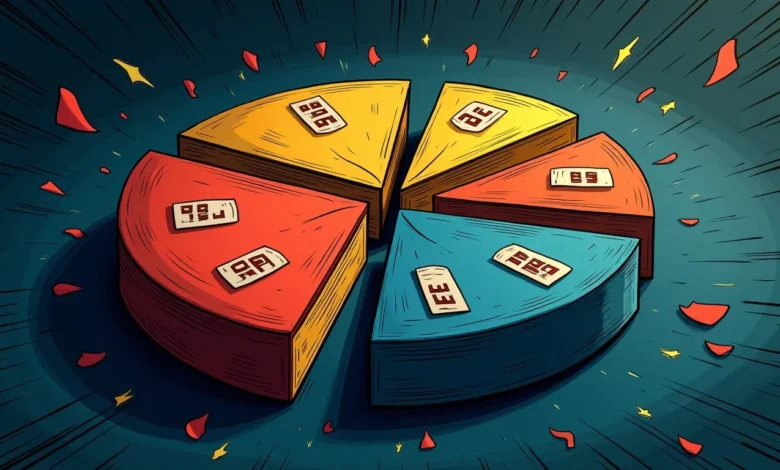
The Question Every DeFi User Gets Wrong

You have found a protocol paying 6.5% on USDC. The audit looks clean. TVL sits at $2 billion. Now you face the real question: how much of your capital goes in?
Most users ask this as an optimization problem. They want the allocation that maximizes return for a given risk tolerance. That is the wrong frame.
The correct question is survival. How much can you lose completely without destroying the rest of your strategy? Position sizing in DeFi is not about finding the efficient frontier. It is about ensuring that when a venue fails – and eventually one will – you still have a portfolio.
DeFi protocols lost over $2.9 billion to hacks in 2025. April 2026 alone recorded $606.7 million in losses, with Kelp DAO suffering a $293 million drain. Aave, one of the most established protocols, experienced an $862,000 oracle manipulation incident in March 2026. These are not theoretical risks. They are the cost structure of the industry.
The framework below does not eliminate that risk. It ensures you survive it.
The Annoying vs. Ruinous Framework

A seasoned DeFi participant was rugged by multiple protocols but remained financially unaffected because they had properly sized every position. That is the standard.
Annoying loss: you rebalance your portfolio, write off the position, and continue. You might skip a vacation or delay a purchase. You do not lose sleep. You do not sell other holdings at a loss to cover expenses. You do not exit DeFi entirely.
Ruinous loss: you are forced to liquidate other positions to meet obligations. Your total portfolio drops below a threshold where your strategy no longer functions. You cannot continue deploying capital because too much is gone. You leave the space.
The difference between annoying and ruinous is not the protocol. It is the position size. A $5,000 loss in a $500,000 portfolio is a rounding error. The same $5,000 loss in a $10,000 portfolio is a restructuring event.
Your maximum position in any single venue should be the amount where total loss triggers rebalancing, not capitulation. For most users, that ceiling sits between 10% and 30% of total DeFi capital, depending on protocol maturity and portfolio size.
Position Sizing by Portfolio Size

For $10,000 Portfolios
Stablecoins commonly form 5-10% of a portfolio as a risk buffer. That means $500 to $1,000 allocated defensively. If your entire DeFi allocation is $10,000, you cannot afford to treat it all as high-risk capital.
A single protocol should not exceed $2,000 to $3,000, or 20-30% of the total. That cap accounts for liquidation risk, composability failures, and gas costs. Transaction costs matter at this scale. Moving $1,000 on Ethereum mainnet during moderate congestion can cost $15 to $40 in gas. That is 1.5% to 4% of the position before you earn a single basis point of yield.
At $10,000, you are better off with four $2,500 positions across distinct protocols than one $10,000 position earning 50 basis points more. Concentration limits are not optional at this portfolio size. They are survival.
Blue-chip protocols – Aave, Uniswap, Compound – can take the higher end of the range, $2,500 to $3,000. Mid-tier protocols with shorter track records should sit at $1,500 to $2,000. Anything experimental or offering yield above 20% APY should be capped at $500 to $1,000 maximum.
For $500,000 Portfolios
Conservative institutional frameworks allocate 60% to blue-chip platforms like Aave, 30% to established mid-tier protocols like Balancer, and 10% to experimental high-yield platforms. That translates to $300,000 in blue-chip, $150,000 in mid-tier, and $50,000 in high-risk.
Even within those tiers, individual venues should be capped. A $300,000 blue-chip allocation should span at least three to four protocols. No single venue should exceed $80,000 to $100,000, regardless of how established it appears. Aave holds $14.49 billion in TVL as of May 2026 and has operated for years. It still experienced an oracle manipulation incident three months ago.
Diversification at this scale must span distinct risk categories, not just different protocols. Deploying $300,000 across Aave, Compound, and Spark feels diversified until you realize all three share similar collateral, oracle dependencies, and regulatory exposure. A single smart contract vulnerability class or regulatory action affecting lending protocols broadly hits all three simultaneously.
A $500,000 portfolio should include exposure to different mechanism types: at least one lending protocol, one DEX liquidity position, and one yield aggregator or liquid staking derivative. That structure reduces the probability that a single exploit type or regulatory decision wipes out more than one position.
Gas costs become irrelevant at this portfolio size. A $50 transaction fee on a $100,000 position is five basis points. It does not move the needle.
Protocol Maturity and Concentration Limits
Not all protocols earn the same allocation ceiling. Maturity is not just age. It is audited history, revenue sustainability, and incident response.
Blue-Chip Protocols (20-30% Maximum Per Venue)
Aave, Uniswap, Compound, Curve. Multi-year operational history, multiple independent audits, revenue measured in hundreds of millions annually. Uniswap generated $170.46 million in fees over the past 30 days as of recent reporting, annualizing to $907 million. Aave V3 generated $33.56 million in fees over 30 days, annualizing to $780.8 million.
These protocols have survived multiple market cycles, regulatory scrutiny, and technical stress tests. They still carry risk. Aave’s March 2026 oracle incident proves that. But the probability of total loss is materially lower than newer protocols, and the industry’s response time when something does go wrong is faster.
You can allocate 20-30% of DeFi capital to a single blue-chip venue if your portfolio exceeds $50,000. Below that threshold, the lack of diversification across mechanism types becomes dangerous even with blue-chip names.
Mid-Tier Protocols (10-15% Maximum Per Venue)
Balancer, Pendle, Yearn, Convex. Established but shorter track records, smaller TVL, fewer audits. Pendle leads this tier with roughly $1.04 billion in TVL across 12 chains as of July 2026. Convex holds approximately $490 million on 4 chains. Yearn has around $150 million in vault TVL across 7 chains.
These protocols generate real revenue and have demonstrated product-market fit. They have not survived as many stress tests as the blue-chip tier. Audit depth matters more than audit existence. High-quality protocols undergo multiple independent audits, manual red-team reviews, and economic stress testing, with evidence of remediation visible in GitHub commits.
If you cannot find at least two independent audits and a history of incident response, the protocol does not belong in this tier. It belongs in the experimental bucket.
Experimental Protocols (5% Maximum Per Venue)
Anything offering yield consistently above 20% APY in 2026 warrants close scrutiny. That kind of return usually involves material token inflation or significant risk. Base yield is the interest or fees the protocol actually generates. Reward yield is token emissions that can stop.
A 12% pool that is 10% base and 2% reward survives emissions cliffs. A 12% pool that is 3% base and 9% reward does not. Real yield, funded by actual protocol revenue rather than fresh token issuance, is more sustainable. Most high-APY pools in 2026 are not funded by sustainable revenue.
Experimental protocols should never exceed 5% of DeFi capital in a single venue, regardless of portfolio size. If you have $10,000, that is $500 maximum. If you have $500,000, that is $25,000 maximum. Splitting experimental allocation across multiple high-risk venues does not reduce risk if they all share the same failure mode – unsustainable tokenomics.
Concentration Risk and Composability
Concentrating more than 80% of portfolio in single protocols or chains without diversification is a documented failure pattern. The risk is not just individual protocol failure. It is contagion.
Many DeFi protocols rely on others for price feeds, collateral, or borrowing markets. If a key protocol fails, that failure can cascade. Composability amplifies systemic risks as interdependencies create contagion vectors where single protocol failures cascade across connected systems.
A portfolio of ten DeFi tokens is less diversified than it looks, because a single exploit or regulatory action affecting DeFi broadly can hit all ten simultaneously. That is why concentration limits must account for shared dependencies, not just protocol count.
If you hold positions in Aave, Compound, and a yield aggregator that deploys into both, you do not have three independent positions. You have one leveraged bet on the Ethereum lending stack. A vulnerability in how any of those protocols handle a specific collateral type can propagate across all three.
Effective diversification requires exposure to different chains, different mechanism types, and different collateral bases. A conservative $100,000 DeFi allocation might include $30,000 in Aave on Ethereum, $25,000 in a Uniswap V3 stablecoin pool on Base, $20,000 in a liquid staking derivative on Arbitrum, $15,000 in a Curve pool on Polygon, and $10,000 in an experimental yield aggregator. That structure survives the failure of any single protocol, chain, or collateral type.
What a Total Loss Would Mean
Run the scenario before you deploy. Assume the venue goes to zero overnight. No recovery, no governance vote, no insurance fund payout. The capital is gone.
If that loss forces you to sell other holdings, change your lifestyle, or exit DeFi entirely, the position is too large. If the loss triggers a portfolio rebalance and a lesson learned, the position is sized correctly.
Most users never run this test. They size positions based on yield, not failure impact. That is why evaluating yield opportunities safely requires separating return potential from loss tolerance.
A $10,000 position in a $50,000 portfolio is a 20% allocation. If the venue fails, you are down to $40,000. Can your strategy continue? Do you have enough capital left to maintain diversification across multiple venues, or are you now forced into concentrated positions in the remaining protocols? If the answer is the latter, the original position was too large.
This test applies regardless of protocol maturity. Even blue-chip protocols fail. The probability is lower, but the position-sizing principle is identical. No single venue should be large enough that its failure forces a strategy change.
When Portfolio Size Changes the Calculation
The annoying-vs-ruinous threshold shifts as portfolio size increases, but not linearly. A $500,000 portfolio does not tolerate ten times the loss of a $50,000 portfolio. Risk tolerance is not proportional to capital.
Smaller portfolios require tighter concentration limits because they have less room for diversification. A $10,000 portfolio split into five $2,000 positions has limited ability to absorb a single position going to zero. You lose 20% of the portfolio. Recovery requires either new capital or outsized returns on the remaining positions.
Larger portfolios can tolerate slightly higher concentration in individual venues because the absolute capital at risk remains manageable relative to the whole. A $100,000 position in a $500,000 portfolio is 20%. If it fails, you are down to $400,000, which is still enough capital to maintain a diversified strategy across multiple protocols and chains.
But even large portfolios should not exceed 30% in any single venue. The math works until it doesn’t. When industry-wide TVL fell by roughly a third during the first half of 2026 due to softer token prices, tighter risk appetite, and a run of security incidents, concentrated portfolios took disproportionate losses.
Red Flags That Lower the Ceiling
Certain protocol characteristics should reduce your allocation ceiling regardless of advertised yield or TVL.
Anonymous teams. If you cannot identify the founders or cannot verify their professional history, cut your maximum allocation in half. Anonymous teams are not inherently malicious, but incident response and accountability are materially harder when no one is publicly attached to the project.
Single audit or no audit. If the protocol has not undergone at least two independent audits from reputable firms, treat it as experimental. Flash loan attacks accounted for about 37% of total protocol losses in 2025, while oracle-related failures were responsible for approximately 42% of major incidents between 2024 and 2026. Most of those failures were visible to auditors before they were exploited.
Treasury smaller than annual expenses. If the protocol’s treasury cannot fund operations for at least 18 months without new token sales, the sustainability of the yield is questionable. Protocols that rely on continuous token emissions or new capital raises to fund yield are funding current returns with future dilution.
Yield with no clear source. Base yield comes from trading fees, borrowing interest, or protocol revenue. Reward yield comes from token emissions. If you cannot identify where the yield originates, assume it is unsustainable. A pool advertising high APY often pays much in a governance token with vesting. If that token’s price drops, real returns in dollars fall even while displayed APY stays high.
Lack of historical data. A 12% yield that held for six months is a different proposition from a 12% yield that launched two weeks ago. If the protocol cannot show consistent yield over multiple months, treat the current rate as promotional, not structural.
The 2026 Environment
Stablecoin yields in 2026 have normalized to 3-7%, while volatile pairs earn 5-10%. Aave USDC supply APY on Ethereum was 6.05% when checked in April 2026. Spark offered USDC savings at 3.65% APY and DAI savings at 1.25% APY.
Easy, inflated APYs from aggressive token emissions have largely faded. What remains tends to be funded more by genuine trading and lending demand than by new token printing. Institutions maintain strict risk parameters including stop-loss mechanisms, concentration limits, and regular security audits of yield-generating positions. That capital is moving toward protocols with longer audit histories and steady revenue, rather than spreading evenly across new launches.
The shift has created a clearer risk-return structure. Protocols offering 3-6% are generally funded by real activity. Protocols offering 15-25% are generally funded by token emissions that will decline. Protocols offering above 25% are either extremely risky or extremely short-term promotional.
Your position-sizing framework should reflect that distribution. Blue-chip protocols earning 4-6% can take larger allocations because the yield is sustainable. Experimental protocols earning 20%+ should take minimal allocations because the yield is promotional.
When You Should Violate the Limits
There are two scenarios where higher concentration makes sense, and both require experience most readers do not have.
First, if you are actively managing the position with stop-loss mechanisms and real-time monitoring. Institutional participants who maintain 24/7 risk monitoring, automated withdrawal triggers, and dedicated staff can tolerate higher concentration because they can exit faster than retail users. If you do not have infrastructure to monitor depeg events in real time, you do not have the infrastructure to justify higher concentration.
Second, if you are explicitly trading short-term yield opportunities and plan to exit within days or weeks. A 50% allocation to a new liquidity mining program makes sense if you intend to harvest rewards and exit before the first token unlock. That is not position sizing for passive yield. That is active trading with a defined exit plan.
For everyone else, the limits above are not conservative. They are realistic. Violating them does not make you aggressive. It makes you undiversified.
The Takeaway
Position sizing is the only risk control you fully own. You cannot control whether a protocol gets exploited, whether an oracle fails, or whether a governance vote changes the fee structure. You can control how much capital you put at risk in any single venue.
The correct size is not the one that maximizes return. It is the one where total loss is annoying rather than ruinous. For most portfolios, that ceiling sits between 10% and 30% depending on protocol maturity. Blue-chip protocols with multi-year track records and sustainable revenue can take the higher end. Experimental protocols offering unsustainable yields should take the lower end. No venue, regardless of maturity, should exceed 30% of DeFi capital. Concentrating more than that does not improve returns over time. It just ensures that when a failure eventually happens, it restructures your entire portfolio instead of triggering a rebalance.
Run the scenario before you deploy. Assume the venue goes to zero. If that outcome is annoying, the position is sized correctly. If it is ruinous, cut the allocation in half and run the test again. The yield you earn this quarter does not matter if the exploit next quarter wipes out everything you made.
Frequently Asked Questions
What is the maximum percentage I should allocate to a single DeFi protocol?
For blue-chip protocols like Aave or Uniswap with multi-year track records and sustainable revenue, 20-30% of your DeFi capital is the ceiling. Mid-tier protocols should be capped at 10-15%, and experimental protocols offering yields above 20% APY should never exceed 5% of your portfolio. These limits ensure that total loss of any single position is annoying rather than ruinous.
How does portfolio size affect position sizing in DeFi?
Smaller portfolios require tighter concentration limits because they have less room for diversification. A $10,000 portfolio should cap individual positions at $2,000-$3,000 (20-30%) to maintain exposure across multiple protocols. A $500,000 portfolio can allocate $80,000-$100,000 to blue-chip venues while still maintaining diversification across chains and mechanism types. Risk tolerance is not proportional to capital, so even large portfolios should not exceed 30% in any single venue.
What is the difference between annoying and ruinous loss in DeFi?
An annoying loss triggers portfolio rebalancing and reflection but does not force you to sell other holdings or exit DeFi entirely. A ruinous loss forces liquidation of other positions to meet obligations, drops your portfolio below functional thresholds, or eliminates your ability to continue deploying capital. The difference is determined by position size, not protocol quality. A $5,000 loss in a $500,000 portfolio is annoying; the same loss in a $10,000 portfolio is ruinous.
Should I allocate more to protocols with higher APY?
No. Protocols offering yields consistently above 20% APY in 2026 usually involve material token inflation or significant risk. Base yield comes from protocol revenue like trading fees or borrowing interest. Reward yield comes from token emissions that can stop. A sustainable 6% yield funded by real activity deserves larger allocation than an unsustainable 25% yield funded by token printing. Position size should reflect sustainability and risk, not advertised return.
How do I account for protocol dependencies when sizing positions?
Many DeFi protocols rely on others for price feeds, collateral, or borrowing markets. If a key protocol fails, that failure can cascade across connected systems. Effective diversification requires exposure to different chains, different mechanism types, and different collateral bases. Holding positions in Aave, Compound, and a yield aggregator deploying into both is one leveraged bet on Ethereum lending, not three independent positions. Concentration limits must account for shared dependencies, not just protocol count.
The Weekly Yield Report
You now have concentration limits for $10,000 and $500,000 portfolios across three protocol tiers. Those ceilings change as audit history lengthens and revenue models shift.
Every Thursday: where crypto yield actually is – stablecoins, liquid staking and DeFi lending, with the risk named next to the rate and what changed since last week.
Free. No trade calls, no allocations, no hype. Unsubscribe in one
click.
Source link