


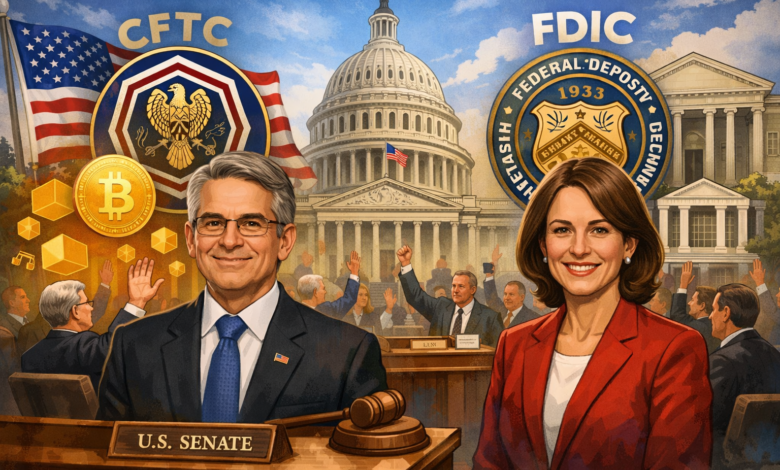
In a landmark development for the evolving crypto regulatory environment, the U.S. Senate has officially confirmed Caroline Selig as Chair of the Commodity Futures Trading Commission (CFTC) and Christy Hill as Chair of the Federal Deposit Insurance Corporation (FDIC). While most traditional financial media outlets have chosen to focus on broader economic implications, seasoned digital asset investors should glean a much more consequential insight: the United States regulatory framework for cryptocurrency and blockchain assets may be on the verge of a positive pivot. These high-level appointments suggest a potential inflection point toward pragmatic, innovation-friendly governance—potentially unlocking significant growth, market access, and institutional confidence within the crypto industry.
Caroline Selig’s appointment is particularly noteworthy for stakeholders in DeFi, Ethereum-based derivatives, and tokenized commodities. Known for her progressive stance on crypto regulation and her nuanced appreciation of decentralized markets, Selig brings deep industry knowledge and regulatory experience to her new leadership role at the CFTC. Her background encompasses years of working alongside developers, institutional trading desks, and policymakers to bridge the gap between emerging protocols and compliance requirements. She is a vocal supporter of common-sense guidelines that reinforce consumer protections while preserving the sandbox environment necessary for cutting-edge blockchain innovation.
In her role, Selig will helm the agency responsible for overseeing crypto futures, options, leveraged tokens, and digital commodities such as Bitcoin and Ethereum. Under her leadership, there’s a rising expectation that the CFTC may implement more structured but nondraconian policies for entities dealing in decentralized perpetual contracts, layer 2 liquidity pools, and smart contract-based synthetic assets. These future-friendly regulations could empower platforms to operate transparently and legally, while minimizing the legal gray areas and enforcement risks that have historically deterred large-scale institutional participation.
Simultaneously, Christy Hill’s confirmation as Chair of the FDIC reflects a significant, if quieter, shift in the institutional approach to blockchain and digital payments infrastructure. The FDIC, while not traditionally at the forefront of crypto dialogue, plays a vital role in regulating the banking sector, including chartered institutions now exploring digital asset custody and stablecoin transaction models. Hill has previously indicated the need for the banking system to modernize its legacy infrastructure, openly referencing blockchain integration and stablecoin use cases as potential solutions to persistent inefficiencies in cross-border settlements and fiat remittance rails.
Regulation as a Signal: Institutional Confidence and Capital Inflows
To the informed investor, the significance of these leadership shifts is clear: regulatory clarity acts as a magnet for institutional capital. For years, many traditional financial institutions, hedge funds, and pension managers have been wary of engaging with crypto—not due to a lack of belief in blockchain potential, but because of regulatory ambiguity and legal risk. Now, with more well-defined oversight likely on the horizon, smart money is beginning to position itself for an inflow into compliant, scalable DeFi projects and blockchain fintech infrastructure.
Just over the last two quarters, analysts have noted a slow but noticeable resurgence in institutional exposure to top-tier decentralized platforms. DeFi blue-chip protocols like Aave (AAVE) and Uniswap (UNI) have experienced resilient user growth, deepening liquidity, and aligning with layer 2 scaling solutions such as Arbitrum (ARB) and Optimism (OP). These integrations could ultimately produce the first generation of “regulatorily approved” DeFi products, designed to coexist within a framework that caters to both transparency and innovation.
Selig’s appointment also signals that the CFTC is likely to distinguish between centralized finance (CeFi) risk and truly decentralized architectures—an important nuance that could benefit permissionless protocols offering derivatives, synthetic assets, and permissionless liquidity provision. Under her leadership, decentralized products that meet clear standards—particularly around risk management, user transparency, and auditability—may finally receive the green light from institutional participants and regulators alike.
Watchlist: Undervalued Projects with High Regulatory Appeal
As market participants recalibrate their strategies in light of these appointments, several projects stand out as poised to capitalize on the new regulatory era:
- dYdX (DYDX): One of the most mature decentralized derivatives exchanges in the ecosystem, dYdX already allows the permissionless trading of perpetual contracts with fees competitive with centralized options. Selig’s influence on clearer derivatives rules, particularly around non-custodial platforms, could dramatically reduce compliance overhead and accelerate institutional adoption.
- Synthetix (SNX): Leveraging smart contracts to create exposure to synthetic commodities like gold, forex, and stocks, Synthetix is an early entrant in an area likely to draw intense interest from both regulatory and institutional circles. If the CFTC embraces tokenized representations of real-world assets under defined rules, SNX’s infrastructure could serve as a compliant gateway for margin-free commodity trading.
- Chainlink (LINK): Chainlink continues to position itself as an indispensable infrastructure layer for secure off-chain data feeds and decentralized identity verification—both critical for regulatory compliance in financial applications. With established relationships across enterprises, Chainlink’s oracles will likely be integral to enabling audit-compliant smart contracts that pass legal muster in a more regulated environment.
Across the ecosystem, the intersection of traditional banking and decentralized finance is also heating up. The appointment of Christy Hill at the FDIC bodes well for ongoing discussions about integrating stablecoins within licensed U.S. financial institutions. Hill’s acknowledgment of stablecoins as legitimate instruments for increasing settlement efficiency spotlights the importance of middleware issuers and liquidity providers in this evolution.
Firms like Circle (USDC) and Frax (FRAX) are likely to benefit from increased cooperation between the FDIC and blockchain firms. As U.S. commercial banks begin interfacing with stablecoins for cross-border settlements, remittances, and programmable finance applications, these projects could find themselves at the center of a new paradigm for global liquidity. Moreover, should the FDIC consider insuring or integrating reserve audits for top-tier stablecoins, it may unlock a floodgate of capital from compliance-first institutional clients and fintech developers.
Beyond Price: Regulatory Momentum as a Bullish Backdrop
Contrary to public opinion, increasing regulation doesn’t have to stifle innovation—it often creates the framework within which it can meaningfully flourish. Much like the early days of internet regulation, establishing clear boundaries inevitably paves the way for mainstream adoption and the development of billion-dollar platforms. For the crypto sector, this regulatory clarity may serve as the foundation upon which the next major bull cycle is built.
While token prices may not soar overnight on the basis of Senate appointments, the confirmation of pro-tech, crypto-aware individuals at critical government agencies is an undeniable tailwind. Investors and builders who have long operated in legal gray zones will be emboldened by the prospect of working within a defined, enforceable, and—most importantly—innovation-permitting legal framework. Already, venture capital flowing into regulatory-compliant DeFi and middleware platforms is on the rise, reflecting growing confidence that these agencies are not out to destroy the industry—but to shepherd its growth responsibly.
Final Thoughts
For retail and institutional investors alike, the appointments of Caroline Selig and Christy Hill mark a significant turning point. The path ahead includes a growing understanding that regulatory acceptance doesn’t kill opportunity—it legitimizes it. In fact, the next wave of decentralized protocols, synthetic asset platforms, and stablecoin technology may well be forged in the crucible of thoughtful regulation.
Smart investors are already recalibrating. They’re identifying the protocols most likely to benefit from a predictable legal landscape, and they’re aligning portfolios with long-term utility rather than short-term speculation. Whether you’re a fund manager, a DeFi user, or a protocol developer, the writing is on the wall: crypto is stepping into its institutional era.
Markets move before narratives, and the smart money moves before both. The time to pay attention is now.
Source link